

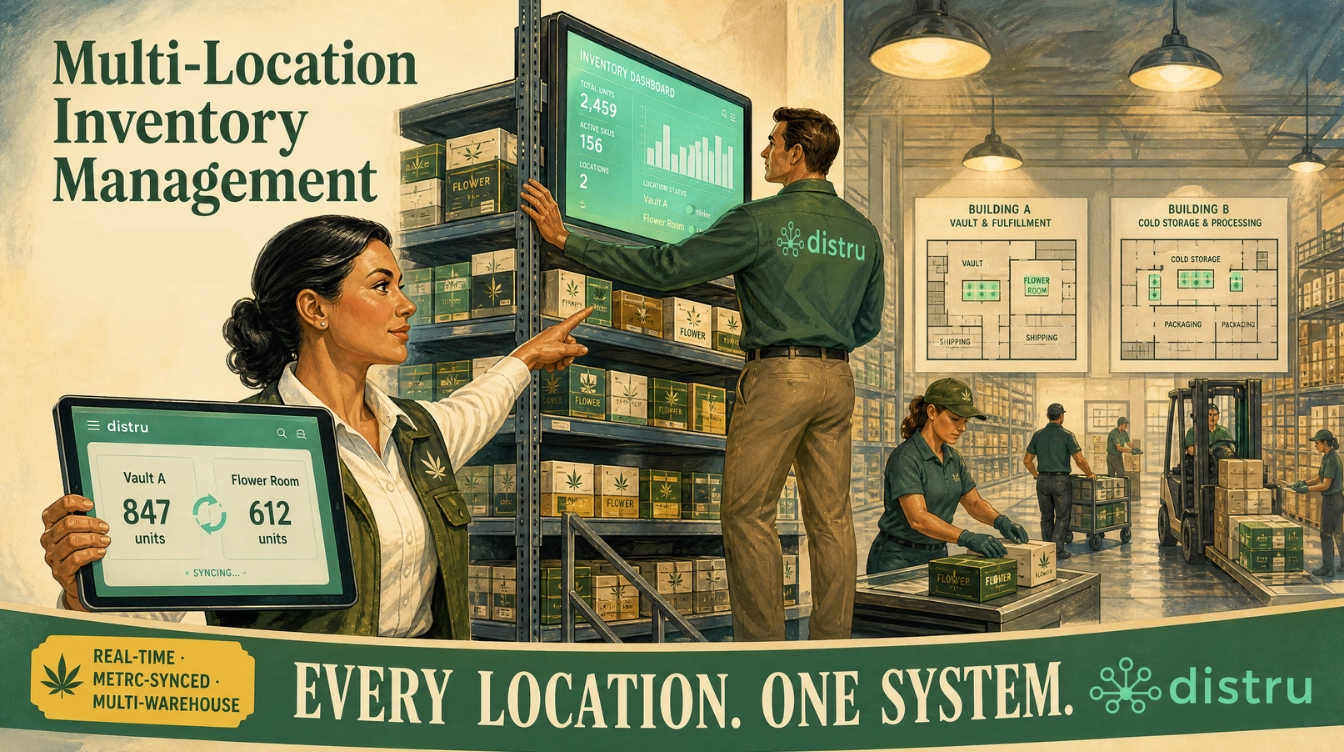
You start with one warehouse, and it's tight and manageable. Then you add a second license, another region, and a third delivery route. Suddenly, your locations aren't talking to each other anymore.
One hub is packed with flower while the other is ghosting orders. As a result, transfers get messy, allocations aren't reflected in real time, data starts living in silos, and your compliance risk increases with every new spreadsheet row.
If you handle cannabis inventory management across multiple locations, but they aren't all on the same page, you're operating at a disadvantage. To successfully scale, you need a single view of your entire supply chain. Here's how to move away from fragmented systems and toward a workflow that keeps your stock levels accurate, protects your legal standing, and supports your growth.
You start with one warehouse, and it's tight and manageable. But the moment you add a second license, another region, or a third delivery route, your locations stop talking to each other. Suddenly, one hub is packed with flower while another is ghosting orders because data lives in separate silos.
If you handle cannabis inventory management across multiple locations, but they aren't all on the same page, you're operating at a disadvantage. To successfully scale, you need a single view of your entire supply chain. Here's how to move away from fragmented systems and toward a workflow that keeps your stock levels accurate, protects your legal standing, and supports your growth.

Why Multi-Location Wholesale Inventory Breaks
Scaling sounds great in a pitch deck, but on the ground, it's usually where the chaos lives. When you move from one facility to three, the mental tracking you used to rely on just can't keep up with the volume.
The primary reason multi-location cannabis inventory management fails is a lack of communication between your tech stacks. If you've found yourself trapped between three specific "truths" that rarely agree with each other, it often comes down to these gaps:
The Three Systems That Must Stay in Sync
Ever feel like you're playing a game of telephone with your own data? It usually starts because your systems are living in silos.
If you're aiming for a tight operation, you need a multi-location-ready cannabis ERP to handle your business's day-to-day demands like inventory levels, specific allocations for pending orders, and granular costing. Then you have Metrc or BioTrack, which serves as the regulatory record and is the only version of reality the state actually cares about. Finally, there's QuickBooks, which holds your financial truth.
The nightmare begins when these three don't talk. If your ERP says you have 50 lbs of flower, but your financial records only account for 40, your COGS are already off. Leaving these solutions disconnected triggers a cycle of the same frustrating problems:
- You end up overselling inventory that was already promised to another buyer.
- Manifests aren't tied to your actual orders, leading to "in-transit" ghosts.
- End-of-month valuation becomes a week-long nightmare for your CPA.
- You're stuck with double or triple data entry, and we all know that's exactly where the expensive typos happen.
Scaling Pain Points for Wholesalers
The bigger you get, the louder the cracks become. What worked for you when you had a single facility may break down as you move cannabis inventory across multiple stores or warehouses. At this volume, winging it with spreadsheets can lead straight to an operational collapse.
When your systems can't keep up with your growth, the friction starts to bleed into every corner of your business and create these bottlenecks:
- Ghost Stock: Think about your wholesale reps for a second. If they're sending out PDF menus that don't reflect real-time allocations, they're basically lying to your customers, not on purpose, but because the data is stale the moment they hit "export." This usually results in those "sorry, we're out of stock" calls that kill trust.
- Batch and SKU Drift: If one warehouse logs a strain slightly differently than the next, your data falls apart. You end up with wrong stock levels, broken sales reports, and mismatched batch IDs, which make it impossible to track a product's quantity, lifecycle, or margins. It turns your master inventory list into a mess of duplicates that no longer account for what's actually on the floor.
- Transfer Dead Zones: Without a digital handshake between locations, your packages disappear into a black hole the moment they depart the dock. Your receiving team is left staring at empty shelves with zero visibility into what's on the truck or when it'll arrive. When a manifest doesn't match the details of your actual order, you lose sight of your most valuable assets and pretty much have to pray the right shipment shows up.
- Compliance Double-Work: Monthly inventory counts are hard enough without doing the same job twice. If your internal logs and state records aren't synced, your team spends days manually reconciling the two. It's a massive waste of time that invites human errors and exposes your licenses to the kind of discrepancies an auditor won't overlook.
- Administrative Overload: Scaling shouldn't feel like you're drowning in paperwork. If you're still chasing unpaid invoices location-by-location or manually updating what's available for sale for dozens of different partners, you've hit a ceiling. You can't lead the market if your best people are stuck managing clunky processes instead of moving your products.

The Single Source of Truth Model for Cannabis Wholesalers
If your North warehouse, South facility, and main storefront are all telling different stories, which one do you trust? You can't expand an operation with several locations when you're constantly second-guessing which site has the right answer. This confusion is why you need to establish a single source of truth for your cannabis inventory.
But what does that actually look like? In practice, it's just having one place where your ERP, compliance, and accounting tools finally share the same reality. To get there, you need to clear up these two things:
SKU vs. Package Identity (Wholesale Reality)
The reason you need that "single source of truth" we talked about earlier is that, as a wholesaler, you're essentially speaking two different languages at once.
On one hand, you have your sales side. When a buyer calls, they ask for 50 units of "Blue Dream eighths." For them, that's just a single product. So, you rely on SKU management for the cannabis you have in stock.
But on the other hand, regulators don't see your product names like "Blue Dream"; they see 50 different physical tags with unique IDs. Sounds simple, but this can get a bit ugly when one single SKU is tied to dozens of different packages scattered across three separate warehouses.
Imagine shipping out an order and realizing the manifest belongs to a batch that's actually sitting in a vault three towns away. If you don't have a way to connect those dots, your records won't match, your audits will fail, and you'll spend every Friday night trying to find "missing" inventory that's actually just hiding under the wrong ID.
That's why tracking every cannabis package, and the physical tag that goes with it, is so important. You need a system that treats the SKU as a name and the tag as the literal digital identity of that product. This way, when you move 50 units, you can quickly identify exactly which ID is leaving the building, saving you from a very long, very expensive audit day.
Inventory Authority by System
If you're using at least three different solutions, which one holds the final word for each specific task? To keep your sanity, you have to set a clear chain of command and give each platform a clear job description so they aren't fighting over the same data.
Your ERP should serve as your operational engine, tracking what's physically in the bin, what's promised to a customer, and where things are moving. It's the hub that centralizes your inventory management across multiple locations. Metrc and BioTrack are strictly for compliance reporting. You use them to tell the state what you've already done, not to run your daily business. Finally, QuickBooks should handle your finances, like COGS and tax records.
Trying to use one of these platforms for something it isn't designed for can cause you a headache. But this clean division keeps your cannabis inventory, compliance, and accounting from stepping on each other's toes. If your ERP logs the movement, Metrc and BioTrack reflect the report, and QuickBooks knows the cost, your operation stays locked down and profitable.
The Compliant Inter-Warehouse Transfer Workflow
Moving product from your cultivation site to your manufacturing hub, or even just between two retail stockrooms, feels like it should be simple. But if you've ever had a transfer stuck "in transit" for three days while your receiving team stares at empty shelves, you know the stress.
This action requires a digital handshake that matches the physical handoff. Otherwise, your records and your reality will start drifting apart. Below is the step-by-step process for a compliant transfer:
- Create a Clear Transfer Order: Start by specifying the origin, the destination, and every specific package ID involved. For high-risk or high-value loads, an internal approval step helps keep things tight.
- Generate the Manifest: Once approved, create a manifest tied directly to that order.
- Mark as "In Transit": Before the driver leaves, scan the tags to update your system. This ensures your sales team doesn’t try to sell inventory that’s currently on the highway.
- Verify and Reconcile: When the van arrives, the receiving team must verify the physical count against the digital record and reconcile it immediately.
- Close the Loop: Confirm the sync across your ERP and the state system to finalize the movement.
What happens if the state reporting system goes down while your driver is idling in the parking lot? It happens more than we'd like, so sometimes, you’ll have to lean on your internal batch records.
If your system tracks the physical movement independently, you can keep the operation moving and push the data to the state once their servers stop spinning. It keeps the business producing without creating a compliance black hole.
Inventory Reconciliation for Multi-Warehouse Operations
Reconciliation is like a regular health checkup. It's where you see if the digital version of your stock matches the physical jars sitting on your shelves, and it's how you catch small errors before they turn into major red flags during an audit.
But you can't just wait until the end of the year to do it, especially if you operate multiple locations. To maintain a compliant, friction-free supply chain across all your facilities, this is how often you should reconcile your cannabis inventory:
- Daily: Take five minutes to review your allocations against your available inventory. You want to confirm there are no negative sellable quantities because selling a product you don't actually have is a fast way to lose a wholesale partner.
- Weekly: Perform risk-based cycle counts. Start with your high-velocity items like flower and concentrates. These are the easiest to lose track of, so verifying them weekly ensures you spot discrepancies before they become "lost" inventory.
- Monthly: This is the big one. Pull a point-in-time inventory snapshot before you start, then do a full physical count by batch. Log every adjustment with a specific reason, whether it's waste, a lab sample, moisture loss, or a simple miscount. Once finished, export that inventory valuation for your CPA so they can keep your COGS clean.
How Distru Makes Multi-Location Wholesale Inventory Easy
If you're feeling the weight of holding multiple licenses, you've likely asked yourself: What is the best cannabis ERP for multi-location operations? It's a fair question when you're trying to move away from the "hope and pray" method of inventory management.
We have good news: Distru was built specifically to handle the headaches that come with scaling. We use a location + batch architecture that maps your physical reality directly to your digital records. Every unit of inventory lives in a specific spot (like "Warehouse B, Rack 4") and remains tied to its unique batch ID. You can even use statuses like "Quarantine" or "Ready for Sale" to ensure nobody accidentally sells a product that's still waiting on lab results.
Also, we have a powerful Metrc integration with 2-way inventory sync. Whenever you move a package or make a sale, that data flows to the state system without you having to touch it twice. What's sold is removed from your sellable stock instantly, giving your sales team total visibility. And during an audit or a monthly count, you can pull point-in-time inventory reports that reconstruct exactly what was in your building at any given moment.
If an employee adjusts a count, Distru won't let them push it to Metrc without attaching the state's required reason code, saving you from accidental regulatory red flags and automatically building a bulletproof audit trail. You can tighten that circle of control even further by setting up cannabis inventory permissions, so your production manager only sees manufacturing data while your wholesale reps stick to CRM and orders.
Plus, with our QuickBooks sync, your invoices and payments stay mirrored in your accounting software, keeping your finance team happy.
DistruCommerce: Your Wholesale Advantage
Managing the backend is only half the battle. You also have to move the product. DistruCommerce helps you handle that B2B side by letting you create multiple wholesale menus by region. If you have different delivery windows for different parts of the state, you can set up a Western menu and an Eastern menu that pull from their specific source locations.
Your buyers see only the live, sellable inventory you've designated for them, synced straight from your backend stock. No more sending out a PDF and having to apologize when a dispensary tries to buy something that sold out an hour ago. Instead, they can use a self-service portal to track live orders and view invoices, or pull a live-updating CSV export right from the platform that always reflects your real-time quantities and pricing.
Forget about messy spreadsheets and PDF menus that are disconnected from your stock. With Distru, you never have to toggle between systems just to see if you can fulfill a request.
With Distru vs. Without Distru (Wholesale Edition)
Most teams don't realize how much noise they're living with until it's gone. You might think a few spreadsheets are fine for now, but those small discrepancies in your cannabis inventory usually signal a bigger problem under the hood.
If you're tired of playing detective every time a manifest doesn't match a physical box, it's time to look at the difference a unified system makes:
| Operational Area | Without Unified ERP | With Distru + DistruCommerce |
|---|---|---|
| Multi-Warehouse Visibility | Separate tools or spreadsheets | Location-based, real-time inventory |
| Allocated Inventory | Not reflected in exports | Allocation reduces sellable stock automatically |
| Manifests | Manual + risk of double entry | Order-level manifest generation |
| Monthly Counts | Manual snapshot comparisons | Point-in-time inventory reporting |
| Audit Trail | Weak adjustment history | Batch-level reason logging |
| Buyer Experience | Static PDFs | Live menus tied to real inventory |
| CPA Reporting | Reconciliation headaches | Clean inventory valuation + QuickBooks sync |
| Scaling (3+ Warehouses) | Operational chaos | Designed for multi-license operations |
Do You Need an ERP or Can You Scale With Spreadsheets?
This is the point where most operators have to be honest about where they're going. If you operate out of a single warehouse, don't move inventory between licenses, and your CPA isn't asking for detailed valuation reports, you can probably survive on spreadsheets for a little longer. They're cheap, and if you're the only one touching them, you know where the errors are.
But if you're running multiple licenses across different regions, the math changes. When you're regularly transferring products, managing diverse wholesale menus, and needing audit trails that won't make a regulator blink, you've moved past the "manual entry" phase of your business. You don't just need a place to record data; you need infrastructure.
If your team is spending more time chasing invoices and fixing "in-transit" ghosts than they're actually selling or producing, the "free" spreadsheet is actually costing you a fortune in labor and compliance risk.
Conclusion
Scaling a wholesale cannabis business doesn't fail because people are lazy or careless. It fails because disconnected systems create sync gaps that eventually swallow your profits and your peace of mind. If your wholesale menu doesn't know what your warehouse is doing, and your warehouse doesn't know what Metrc thinks, you're building on sand.
One system for all your locations ensures that your compliance is ready for an audit at any moment. The work involved in managing cannabis inventory across multiple locations should act as the foundation for your next ten licenses, not the ceiling that stops your growth.
Have you ever wondered what your team could actually achieve if they weren't stuck chasing manifests and fixing spreadsheet errors all day? Schedule a demo with us. We'll show you how Distru and DistruCommerce take the manual guesswork out of your multi-license operations.