
Your phone buzzes at 4:30 PM with a frantic text from a buyer, followed by three manual order entries that you still need to type into your system before the warehouse closes. You check your spreadsheets, and they claim you have 50 cases of gummies, but your manager on the floor is saying there are only 10. You realize you promised a huge delivery to a dispensary based on stock that just isn’t there. And to top it off, you’re still chasing invoices from sixty days ago. This messy reality leaves you wondering: how do you effectively manage cannabis distribution channels without burning out?
The problem is, you’re probably juggling three or four disconnected systems that refuse to talk to each other, which drains your time, kills your accuracy, and eats your margins for breakfast.
But what if you could actually breathe? The secret is a connected framework that ties your inventory, compliance, and fulfillment into one smooth flow. By the end of this guide, you’ll have a clear, actionable roadmap to run your distribution operation like a pro.
.avif)
What Are Cannabis Distribution Channels?
Before we start moving boxes and signing manifests, we need to get our bearings on what we’re actually working with.
In the simplest terms, these channels are the paths your product takes to get from your facility into the hands of a retailer. While traditional distribution is a well-oiled machine of wholesalers and retailers, the cannabis version is its own beast, shaped by strict state laws and the ever-present eye of track-and-trace systems.
You aren't just shipping widgets; you're moving a highly regulated plant that requires a specific paper trail at every stop. Because the rules vary so much, we generally see three main ways to get the job done. Let’s break down the primary cannabis distribution channels you can use in this industry:
Direct-to-Retailer Distribution
If you like having total control over your story and your bottom line, this is your lane. This channel is exactly what it sounds like: your brand or cultivation team sells and ships directly to the dispensaries.
It’s usually the best fit for established brands that have the budget for a dedicated sales force and their own fleet of vans. Why? Because you aren't just selling a product; you’re building a relationship.
- Pros: You get much higher margins because you aren't paying a middleman a cut of every sale. You also keep 100% control over how your brand is presented and maintain a direct line of communication with the buyers.
- Cons: The heavy lifting is all on you. You need a full sales team, a solid logistics setup, and the administrative backbone to handle Metrc compliance and insurance for every mile on the road.

Third-Party Distributor Partnerships
Sometimes you just want to focus on growing or manufacturing and let someone else handle the "getting it there" part, and this option is the right solution to that.
Working with a licensed third-party distributor is right for newer brands looking to scale fast without buying a fleet of trucks. These partners already have the relationships and the routes; you just provide the product.
- Pros: You get into the market much faster by piggybacking on their existing retail network. It’s an instant "in" with dozens of shops you might not have the time to visit yourself.
- Cons: Your margins will take a hit because the distributor needs their piece. Plus, you lose a bit of that personal touch; you’re relying on their reps to pitch your brand alongside twenty others.
Wholesale Marketplace Channels
Think of this as the digital storefront for the industry. These platforms are online wholesale cannabis channels where retailers go to "window shop" and discover new products. This is a solid choice for any operator who wants to lower the friction of the sales process.
Instead of a sales rep chasing down a buyer, the buyer comes to you. When you dive into cannabis wholesale distribution, you’ll find that these sites make it much easier for a small brand to get noticed by a buyer halfway across the state.
- Pros: You get a massive reach with much less effort. Self-serve ordering means buyers can place an order at 11 PM when they’re finally doing their inventory, which is way easier for everyone involved.
- Cons: It can be a crowded house. You’re often sitting right next to your biggest competitor, so your product photos and descriptions have to be top-tier to stand out.
One thing we do differently at Distru is offer private menus. While a public cannabis B2B marketplace is great for discovery, a private catalog lets you send a curated link to your VIP accounts so they only see your products and their specific pricing. It keeps the focus on you, not the noise of the competition.
Comparison of Channel Types
| Feature | Direct-to-Retailer | Third-Party Distro | Cannabis B2B Marketplace |
|---|---|---|---|
| Profit Margin | Highest | Lower (fees apply) | Moderate |
| Effort | High (sales + logistics) | Low (partner handles it) | Low (self-serve) |
| Control | Full Brand Control | Limited | Shared Platform |
| Best For | Large, established brands | New brands scaling fast | Brands seeking discovery |
How to Set Up Your Cannabis Distribution Channels
Have you ever wondered how to optimize cannabis wholesale distribution without hiring five more people just to manage the paperwork? It starts with a solid foundation, and we’re going to walk through the exact steps to get you there.
Step 1 , Define Your Distribution Strategy
You can’t build a house without a blueprint, and you definitely shouldn't start shipping units without knowing what the best cannabis distribution strategy is for your specific business. This isn't a one-size-fits-all situation; what works for a boutique indoor grower in Oregon won't work for a massive MSO in Illinois.
First, look at your cannabis distribution license type. Some states have strict "firewalls" where you have to use a third party, while others let you do everything in-house.
Once you know the legal guardrails, assess your operational capacity. Do you actually have the staff to handle a multi-channel approach? Selling through your own reps while also using a marketplace sounds great until you realize you have two different people promising the same last case of flowers to two different shops. Decide now if you're going all-in on direct sales or if you’re going to let a partner take the wheel.
Step 2 , Build Your Product Catalog for Wholesale
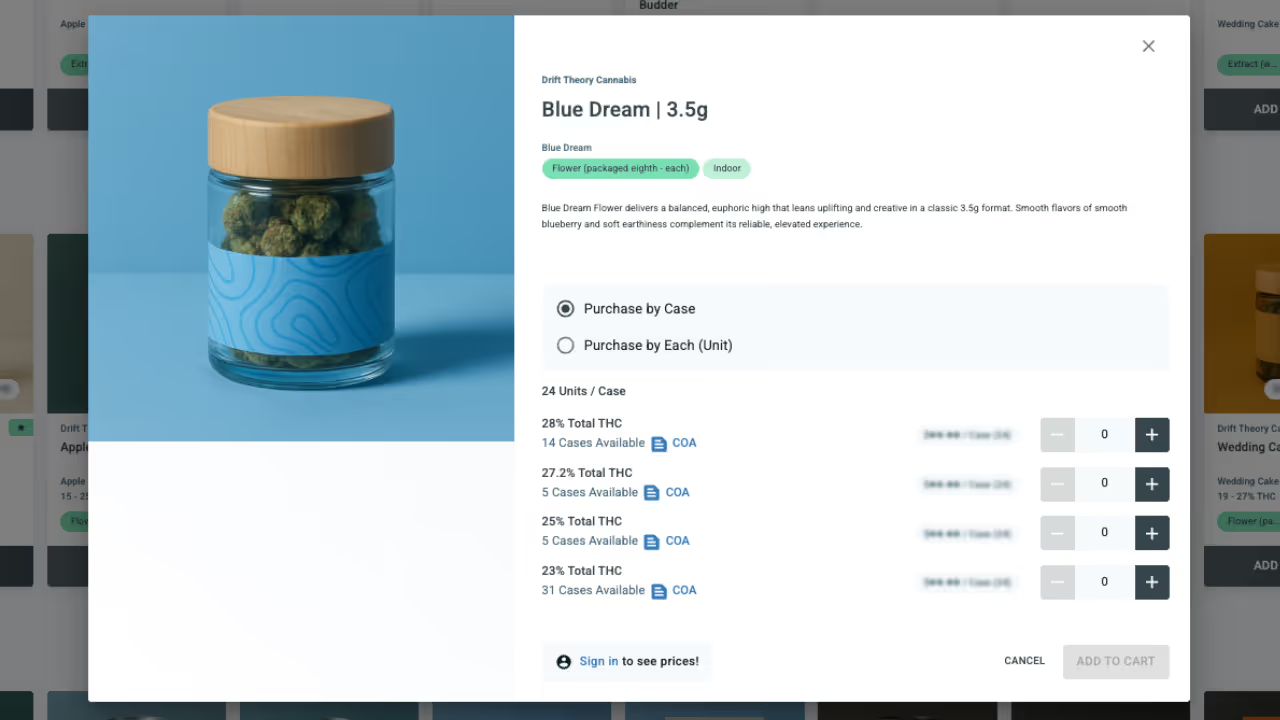
Now that you have a plan, you need to look good on paper (or on a screen). Your product catalog is your first impression. If you’re sending a grainy photo and a "TBD" on pricing, don't expect a call back. You need a centralized spot for pricing, high-res photos, categories, and, most importantly, your COAs.
Retailers are busy, and they don't want to hunt through their emails for a lab result. On platforms like DistruCommerce, you can learn how to set up a digital wholesale menu for your cannabis business that pulls directly from your live inventory.
We’re talking up to four photos, detailed descriptions, and even customer-specific pricing tiers. That way, your legacy accounts see the loyalty discount they’ve earned, while new guest buyers see the standard rate. You can even toggle between selling by the unit or by the case, making it easier for buyers to click "add to cart" without a three-day back-and-forth over email.
Step 3 , Establish Ordering Workflows
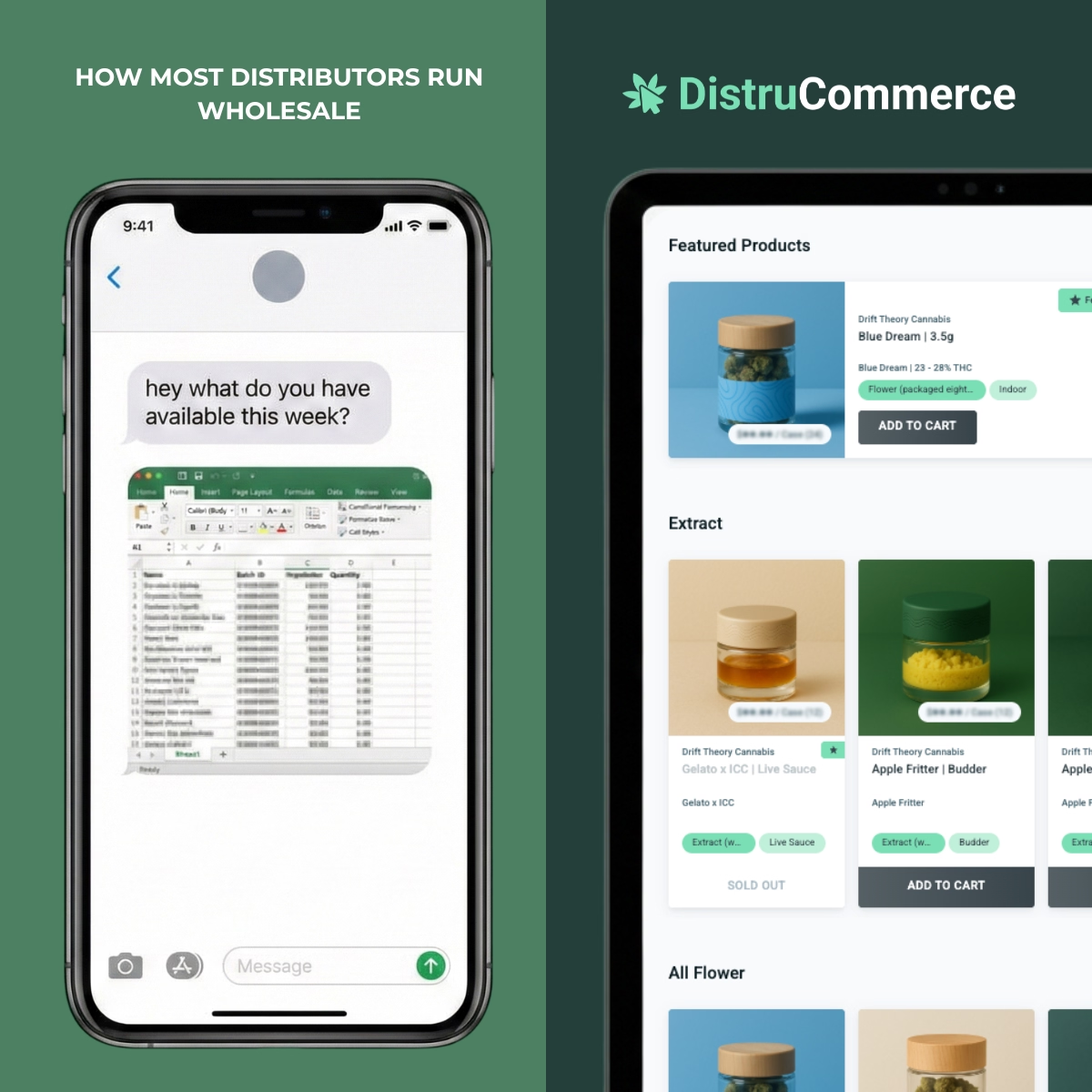
This is where the wheels usually fall off. If your cannabis wholesale ordering process currently looks like a mix of Instagram DMs, texts, and the occasional voicemail, we need to talk.
Wondering how cannabis distributors manage wholesale ordering without losing their minds? They move from manual chaos to digital self-serve.
Think about the difference between an "order request" and a "sales order." When a buyer sees your menu and hits buy, it should come in as a request. This gives you a chance to double-check their license and make sure you actually want to fill that order before it becomes a legal commitment in your system.
You also have to consider how logged-in buyers vs. guest buyers affect your routing. A logged-in buyer might get routed straight to their dedicated rep, while a guest buyer goes to a general "new lead" queue. Setting these lanes up early keeps your team from tripping over each other.
Step 4 , Connect Compliance to Distribution
In this industry, compliance isn't just a department, it's the whole game. You need a rock-solid Metrc or BioTrack integration that handles your transfer packages and manifests without you having to re-type every tag number. If your physical inventory and your compliance records don't match, you're looking at a world of hurt during your next audit.
The real magic happens when your cannabis distribution software stays in constant communication with the state's system. For example, Distru pings Metrc 3–40 times every single second. This ensures that when a package is moved or an order is fulfilled, the state knows about it instantly.
Real-time sync means you never accidentally sell a batch that’s been put on hold or a package that has already been manifest to another shop. It's about sleeping better at night knowing the data is actually right.
Scaling Your Cannabis Distribution Channels
Success brings its own set of headaches, usually in the form of more licenses and more complicated tax codes.
Once you feel like you know how to distribute cannabis, it’s time to learn how to scale once you do. Growth doesn't have to mean more spreadsheets; it just means a bigger, more connected map.
Adding New Markets and Licenses
Expanding into a new state is like starting a brand-new business that happens to share your logo. You have to deal with different regulations, different tax rates, and brand-new Metrc distribution compliance hurdles.
One of our customers who recently expanded into Kentucky put it rightly: if you can start with a tool that works from the jump, you won't have to retrain your entire staff six months down the line when the manual process breaks.
You can manage this growth by using virtual and Metrc locations within one system. This setup allows you to see your entire empire from one dashboard without switching logins every time you want to check stock in another zip code.
If you build on the right foundation from day one, adding a second or third license feels like adding a new folder to a computer rather than rebuilding the whole hard drive.
From Private Menus to Public Marketplace
Most operators start by sending private digital menus to their "ride or die" accounts. This is a smart move because it keeps your core business stable and gives those VIP buyers a polished, dedicated experience. They get their unique pricing, they see your real-time availability, and they can order in their pajamas at midnight.
Once that's running smoothly, you can flip the switch to public marketplace visibility. This opens your doors to new buyer discovery across the entire state.
Retailers who have never heard of you can browse your catalog, check your COAs, and place an order request. It’s the natural evolution of your sales funnel: take care of your inner circle first, then use the marketplace to fill the gaps and find your next big retail partner.
Integrating Across Your Tech Stack
A distribution business is only as strong as its weakest integration. If your sales system doesn't talk to your accounting software, you’re stuck manually entering invoices into QuickBooks like it’s 1995. You have to ask yourself: what software do cannabis distributors use to actually stay sane? The answer is a system that bridges the gap between the warehouse and the front office.
We’ve seen that most operators are used to entering data into three or four separate places. You might have a POS for retail (like Treez, BLAZE, or Dutchie), a spreadsheet for inventory, and another tool for manifests. A connected system collapses that chaos. When your POS talks to your ERP, and your ERP talks to your accounting tech, a single sale triggers a ripple effect that updates your stock, your taxes, and your compliance records simultaneously.
Common Cannabis Distribution Mistakes to Avoid
A few common traps can cost you more money than a record-breaking sales month ever could. You can have the best flower in the state, but a back office that looks like a digital crime scene will eventually cap your growth. One of the biggest pitfalls involves cannabis distribution management by "vibes" rather than actual data.
Many brands hit ten or fifteen retail accounts and try to keep managing everything through text messages and shared spreadsheets. Have you ever tried to track down a specific invoice in a group chat with three sales reps and a buyer? It’s a nightmare, and it’s exactly how inventory slips through the cracks.
So, watch out for these other silent killers:
- Inventory Desync: A menu that says you have ten units when you actually have zero wastes your buyer's time and your rep's gas money.
- AR Blindness: Cash flow crises often start when you ignore accounts receivable until the bank account hits a scary number. You need to know who owes you money the second an order leaves the dock.
- Competing Against Yourself: Some marketplaces force you into a race to the bottom on price by highlighting your competitors' discounts right next to your premium product.
- Poor Expansion Planning: New states mean new rules. If your system doesn't handle multi-state Metrc compliance, your team will drown in manual data entry.
The Bottom Line
Your operational peace of mind comes down to one thing: connectivity. When your inventory knows what your compliance officer is doing, and your sales team sees exactly what the warehouse has on the racks, the chaos simply disappears. You stop acting like a full-time firefighter and finally start being a strategic business owner again
We built our platform to be the glue that holds all these moving parts together. From tightening up your wholesale ordering to syncing your inventory with Metrc in real-time, we’ve got your back.
Want to see how Distru and DistruCommerce connect your distribution operations, from inventory to wholesale ordering to compliance, in one platform. Book a demo and try our ERP and our marketplace today!