In This Article:

Ask AI about this article
OpenAI
Claude
Perplexity
Google Gemini

Cannabis Financial Reporting That Lenders Trust

Distru Team  |
Updated
November 12, 2026
TL;DR

• Lenders judge cannabis operators on inventory valuation, COGS by product line and AR aging, so most of what they review comes from operations, not the P&L.

• Inventory that doesn't tie to Metrc counts and invoices that don't match shipments are the two fastest ways to stall a loan application.

• A 30-day plan covering inventory, COGS, receivables and the audit trail gets most operators lender-ready before they apply.

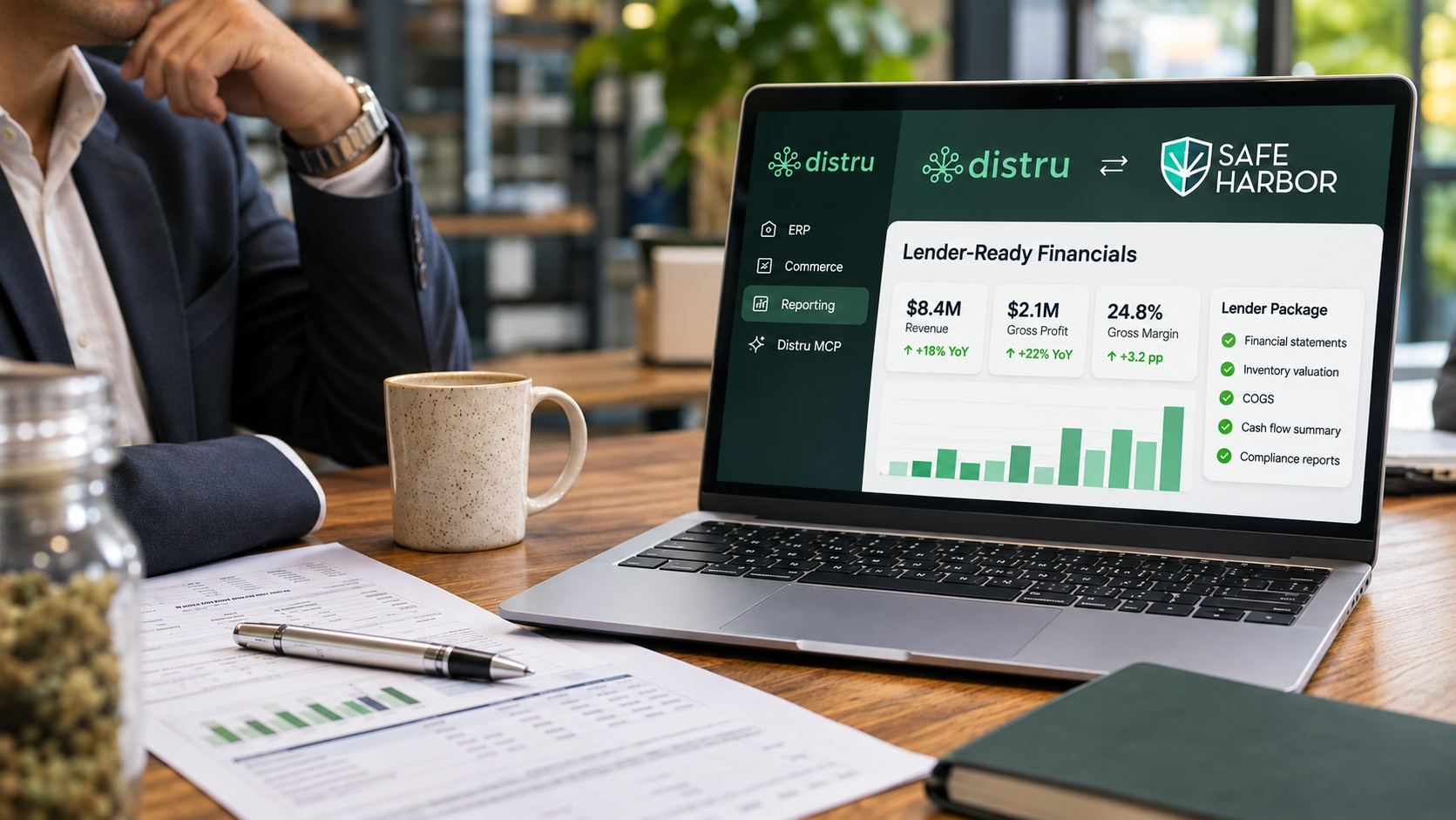
• Distru keeps the records lenders review in one system, and Safe Harbor Financial, the first compliant cannabis banking provider in the U.S., offers the cannabis banking and business loans to fund what comes next.

You're filling out a loan application with three spreadsheets open. One has inventory from your last count. One has receivables your bookkeeper exported last month. The third is your best guess at margin by product line. None of them agree, and the lender wants all three by Friday.

Yeah, we've all been there. Most cannabis operators don't get turned down for a loan because the business is bad. They get stalled because the records can't prove the business is good.

Let's walk through what lenders actually look at, where cannabis financial reporting usually falls apart, and a 30-day plan to get your books lender-ready.

We put this guide together with our partners at Safe Harbor Financial, the first compliant cannabis banking provider in the U.S. Distru sees the operating data that runs your business. Safe Harbor sees what a lender does with it. This is what both sides look for.

Why Do Lenders Care How You Run Operations?

Because in cannabis, your operating data is the collateral story. Inventory, receivables and margin by product tell a lender more about your ability to repay than a P&L does.

A P&L is a summary. It can look healthy while inventory is overstated, receivables are aging past 90 days and one product line quietly loses money. Cannabis lenders know that, so they dig into the records underneath.

They'll usually ask for:

  • Inventory valuation that ties to your Metrc counts
  • COGS by product line, not one blended number
  • AR aging with payment history by retailer
  • Tax position, including how you handle 280E
  • Banking history and license standing

Notice that most of that list comes from operations, not accounting. That's why cannabis financial reporting starts on the warehouse floor.

Why Don't Your Metrc Counts Match Your Books?

Usually because the two records get updated by different people at different times. Every unlogged adjustment, typo on a manifest and repack entered in one system but not the other widens the gap.

That gap matters to a lender because inventory is often your largest asset. If your books say $1.2M in inventory and your Metrc counts support $1.05M, the lender won't split the difference. They'll trust the lower number, or they'll stop and ask why, and your timeline slips.

Stale costs make it worse. If inventory is valued at what flower cost two harvests ago, your cannabis inventory valuation is off even when the unit counts are right.

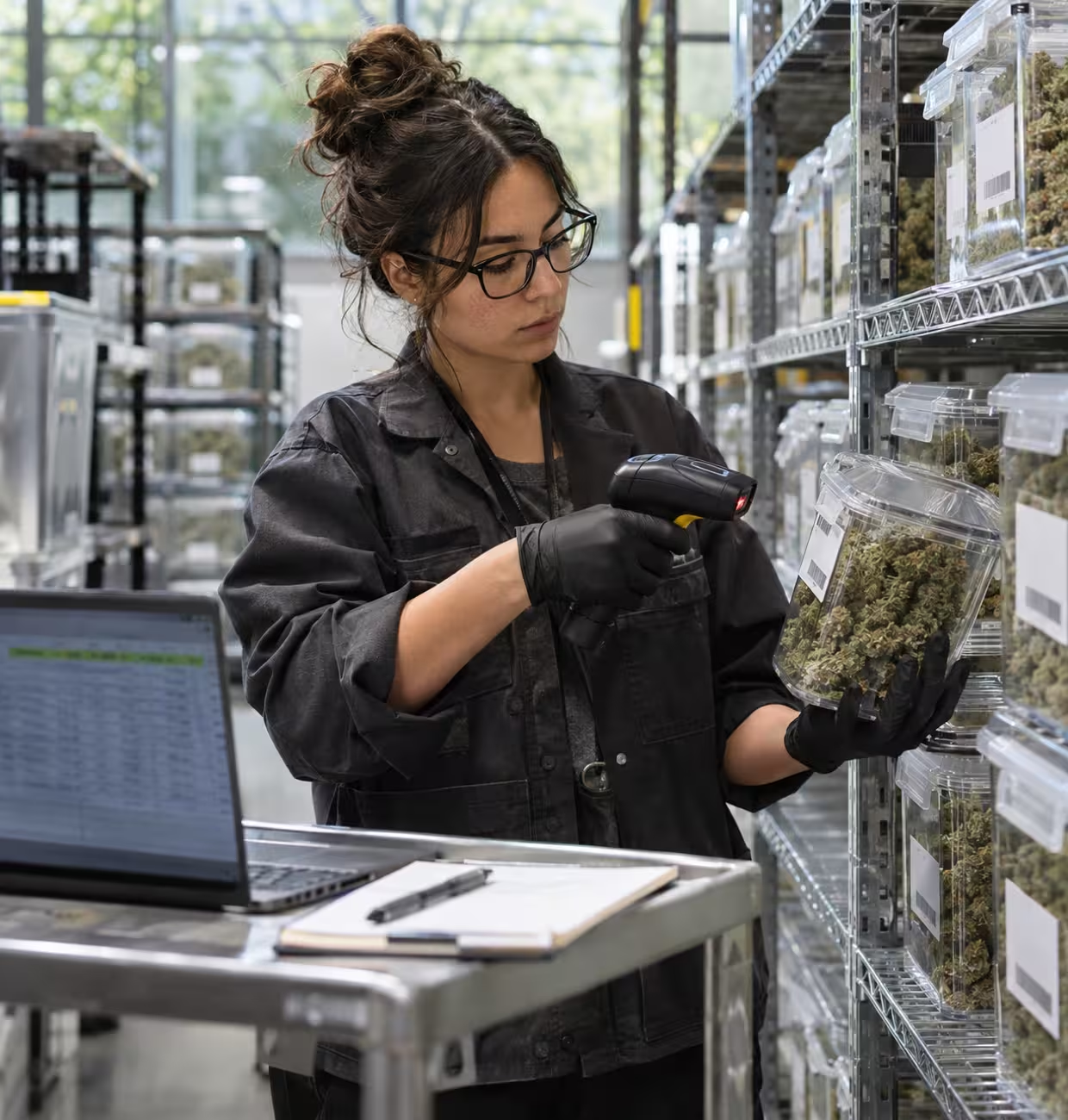
The fix is Metrc reconciliation that happens continuously, not the week before an application. When your inventory system and Metrc stay linked package by package, the counts stay aligned and mismatches surface as exceptions you can work in a day.
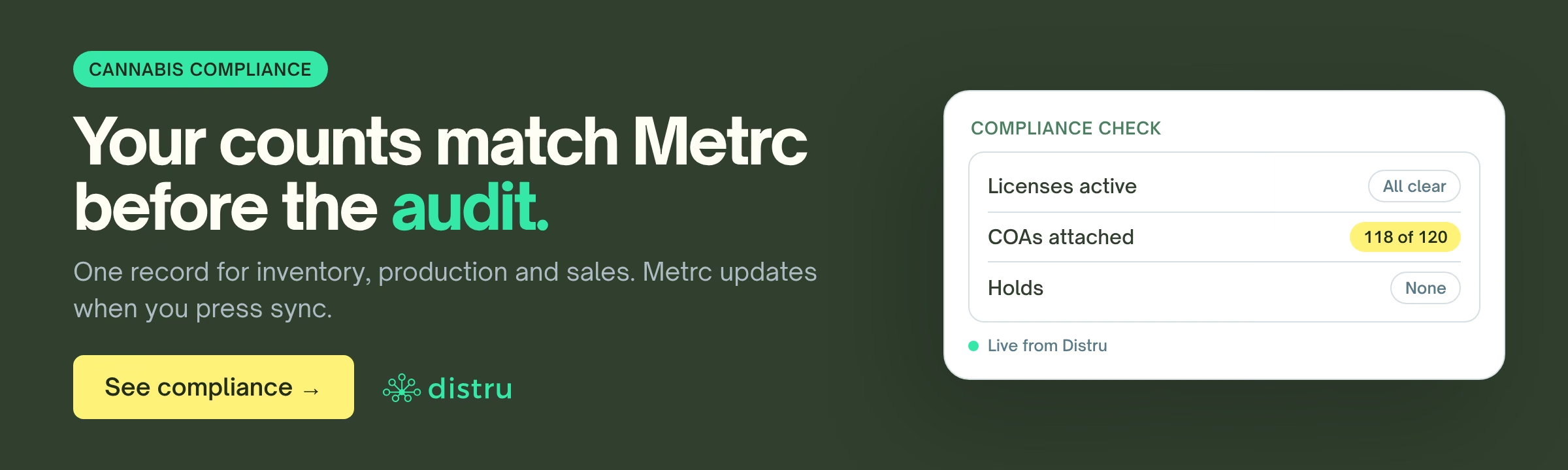
Your counts match Metrc before the audit. Cannabis compliance. Distru.

Do You Know Your Margin by Batch and Product?

If you can't answer that in a few minutes, a lender will notice. Margin by product line is how they judge whether growth will help you repay or just burn more cash.

A blended gross margin of 42% can hide a lot. Your carts might run at 50% and your jars at 30%. If the plan is to grow jar volume, that loan funds the weaker side of the business. A good lender will ask about that.

The answer comes from cannabis COGS tracking at the batch level: materials by lot, direct labor tied to the run and production overhead allocated where the work happened. Track cost live as inventory moves through your facility, and margin by SKU becomes a report you pull, not a project you start.

Distru, a cannabis ERP with a built-in wholesale marketplace, tracks cost that way, so finance teams see projected COGS before product goes to market and margin down to the line item being sold. For the tax side of the same records, see our guide to 280E, COGS and audit-ready records.
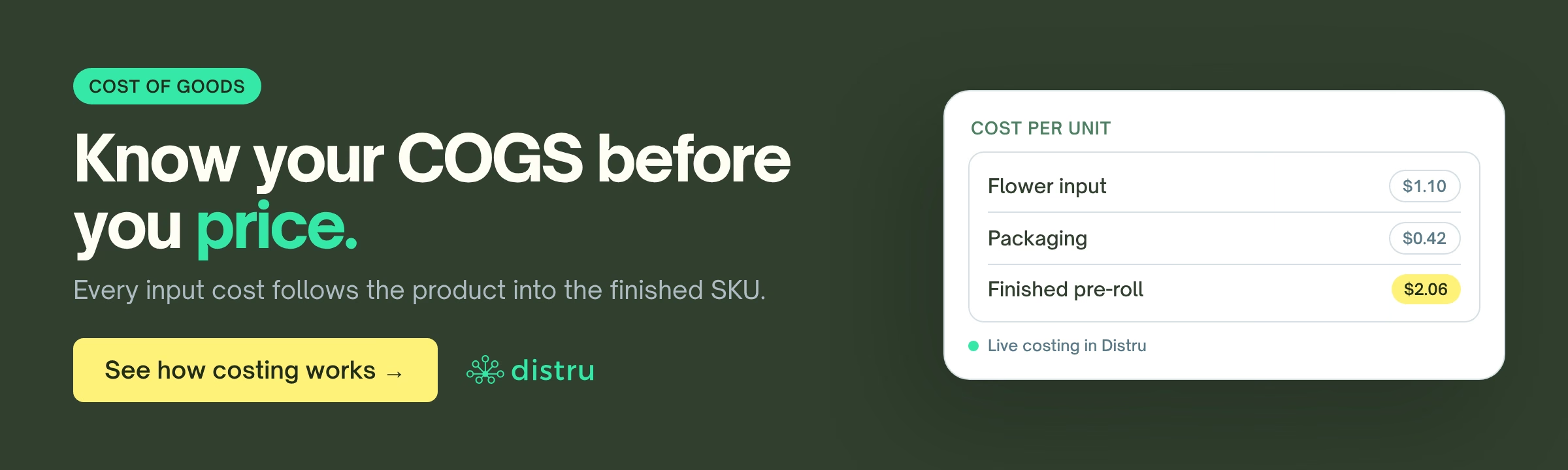
Know your COGS before you price. Cost of goods. Distru.

Will Your Receivables Hold Up to Review?

They will if your AR aging is current, your terms are consistent and every invoice traces back to a shipment. Cannabis accounts receivable gets extra scrutiny because slow-paying retailers are common in our industry.

Here's what a lender looks for:

  • Aging buckets that make sense. A lot of balances past 60 or 90 days raises questions about collectability.
  • Consistent payment terms. Net 30 for one retailer and "whenever" for another looks like a collections problem.
  • Days sales outstanding (DSO) trending the right way. Rising DSO means cash is coming in slower than you're selling.
  • Invoices tied to real shipments. Each invoice should match a sales order and a Metrc manifest, with the same products and quantities.

That last point is where manual processes break. When the sales order lives in one tool, the manifest in Metrc and the invoice in QuickBooks, they drift. A lender who finds a mismatch will wonder what else doesn't match.

What Happens After Your Books Are Clean?

You take them to a lender who understands cannabis. Clean records get you to the table. The right lender is what gets you funded.

That matters because a lot of traditional lenders still won't touch plant-touching businesses, and the ones that will often don't understand 280E, Metrc or seasonal harvest cash flow. You end up explaining the industry before you can explain your business.

Distru handles the operations side. Safe Harbor Financial handles the capital side. Safe Harbor has worked with cannabis operators since 2015, when it became the first compliant cannabis banking provider in the U.S., and offers cannabis business loans for working capital, equipment and real estate, alongside the banking relationship to support them. Its lending platform has originated $120M in loans since 2022.

A 30-Day Lender-Readiness Checklist

Give yourself four weeks before you apply. Here's how to spend them.

Week 1: Inventory

  • Run a full count and reconcile it against Metrc by package tag
  • Resolve or document every discrepancy with a reason code
  • Revalue inventory at current cost, not cost from two harvests ago

Week 2: COGS and margin

  • Confirm every top SKU has a complete BOM with labor steps
  • Pull COGS and gross margin by product line for the last 12 months
  • Write down how you allocate costs under 280E, and have your CPA sign off

Week 3: Receivables

  • Pull AR aging and chase or write off anything past 90 days
  • Standardize payment terms across retailers
  • Calculate DSO for the last four quarters

Week 4: Audit trail and package

  • Spot-check 20 orders: sales order, Metrc manifest and invoice should match
  • Close the books for the most recent month
  • Assemble financial statements, bank statements, licenses and tax returns

If this checklist feels like a month of fire drills, that's the signal. A cannabis ERP that keeps inventory, costing, orders and invoicing in one system turns most of it into reports you can pull on demand.
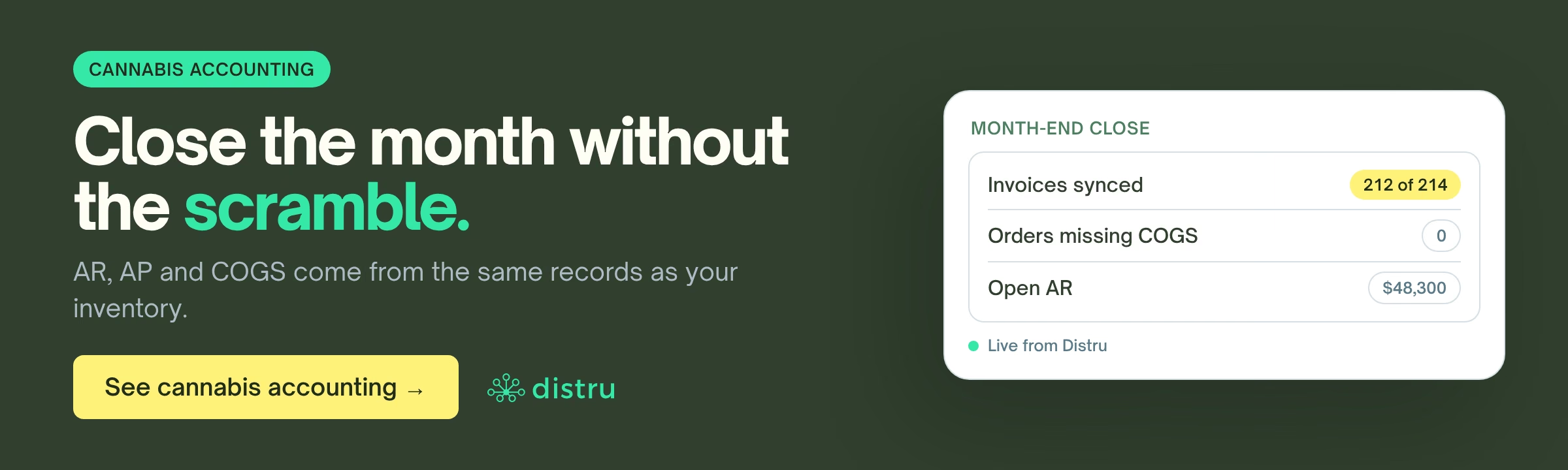
Close the month without the scramble. Cannabis accounting. Distru.

Where Should Cannabis Operators Go for Financing?

Start with lenders who already serve our industry, and bring your advisors in early. A short list to work from:

  • A cannabis-focused bank or lender. Safe Harbor Financial offers cannabis banking and lending across 41 states and territories, so the banking history a lender wants is already in one place.
  • Equipment financing. Extraction rigs, packaging lines and HVAC can often be financed against the equipment itself.
  • Your CPA. They'll pressure-test your financials and your 280E position before a lender does.
  • Your own records. The cleaner your inventory, COGS and receivables, the more options you'll have and the better your terms.

That last one is the part you control. Distru's 440+ customers across 30+ states run inventory, costing, orders and invoicing from one system, so the records a lender asks for are already there.

Ready to see what lender-ready books look like for your operation? Schedule a demo and we'll walk through your exact workflow, from sales order to manifest to invoice.


FAQs

What financial records do cannabis lenders ask for?

Most cannabis lenders ask for recent financial statements, bank statements, tax returns, AR aging, inventory valuation and COGS by product line. Many also want proof of license standing and a clear explanation of how you handle 280E. The records carry more weight when inventory ties to Metrc and invoices trace back to shipments, because that shows the numbers reflect what actually happened.

Why does Metrc reconciliation matter for a cannabis loan?

Inventory is often a cannabis operator's largest asset, and lenders want proof it's real. If your books and your Metrc counts don't match, a lender will trust the lower number or pause to ask why. Reconciling Metrc continuously, by package tag, keeps your inventory valuation defensible and keeps the application moving instead of stalling on questions.

How long does it take to get cannabis books lender-ready?

About 30 days for most operators if you work through it in order: inventory in week one, COGS and margin in week two, receivables in week three, and the audit trail and document package in week four. Operators running on spreadsheets usually need longer, because each step means rebuilding records from several sources by hand.

How does Distru help with cannabis financial reporting?

Distru keeps inventory, live costing, sales orders and invoicing in one cannabis ERP, linked to Metrc package by package and synced on your command. Finance teams can pull inventory valuation, COGS by product line, margin by SKU and AR aging on demand. Distru also syncs with QuickBooks Online and Desktop, so bills and invoices land in your books without being typed twice.

How do Distru and Safe Harbor Financial work together?

They cover the operations side and the capital side of a cannabis business. Distru, a cannabis ERP, keeps inventory, live costing, orders and invoicing in one system, so you can pull Metrc-reconciled inventory valuation, AR aging and batch-level COGS on demand. Safe Harbor Financial provides cannabis banking and business loans for working capital, equipment and real estate, and has originated $120M in loans since 2022.

Does Distru keep sales orders, manifests and invoices matched?

Yes. In Distru, a sales order becomes the Metrc transfer template and the invoice, so all three carry the same products and quantities. That gives you an audit trail from order to manifest to invoice. When a lender or auditor spot-checks orders, the records match because they started from the same source in one system.
The AI cannabis library

Free skills to put AI to work on your inventory, compliance and costing, and guides on where it actually saves time.

SKILL
Forecasting

Distru Production Forecast

Know how much of each product to make this week, based on real sell-through.

SKILL
Finance and COGS

Past-Due Invoice Emails

Draft one payment reminder per customer for every past-due invoice.

SKILL
Customer Management

Company List Clean-Up

Clean a state license export or lead list before it goes into your CRM.

SKILL
Compliance

Cannabis Inspection Readiness

Turn an upcoming state inspection into a checklist, binder index and gap list.

SKILL
Compliance

Cannabis Transfer Manifest Precheck

Check a B2B transfer before the driver leaves and get GO or HOLD per line.

SKILL
Purchasing

Cannabis Replenishment Planner

Turn sales and on-hand exports into a reorder plan and a draft PO by vendor.

SKILL
Compliance

Cannabis State Rules Lookup

Get a cited, dated answer to a state cannabis rule question.

SKILL
Operations

Cannabis Staff Scheduling Planner

Build a shift schedule that matches demand and stays inside your labor budget.

SKILL
Cultivation

Cannabis Harvest Yield Analysis

See which rooms and strains actually make money, from your own harvest data.

SKILL
Compliance

Cannabis Traceability Reconciliation

Find out why your physical count doesn't match Metrc or BioTrack.

SKILL
Compliance

Cannabis SOP Generator and Trainer

Turn process notes into an inspection-ready SOP and a staff training packet.

SKILL
Finance and COGS

Cannabis Batch COGS Calculator

Find out what a batch really costs per finished unit, line by line.

AI GUIDE
Blog

Why the Harness Matters More Than the AI Model

Two products can use the exact same AI model and perform completely differently. Here's why the harness, not the model, usually explains why.

AI GUIDE
Blog

What Is an Agent Harness? A Plain-English Primer

An AI model alone can't do much. The 'harness' around it is what makes it useful. Here's what that actually means, no jargon required.

AI GUIDE
Blog

Why MSOs Need an AI Strategy Before More Software

Adding another point solution won't fix an MSO's AI readiness problem. Here's why the data foundation has to come first.

AI GUIDE
Blog

The Supply Chain Buyer's Guide to AI Agents and MCP

Evaluating AI agent features in supply chain software? Here's a practical buyer's checklist, including what MCP means for your evaluation.

AI GUIDE
Blog

AI in Supply Chain: What's Hype, What's Working

AI in supply chain gets a lot of hype. Here's an honest look at what's actually delivering results in 2026, and what still needs a person.

AI GUIDE
Blog

Where AI Agents Fit in Cannabis Compliance

Not every step of your compliance workflow is a fit for AI. Here's a clear map of where it helps, and where it should stay hands-off.

AI GUIDE
Blog

The Skills Ops Teams Will Need When AI Agents Arrive

AI agents are coming for repetitive ops tasks in cannabis. Here's what your team needs to get good at instead, starting now.

AI GUIDE
Blog

What Happens When AI Gets Access to Your ERP

Giving an AI tool access to your cannabis ERP isn't all-or-nothing. Here's what real, scoped access looks like, and what to watch for.

AI GUIDE
Blog

AI and 280E: Where Automation Actually Saves Money

280E just got more complicated for mixed medical and adult-use operators. Here's where automated cost tracking actually helps, and its limits.

AI GUIDE
Blog

Can AI Forecast Wholesale Demand Better Than Excel?

Your wholesale forecast spreadsheet has limits. Here's what AI-assisted forecasting can actually add, and where a spreadsheet still wins.

AI GUIDE
Blog

Should Your Cannabis Business Have an AI Strategy?

You don't need to be an AI company to have an AI strategy. Here's a practical starting point for cannabis operators, no hype required.

AI GUIDE
Blog

What Is Claude Cowork? Could It Kill Data Entry?

Claude Cowork lets AI work directly in your files and tools. Here's what that means for the data entry eating your cannabis team's week.