

"Should we use AI for compliance" is the wrong question. Compliance isn't one task, it's a chain of different steps, and some of those steps are a genuinely good fit for AI assistance while others should stay entirely hands-on. Here's how to think about the difference.
Mapping the Compliance Workflow
A typical cannabis compliance workflow runs through several distinct stages: data capture (recording what happened), reconciliation (checking it against what should be true), flagging (identifying a discrepancy), investigation (figuring out why), and resolution (deciding and executing the fix). Each of these stages has a very different relationship to AI assistance.
Data Capture: A Strong Fit
Turning a messy input, a handwritten note, a text message, a photo, into a structured record is exactly the kind of task AI handles well. This is the step furthest from the actual compliance decision and closest to pure data transcription.
Reconciliation and Flagging: Also a Strong Fit
Comparing your recorded data against what Metrc or another system of record shows, and surfacing the mismatches, is a structured comparison with a clear right answer. This is where AI-assisted tools add real, measurable time savings without taking on judgment they're not equipped for.
Investigation: A Mixed Fit
Figuring out why a discrepancy happened often benefits from AI-assisted pattern recognition, "this type of mismatch has happened three times this month, always after a transfer between these two locations", but the actual conclusion about what's going on still needs a person who understands the full context.
Resolution: Stays With a Person
Deciding how to correct an issue, and actually executing that correction in a system of record, is not a step to hand off. This is where accountability lives, and accountability has to sit with a specific person, not a tool.
Why This Framework Matters More Than a Blanket Answer
Vendors pitching "AI for compliance" as one undifferentiated feature are glossing over the fact that these steps have very different risk profiles. A tool that's great at data capture and reconciliation but poorly suited to resolution isn't a failure, it's doing exactly what it should. The mistake is expecting it to do more than that, or a vendor implying that it does.
A Concrete Illustration
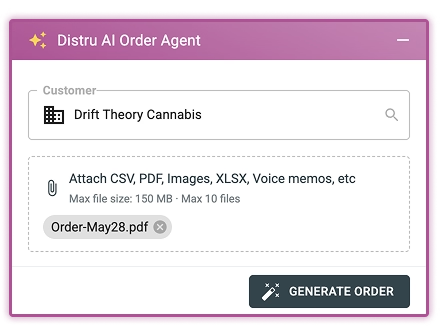
Distru's AI Order Agent lives entirely in the data capture and flagging stages of a related workflow: it turns an incoming order into a structured record and flags anything that won't fill against inventory. It doesn't decide how to resolve a fulfillment problem, that's still your rep's call, reviewed before anything ships. That's the model worth applying to compliance specifically: AI handles the structured front half, a person owns the judgment-heavy back half.
How to Apply This to Your Own Workflow
Take whatever compliance process is eating the most time on your team and map it against these five stages. You'll usually find that most of the actual hours are going into data capture and reconciliation, the stages best suited to AI assistance, while the stages that actually require your compliance officer's judgment are a smaller slice than the workflow feels like from the inside.
A Test Before You Adopt Anything
Ask any tool you're evaluating which of these five stages it actually touches. A vendor who can point to data capture and flagging specifically, and clearly says resolution stays with you, is being honest about where the value is. A vendor who claims to handle "compliance" broadly without that breakdown hasn't thought it through as carefully.
.avif)
A Worked Example Across All Five Stages
Seeing the framework applied to one real situation makes it easier to apply to your own workflow.
The Situation
A package transfer between two locations results in a recorded weight that doesn't match what Metrc shows after the transfer completes.
Capture and Reconciliation
The transfer details get recorded as structured data, and a reconciliation check compares your recorded weight against Metrc's. Both steps are well suited to AI-assisted tools working quickly and consistently.
Flagging
The mismatch gets surfaced to your compliance team the same day instead of waiting for a routine audit weeks later. Still a strong fit for automated flagging.
Investigation and Resolution
Your compliance lead looks into why the weights don't match, maybe a scale calibration issue, maybe a data entry error at the origin location, and decides how to correct the record. Both of these steps need a person who understands the full operational context, and that's exactly where they should stay.
Want to map your own compliance workflow against this framework? Talk to Distru and we'll walk through it with you.