

Supply chain AI has been promised as transformative for a few years running. Some of it actually is. A lot of it is still a slide deck. Here's an honest split, based on what's actually shipping and delivering measurable results versus what's still mostly a pitch.
What's Actually Working
A handful of use cases have moved past the pilot stage and into genuine, repeated production use across supply chain and distribution businesses.
Demand Forecasting From Real Order History
Pattern-matching against historical order data to predict near-term demand is one of the most consistently successful AI applications in supply chain, precisely because it's a structured problem with a clear right answer to check against.

Exception Flagging
Systems that watch inventory, orders, and shipments continuously and surface the handful that need attention, rather than requiring someone to manually scan everything, deliver real, measurable time savings. This works because the underlying task, comparing current state against an expected pattern, is exactly what AI tools are good at.
Turning Unstructured Orders Into Clean Records
Converting a text message, email, or spreadsheet into a structured, usable record is one of the clearest wins across distribution businesses generally, because it removes a genuinely tedious task without requiring judgment the tool doesn't have.
What's Still Mostly Hype
A few categories get outsized attention relative to what's actually deployed and working reliably today.
Fully Autonomous Planning
The idea of an AI system that plans your entire supply chain end to end with no human input sounds impressive in a keynote. In practice, the businesses actually running production systems keep a person reviewing and adjusting at multiple points, because the cost of an unreviewed mistake in a real supply chain is too high to risk on an unproven system.

Autonomous Vendor Negotiation
Despite the pitch decks, real vendor negotiation still depends on relationship history and leverage that isn't fully captured in any dataset. This one shows up in more marketing than actual production deployments.
"Set It and Forget It" Compliance
Any pitch implying a system handles compliance completely on its own, with no review needed, deserves real skepticism, especially in a regulated industry. The businesses that have adopted AI most successfully in compliance-adjacent workflows kept a defined human review step, not because the tool wasn't good, but because the stakes of an unreviewed mistake are too high.
Why This Distinction Matters for Cannabis Specifically
Cannabis operators evaluating software vendors should apply the exact same skepticism the broader supply chain industry has already learned to apply. If a pitch sounds like the hype category, fully autonomous, no review needed, that's worth extra scrutiny rather than extra excitement.
A Working Example of the "Actually Working" Category
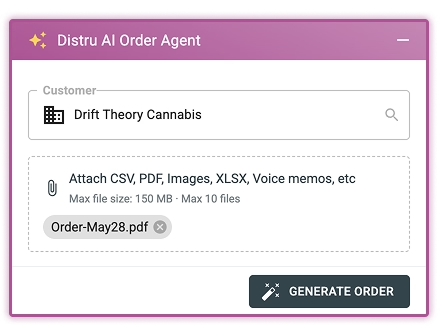
Distru's AI Order Agent sits squarely in the proven category: turning unstructured orders into clean, structured sales orders and flagging fulfillment issues against inventory. A rep reviews it before anything ships. Customers using it save 40+ hours a week, which lines up with the kind of results the broader supply chain industry has seen from this specific use case, not the more speculative ones.
How to Apply This When Evaluating a Pitch
Ask which category a vendor's AI feature actually falls into: forecasting, exception flagging, structured data entry, or one of the hype categories. If they can't place it clearly, or if it sounds too good to be true relative to what the broader industry has actually proven out, treat that as a signal to dig deeper before committing.
Why the Hype Persists Anyway
If the hype categories aren't real yet, it's worth understanding why they keep showing up in every vendor's pitch regardless.
Ambitious Claims Are Cheap to Make
Describing a fully autonomous system in a slide deck costs nothing. Building one that actually works reliably on messy real-world data, with the trust of a compliance-heavy buyer, is a much harder and slower problem. The gap between the pitch and the product is where most of the disappointment in this space comes from.

Proven Categories Sound Less Exciting
"We flag discrepancies for your team to review" is a less thrilling sentence than "our AI runs your supply chain autonomously." It's also the sentence that's actually true for most working systems today. Don't let the less exciting framing make you undervalue what's actually delivering results.
Want to see a proven use case applied to your own operation? Schedule a demo with Distru.


