

It's Tuesday morning. Your production manager is trying to answer one question: how many units can we ship this week?
To get that answer, they open Metrc. Then QuickBooks. Then the order spreadsheet. Then they call the warehouse to confirm what's actually on the shelves.
Forty minutes later, they have a number. Maybe.
That's the problem cannabis ERP software solves. Not the question itself, the 40 minutes it takes to answer it.
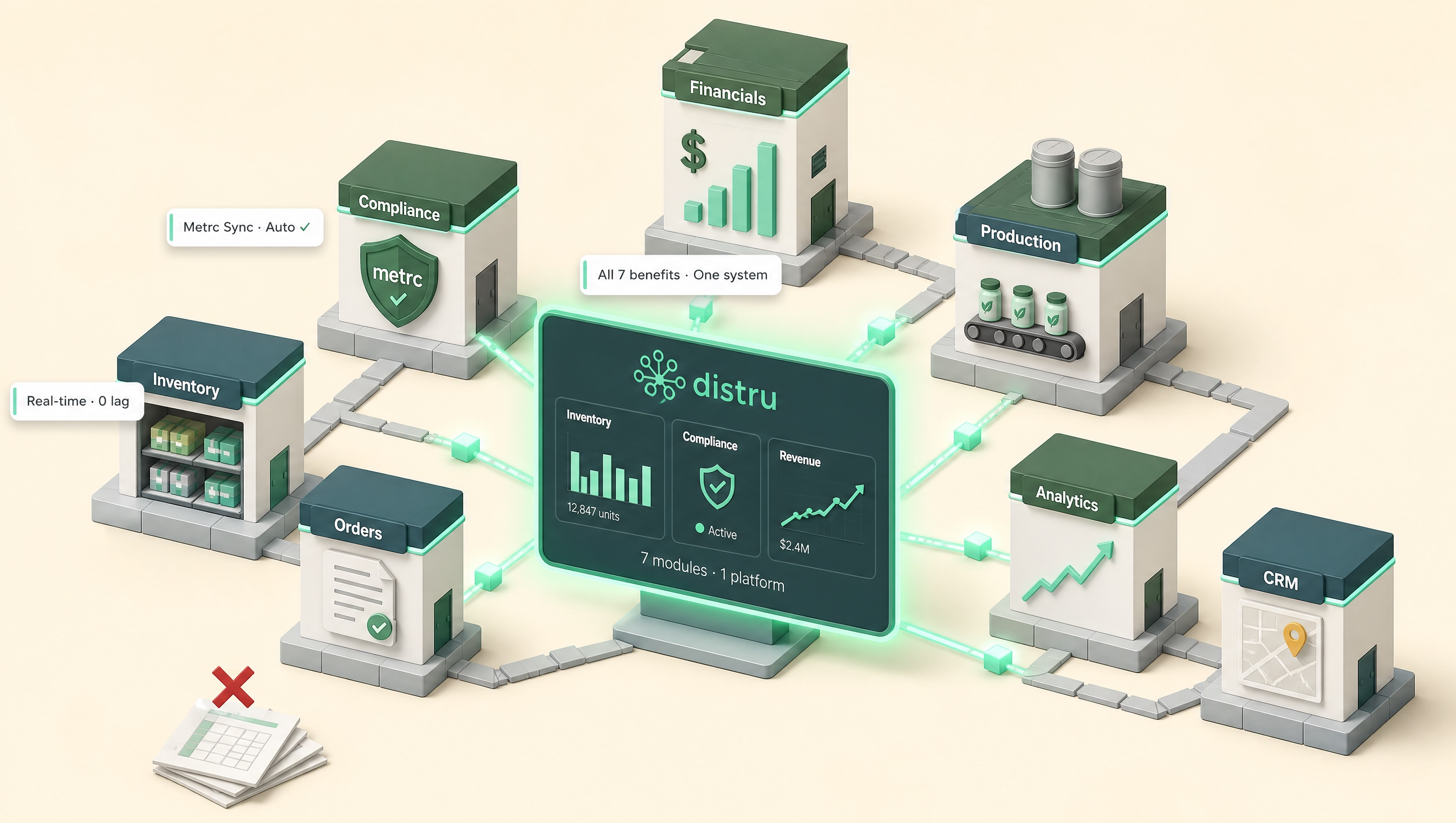
Cannabis ERP (Enterprise Resource Planning) is the category of software that consolidates your core operations into one system. For cannabis businesses, that means inventory, compliance, production, sales, and financials all living in the same place: connected, synchronized, and visible in real time.
Here are the seven benefits that matter most in 2026.
1. Real-time inventory visibility across every location
Most cannabis operators track inventory across some combination of Metrc, a spreadsheet, and their own memory. The numbers don't always match. Cycle counts are a production stoppage every time. And nobody knows for certain whether the batch of pre-rolls in warehouse B is allocated to an order or still available.
A cannabis ERP tracks inventory live. Bin-level, batch-level, with FIFO (first-in, first-out) enforcement built in. When product moves: from production into finished goods, from the shelf onto a delivery manifest, the system updates automatically.
Distru, a cannabis ERP platform built for licensed operators, tracks inventory with barcode scanning, batch tracking, and shelf-level granularity across multiple warehouse locations. Virtual Metrc locations are tracked separately without creating a reconciliation problem.
The result is one accurate number. Not three different numbers depending on which system you check first.

2. Compliance that runs in the background
Every cannabis operator in a regulated state has to report to Metrc or BioTrack. That means logging plant actions, creating packages, recording transfers, and filing manifests. All with specific timing requirements. Get it wrong and you're looking at a compliance notice, a fine, or worse.
The manual version of this workflow means entering data twice: once in your operational system, once in Metrc. It creates lag. It creates errors. And it puts your compliance accuracy at the mercy of whoever happened to be in a hurry that afternoon.
A cannabis ERP with live Metrc integration eliminates the double entry. When you create a package in your ERP, it pushes to Metrc. When a transfer is recorded, the manifest is built automatically. You stay compliant without making compliance a separate full-time job.
Distru pings Metrc between 3 and 40 times per second to maintain real-time sync. The practical result: your operations team only needs to touch Metrc directly for three actions. Accept a package. Transfer a package. Register a manifest. Everything else flows through Distru.
That's not a small thing. For a busy distribution operation, this difference runs to 150–200 hours per month.
.avif)
3. COGS and margin visibility by SKU
Here's what most cannabis operators don't actually know about their business: what their products cost to make.
Not ballpark. Not "roughly what we spent on inputs." The real cost per unit: accounting for labor, packaging, waste, and overhead, tracked live as production happens.
This gap hurts most at tax time. Section 280E of the Internal Revenue Code disallows standard business deductions for cannabis companies, which makes COGS tracking your primary lever for reducing taxable income. If you're not tracking COGS accurately at the SKU level, you're either overpaying taxes or building audit risk.
A cannabis ERP tracks cost accounting as inventory moves through your facility. The moment raw materials enter a work order, the cost starts accumulating. By the time you're looking at a finished SKU, you know exactly what it cost to produce, and what margin you're actually making when you sell it.
Distru tracks standard versus actual cost variances, so you can see where production is running over budget in real time. You can build a new BOM and see projected COGS before you ever go to market with a product. That's the kind of visibility that turns production decisions from gut calls into data-backed ones.

4. Production management that connects inventory to output
You know you have materials in stock. You know you have orders to fill. But do you know exactly how many units you can produce today based on what's actually available?
Most operators don't, not without pulling that number manually from multiple sources.
A cannabis ERP connects your inventory to your production planning. Bills of materials (BOMs) pull from live inventory. When you schedule a work order, the system tells you how many units you can make with what's on hand, what's running low, and what's incoming on purchase orders.
Distru shows possible production quantities based on current inventory levels, with low-stock alerts and incoming PO visibility. Your production team stops guessing and starts scheduling against real numbers.
This matters especially for manufacturers running multiple SKUs with shared inputs> a concentrate producer making several vape formulations from the same distillate supply, for example. The material planning view shows you exactly how to allocate materials across pending work orders. No spreadsheet required.
5. Wholesale ordering without double entry
If you're selling wholesale: as a brand, a manufacturer, or a distributor, you're probably running at least two separate systems: your operational ERP (or Metrc plus spreadsheet equivalent) and some kind of ordering tool.
The problem is they don't talk to each other. A dispensary places an order on your menu. Someone on your team manually enters that order into your fulfillment system. Your menu still shows the old inventory level. Buyers can't see accurate availability. That's the double-entry problem, and it costs more time than most operators realize.
A cannabis ERP with a native wholesale marketplace fixes this at the source. When your inventory updates in the ERP, your buyer-facing menu reflects it immediately. When an order comes in, it flows directly into your fulfillment queue. The order doesn't get typed twice.
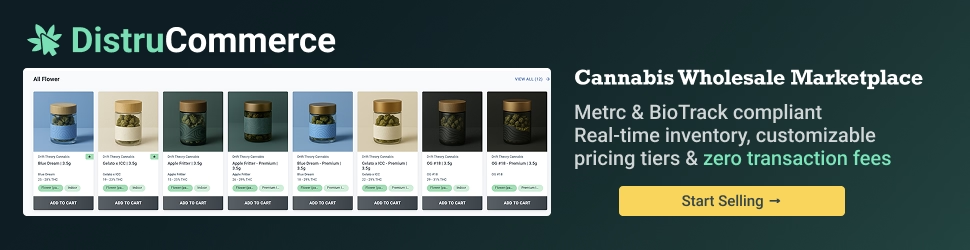
DistruCommerce, Distru's wholesale marketplace, is built natively into the ERP. Menus auto-populate from live inventory. Orders from dispensaries drop directly into your pick-and-pack workflow. Your sales team processes more orders in less time, and buyers get accurate, real-time availability.
6. Financial operations tied to your actual inventory
Your accounting system is only as accurate as the data going into it. For most cannabis operators, someone is manually creating bills and invoices to match what happened in operations, usually a day later, sometimes a week.
A cannabis ERP with accounting integration closes that gap. When you create a purchase order in your ERP, it automatically creates a corresponding bill in QuickBooks. When an invoice is fulfilled, it syncs. Your accountant works from the same data your operations team does, without anyone transferring it manually.
For cannabis specifically, this also matters for 280E documentation. Your COGS records need to be airtight. When production costs flow automatically into your financial records, that documentation is there without anyone reconstructing it at year-end.
Distru syncs with QuickBooks Online and Desktop, and maintains AR and AP dashboards so your finance team can see aging accounts and outstanding balances without leaving the platform. When you create a purchase order in Distru, it automatically creates a bill in QuickBooks. Distru becomes your source of inventory and your source of cost accounting, in sync, all the time.

7. Scalability for multi-location and multi-state growth
Most cannabis operators don't start with an ERP. They start with Metrc, a spreadsheet, and QuickBooks. That works fine until it doesn't.
The problem with building your operation on disconnected tools is that you migrate when you're at your busiest. Adding a second license doubles the complexity of a system already held together with manual processes. Adding a state means learning a new Metrc environment while keeping the first one running.
The cost of switching later is real. It's not just the time and money of implementation; it's the operational risk of running a transition on top of a live business.
A cannabis ERP lets you start with what you need today and expand as complexity grows. Distru supports multi-location inventory, multi-state MSO operations, and modular feature adoption. Operators who started on a single license are now running five-state MSO operations on the same platform.
The right time to get on an ERP is before you need it badly. Because when you need it badly, the last thing you want is to implement new software.

Is cannabis ERP right for your operation?
Here's a quick self-check. If more than two of these are true, you've outgrown your current setup:
- You can't answer "what's our current inventory?" without pulling from multiple systems
- Your Metrc records and internal records don't always match
- You don't know your true cost per unit on your top SKUs
- You're entering the same data in two or more places regularly
- Your accountant is pulling data manually to reconcile financials
- You have more than one location and can't see across them in real time
Distru's average onboarding timeline is 3 to 4 weeks. The platform serves 440+ customers across 30+ states, and operators save 2,000+ hours annually.
You can read more about what cannabis management software should actually do for your operation before you start evaluating vendors.
Not sure if it's the right fit? Book a discovery call with Distru. We'll walk through your current workflow and be straight with you about whether it makes sense.