

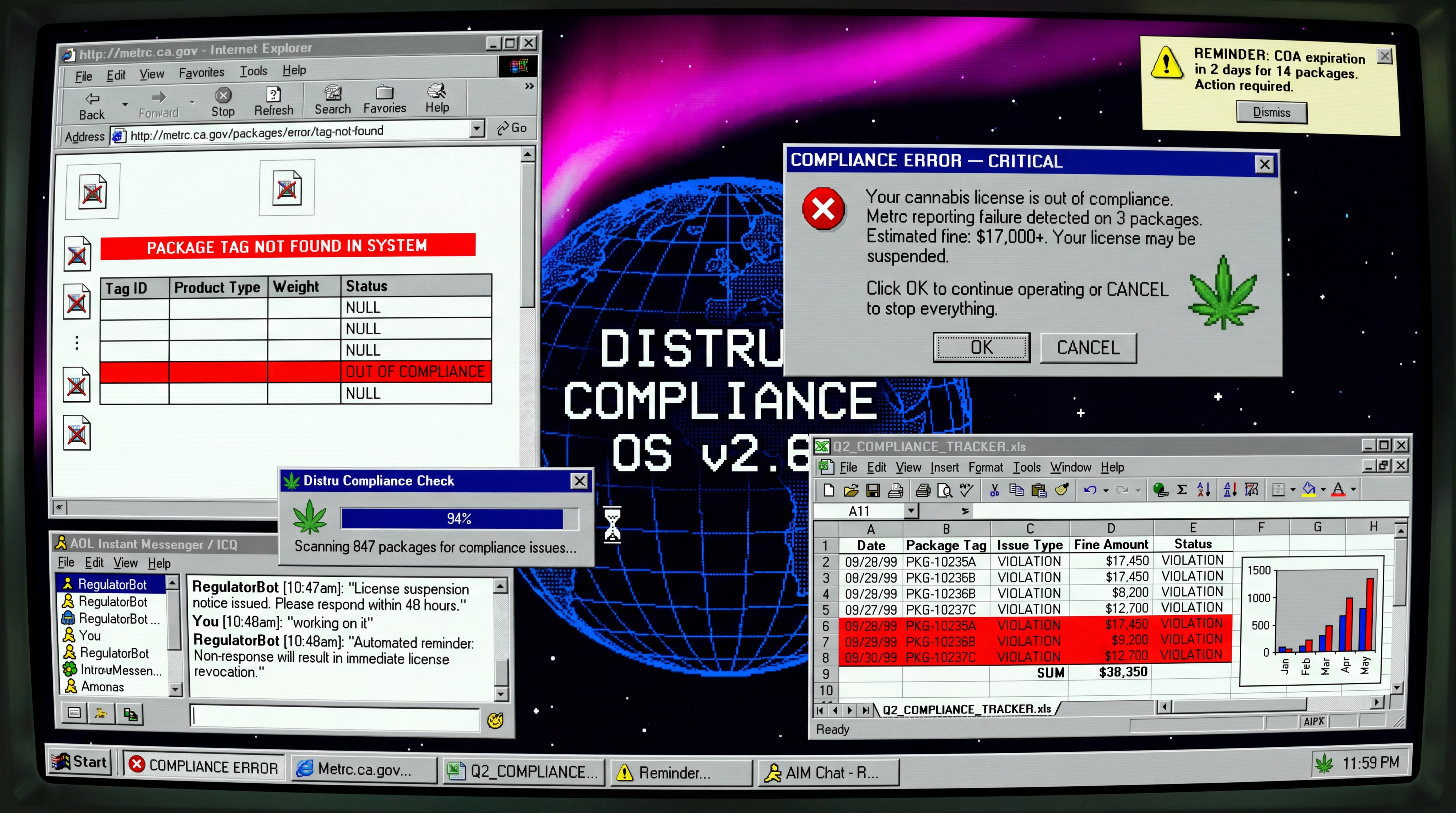
You're running a tight operation. Plants are tagged, transfers are logged, and your team knows the rules. Then a state inspector walks in, and two hours later you're staring at a notice of violation for a Metrc inventory discrepancy you didn't even know existed.
That's what being out of compliance actually looks like in cannabis. It's not always a dramatic failure. Sometimes it's a data entry error from three weeks ago that snowballed into a 4% inventory variance. Sometimes it's a label that missed one required field. Either way, the clock starts ticking the moment the regulator finds it.
This article breaks down what "out of compliance" means for licensed cannabis operators, the most common triggers, what the real penalties look like in 2024 and 2025, and what you can do to stay ahead of it.
What "Out of Compliance" Means in Cannabis
Out of compliance means your business operations or products have failed to meet the regulatory requirements set by your state's cannabis licensing authority. Those requirements cover almost every part of your business: cultivation, manufacturing, distribution, retail, testing, tracking, packaging, and advertising.
The term is broad by design. A single Metrc tag error and a multi-year pattern of diverting unlicensed product both fall under "out of compliance." That's why regulators use a tiered enforcement system, ranging from written warnings and corrective action plans all the way to license revocation and criminal referrals.
The critical thing to understand: your compliance status isn't just your problem. If you're a distributor or manufacturer, an out-of-compliance finding can freeze your transfers, block your retailer's inventory, and damage relationships you've spent years building. Compliance runs downstream.
The Most Common Compliance Violations in Cannabis
1. Metrc and Seed-to-Sale Tracking Errors
Track-and-trace violations are the single biggest source of enforcement actions in most states. According to MJBizDaily, U.S. cannabis regulators issued nearly 2,500 violations in 2024, resulting in $10.8 million in fines. Nearly half of those violations were tied to track-and-trace errors.
The most common Metrc failures include:
- Inventory discrepancies between physical counts and Metrc records
- Late or missed transfer manifests for outbound shipments
- Improper waste documentation. Not logging destruction events correctly
- Duplicate entries or wrong-tag transactions that throw off package totals
- Incorrect receiving records that don't match the incoming manifest
Most states treat a variance above 2-3% of total tracked units as a red flag. A discrepancy above 5% in a single audit cycle can trigger license suspension or a mandatory corrective action plan.

2. Packaging and Labeling Violations
Packaging is one of the most technically detailed areas of cannabis regulation, and it changes constantly. States require specific disclosures, specific font sizes, specific warnings, and child-resistant packaging standards. Missing a single required field on a label can trigger a product recall, a fine, or a stop-sale order.
Common labeling violations include:
- Missing or incorrect THC/CBD potency disclosures
- No CoA batch number or QR code link where required
- Improper serving size callouts on edibles
- Labels that don't match what's in Metrc (SKU mismatch)
- Using unapproved health claims
In 2024, the California Department of Cannabis Control issued 366 disciplinary actions against licensees, including 230 license suspensions and 73 license denials or revocations. A significant share of those were tied to product labeling and packaging failures.
.avif)
3. Testing and Product Quality Violations
Cannabis products must pass third-party laboratory testing before they can be sold. Selling untested product, selling product that failed testing, or misrepresenting test results are all grounds for serious enforcement action.
Florida regulators fined Ayr Wellness $2.43 million in 2024 for distributing unapproved "seeded flower" product that hadn't cleared proper testing. In California, a cultivator was fined $350,000 after regulators found evidence of banned pesticide use and an attempt to conceal it.
Your CoA isn't just a formality. It's the paper trail that connects your product to a tested batch. If it's wrong, missing, or attached to the wrong SKU, you're exposed.
4. Licensing and Authorization Violations
Operating outside the scope of your license is one of the fastest ways to trigger severe penalties. This includes:
- Selling product categories not covered by your license type
- Conducting transfer or distribution activities without the proper license endorsement
- Failing to renew a license before expiration and continuing to operate
- Adding new locations or activities without regulatory approval
New Mexico regulators revoked the licenses of two grow operations and imposed $1 million fines on each after finding multiple violations including exceeding plant count limits and failing to maintain proper inventory tracking.
5. Security and Surveillance Failures
Every licensed cannabis facility must maintain specific security infrastructure. That means functioning cameras covering all access points and storage areas, visitor logs, employee badging, and alarm systems. States conduct inspections and review camera footage during audits. A dead camera over a storage room door is a violation.

What Happens When You're Found Out of Compliance
Regulators don't treat every violation the same. The severity of the response depends on the nature of the violation, whether it's a first offense, and whether there's evidence of intent.
Here's the general escalation path:
Written warning or notice of violation. You receive formal notice that a violation was found, with a deadline to respond or cure it. This is common for first-time, minor violations.
Corrective action plan (CAP). You're required to submit a documented plan showing how you'll fix the problem and prevent it from recurring. CAPs are standard for inventory discrepancies, documentation failures, and labeling issues.
Administrative fine. For inventory discrepancies, first-offense fines typically run $1,000 to $10,000 depending on the state and size of the variance. Repeat violations escalate quickly: second and third offenses can carry fines of $10,000 to $50,000. When you add legal fees, consultant costs, and lost revenue from operational disruptions, the average violation costs around $12,700 with serious cases exceeding $170,000.
License suspension. The regulator puts your operations on hold while an investigation continues. This can freeze your ability to make transfers, sell product, or receive inventory.
License revocation. Your license is canceled. In most states, revocation bars you from applying for a new license for a specified period.
Criminal referral. In cases involving intentional diversion, falsified records, or sales to minors, the matter can be referred for criminal prosecution.
A Metrc compliance violation doesn't stay contained to one finding. When regulators find one issue, they often expand the audit scope. One tracking error can open a review of your entire operation.
How to Get Back into Compliance
If you've received a notice of violation or discovered a discrepancy before a regulator did, here's the practical path forward.
Acknowledge the problem in Metrc
Don't ignore inventory variances hoping they'll resolve. Make the adjustment in Metrc using the correct reason code, and document why the discrepancy occurred. Regulators want to see a clear, auditable record. A well-documented adjustment shows good faith. An unexplained discrepancy looks like concealment.
Conduct a full physical inventory count
Don't estimate. Count every package in every location, compare it against your Metrc records, and document the date and the counters. For significant discrepancies, use a second counter to verify. Most state regulations require physical counts at specific intervals. Doing them proactively, before an inspection, gives you time to reconcile before anyone is watching.

Review your SOPs
Most compliance failures trace back to a gap in standard operating procedures. Someone didn't know how to log a waste event. Someone recorded a transfer quantity by rounding instead of weighing. Build the correct steps into written SOPs, train your team on them, and document the training.
Respond to your CAP on time
If you've received a corrective action plan requirement, don't miss the deadline. Late responses or incomplete documentation escalate the enforcement action. Treat the CAP as seriously as the original violation.
Bring in a compliance consultant if needed
For serious violations, especially those involving multiple findings or impending hearings, work with a licensed cannabis compliance attorney or consultant. The cost is far less than a suspension.
How Distru Helps Operators Stay Compliant
Most compliance violations don't come from operators who don't care. They come from operators running manual processes that can't keep up with the volume, speed, and complexity of cannabis regulations.
Distru, a cannabis ERP platform built for licensed operators, is built specifically to eliminate the gaps where violations happen.
Real-time Metrc sync. Distru's Metrc integration pings the state system 3 to 40 times per second, pushing every transfer, adjustment, and production event in real time. You're not waiting for a nightly batch sync to find out something didn't post. Distru is the #1 Metrc integration partner by API call volume. When your Metrc records match your physical inventory, you don't have discrepancy problems.
Inventory management with audit trails. Every movement in Distru's inventory management system is logged with a timestamp, a user, and a reason. When a state auditor asks for your transaction history, you can produce it in minutes.
Label compliance tools. Distru generates compliant labels tied to specific Metrc packages and SKUs. When your label matches your Metrc record and your CoA, you've closed the loop that trips up most operators.
BOM and production tracking. For manufacturers, Distru's bill of materials and production management features track every input and output in a batch. You know exactly which raw materials went into which finished SKUs and which batch numbers appear on which CoAs.
More than 700 active operators across multiple U.S. states use Distru to manage over $10 billion in processed wholesale sales. The platform's 99% customer support satisfaction rating reflects the reality that most compliance questions get answered fast, before they become violations.
The Real Cost of Non-Compliance
It's worth naming what's actually at stake.
A single packaging violation might cost $5,000 to $15,000 in fines. A Metrc discrepancy investigation might cost $10,000 to $50,000 in fines, plus 40 to 80 hours of staff time to reconcile records, respond to the regulator, and update your SOPs. A license suspension can cost you weeks of revenue. A revocation can end your business entirely.
More quietly, compliance problems damage your B2B relationships. Retailers don't want to carry product from a flagged operator. Distributors won't move your product if your transfers can't clear Metrc. Your reputation in the supply chain is tied to your compliance record.
The Cannabis Business Times reports that California regulators are actively pushing for tighter penalties and more frequent inspections. Other states are following the same trajectory. The regulatory environment is getting stricter, not looser.
Common Questions About Cannabis Compliance
What's the difference between a warning and a violation?A written warning is usually issued for a first-time, minor infraction with no evidence of intent. A formal notice of violation triggers a response requirement and becomes part of your license record. Repeated warnings in the same area can escalate to formal violations.
Can I self-report a compliance issue before an inspection?Yes, and in most states, self-reporting is viewed favorably. It demonstrates good faith and often results in reduced penalties. If you find a discrepancy, document it, fix it in Metrc, and report it according to your state's self-disclosure protocol before your next inspection.
How long does a compliance violation stay on my record?This varies by state. In most jurisdictions, violations remain on your license record for 3 to 5 years and are reviewed during renewal. Multiple violations in that window can affect your renewal approval.
Does a violation in one state affect my license in another?Not directly, but multi-state operators should be aware that regulatory agencies in some states conduct background checks that include out-of-state compliance history.
Stay Ahead of Compliance Issues
Cannabis regulations aren't getting simpler. States are adding product categories, tightening testing standards, expanding track-and-trace requirements, and increasing the frequency of inspections. Being out of compliance once is survivable. Being out of compliance repeatedly is a business risk you can't afford.
The operators who stay clean are the ones who've built compliance into their daily operations, not their quarterly reviews. That means real-time tracking, documented procedures, trained staff, and technology that closes the gap between what's in your facility and what's in your state's system.
If you want to see how Distru handles Metrc compliance, inventory tracking, and audit documentation for licensed operators, request a demo.