

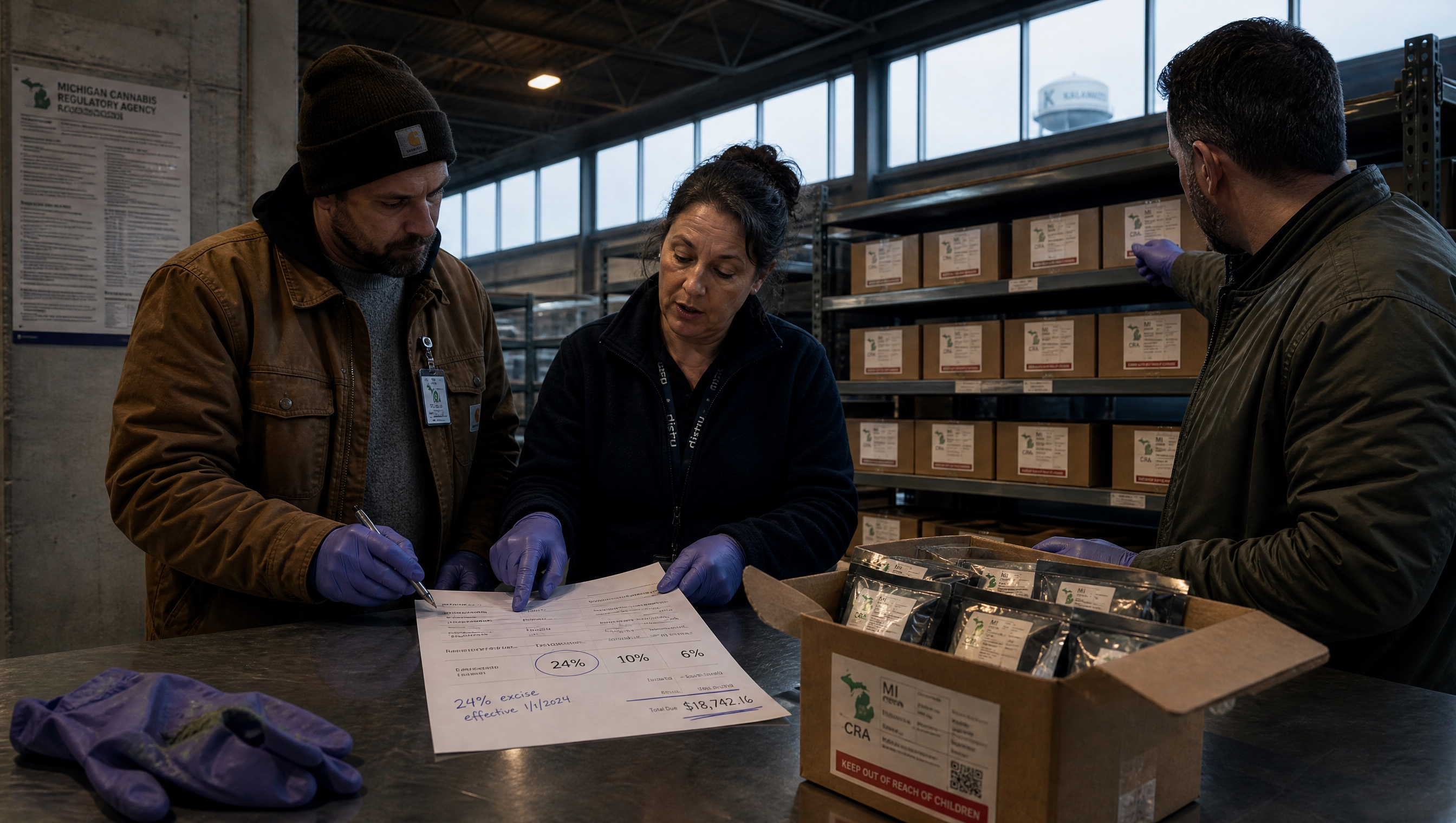
January 1 wasn't just the start of a new year for those of us in the Great Lakes State. On the first day of 2026, the Michigan cannabis wholesale tax kicked in at 24%. But looking at that number alone is like opening a house pre-roll and expecting top-shelf flower. Once you get past the paper, the reality is a lot messier.
First off, we're dealing with an ambiguous definition of the "wholesale price" being taxed. Then, we have the other taxes (10% retail excise and 6% sales) that the new one stacks on top of, which leaves us with an effective burden that goes way beyond 24% and lands closer to 40-50%.
The market is already feeling the squeeze. Sales in Q1? Dropped. And on the legal front? A battlefield. Lawsuits are flying through multiple courts. Even a repeal has been filed.
Amid all this uncertainty, we created this guide to help you make sense of the chaos. Let's break down who pays the tax, how to calculate the real cost, and what you need to do to keep your head above water while the lawyers fight it out.

What Is Michigan's Wholesale Cannabis Tax?
To understand where this new financial burden comes from, we have to look at the Complete Road Funding Tax Act (CRFTA). Cannabis is the primary target of this legislation, which is also known as House Bill 4951. While Governor Whitmer signed it on October 7, 2025, it wasn't exactly a landslide victory. The Senate passed it with a razor-thin 19–17 vote.
Why did this happen? Put simply, the state needed a way to fund road and bridge repairs, and they saw the adult-use cannabis market as an ideal piggy bank. Passing the CRFTA, which is part of a broader $81 billion budget, became the most politically viable path to secure $420.7 million annually without raising gas or income taxes. This money fuels an annual $1.8 billion plan to improve local infrastructure.
The tax took effect on January 1, 2026. You owe it on the first sale or transfer to a retail licensee or the first sale of the cannabis you cultivate, produce, and sell yourself directly to customers. For example, if you're a grower who sells bulk flower to a processor to make edibles, no tax is due yet. The tax only triggers when that product moves to a retailer.
Since this is a wholesale excise tax rather than a retail sales tax, it doesn't appear on the customer receipt. Instead, it stays hidden in the base price. Retailers don't pay the state directly, but as you adjust your pricing to cover the cost, the financial weight flows downstream to them, and ultimately, the consumer.
While Michigan's 24% wholesale cannabis tax officially targets adult-use, a dual-license transfer from a medical facility to an adult-use retail establishment is also taxable.
For standard sales between unrelated parties, the tax is on the actual price paid. But if you run a vertical operation or a microbusiness, you must use the "average wholesale price" that the Treasury publishes every quarter.
.avif)
Our Tax Calculator Helps Michigan Cannabis Operators Save Time & Stay Compliant
Talk with a Michigan Cannabis Expert Today
Who Actually Pays the Michigan Cannabis Wholesale Tax?
In the eyes of the Treasury, the responsibility falls on the wholesaler. Specifically, the tax is imposed on the marihuana establishment that makes the first sale or transfer of product to a retail licensee.
Under the law, you have to pay this tax if you're a:
- Cultivator selling flower or trim directly to shops.
- Processor selling finished goods like gummies or carts to retailers.
- Microbusiness or vertically integrated operator bringing your own produced goods into retail.
- Medical provisioning center transferring inventory over to an adult-use retail license.
The government expects this money the moment the transaction happens. You owe the tax even if the buyer hasn't paid. If you're operating on net-30 or net-60 terms, you're essentially fronting the tax for the state while you wait for your invoice to clear. It's a massive cash flow gap that can kill your business if you aren't watching your margins closely.

The Real Tax Burden: Why 24% Isn't the Whole Story
If you thought the 24% number was the end of the conversation, we have some tough news. On paper, it looks like a standard flat fee, but once you get into the actual implementation, it starts to look a lot more like a puzzle.
The Recursive Definition Problem
There's a huge disconnect between the literal language of the law, the Treasury's guidance, and the economic reality you face every day.
The issue stems from a "circular" or recursive definition in the CRFTA. The fine print says that "wholesale price" includes "any tax, fee, or other charge" reflected on your sales documentation, whether that's an invoice, a bill of sale, or a PO. Many industry experts argue that this creates a "tax-on-tax" scenario where the 24% is applied to a base that already has the tax baked in.
To understand how Michigan's cannabis wholesale tax would work if the literal wording of the law were to be followed, let's look at the math. Most people assume that if a product costs $100, a 24% tax simply adds $24. But if you need to keep exactly $100 to pay your staff and cover your operating costs, you cannot just charge $124. If you do, the state takes 24% of that $124 total, which is $29.76. After paying that, you're left with $94.24, meaning you just lost $5.76 of your own capital.
To end up with exactly $100 after the 24% tax is applied, you need to calculate the total price that leaves $100 remaining. Since you keep 76% of the total amount, you divide the target amount by 0.76.
- $100 ÷ 0.76 = $131.58
- 24% of $131.58 = $31.58
- $131.58 − $31.58 = $100 remaining to the seller.
Because you'd have to add $31.58 to your price just to stay even, the effective rate on your $100 product (and the reality required to protect your bottom line) jumps to roughly 32%. That's the gap everyone is talking about.
Treasury says the tax shouldn't be pyramided this way and must be excluded from the taxable base. For example, if you sell goods for $4,000 and add a $960 tax charge, you only owe 24% on the original $4,000. However, many see this guidance as a temporary patch. A state agency can't legally override the specific wording of a law passed by the legislature, and right now, that law doesn't offer an exception for the wholesale tax itself. This "32% vs 24%" debate is easily one of the hottest legal disputes in the state right now.

How the Layers Stack
Recursive math isn't the only hurdle you have to clear. This new levy isn't replacing the old ones but sitting right on top of them. You now have to manage three separate layers that eat away at the final sale price.
This stacking of Michigan's cannabis taxes means the wholesale tax hits before the 10% retail excise and 6% sales tax are even calculated, forcing consumers to pay sales tax on a price already inflated by the wholesale level. Here's how those compounding charges turn a $100 wholesale product into a $150+ price tag at the register.
Michigan's Cannabis Tax Structure in 2026:
| Tax Layer | Rate | Who Pays | Notes |
|---|---|---|---|
| Wholesale excise tax (new) | 24% / ~32% | Wholesaler | Recently passed tax. Recursive definition inflates effective rate to ~32% |
| MRTMA retail excise | 10% | Retailer | Original excise from the 2018 legalization act; collected at point of sale |
| Michigan state sales tax | 6% | Consumer | Collected by retailer; applied at point of sale |
| Combined effective burden | ~40–51% | Distributed | Varies by transaction structure |
The state recently shifted from being a relatively tax-friendly market to having one of the highest effective rates in the country. To put that in perspective, Michigan's cannabis tax burden now dwarfs the 25–35% caps seen in most other legal markets. Such a high percentage puts a massive strain on your ability to compete with the illicit market, where these layers don't exist.

How the Wholesale Price Is Calculated
How you do business with your buyer dictates the math you'll need to reach a final number. To keep your books clean, you have to figure out if a sale is a standard market deal or just an internal transfer, as the calculation for Michigan's wholesale price changes depending on who's getting the product.
Arms-Length Transactions
If you're selling to an unaffiliated business, the process is straightforward. You calculate the tax based on the actual price paid by the retail licensee to acquire the cannabis. This amount includes every fee or charge listed on the invoice, though, as mentioned, current guidance from Revenue Administrative Bulletin 2026-3 suggests you can exclude the 24% wholesale tax itself.
Just keep in mind that you cannot lower your taxable base through rebates, trade allowances, or exclusivity discounts. Use your final invoice price as the starting point for your calculation.
Affiliated and Vertically Integrated Operators
If you're moving inventory between related entities or within a vertically integrated operation, the calculation for Michigan's cannabis tax is a bit more intricate. You can't simply use your internal costs or the amount on the invoice. Instead, Treasury wants you to go by the average wholesale price they put out every quarter.
For Q2 2026 (April through June), Treasury has set the following benchmarks:
- Flower: $629.39 per pound
- Concentrate: $2,076.18 per pound
- Infused Edibles: $34.79 per pound
- Infused Liquids: $0.36 per fluid ounce
The main problem here is the rigid nature of these numbers. If your actual internal transfer cost sits below the average, you still owe tax on the higher published figure.
Compliance Requirements and Payment Deadlines
To keep the state off your back, you'll need to file quarterly based on your actual business activity, following the payment schedule for Michigan's cannabis wholesale tax established for this transition year.

2026 Payment Schedule
The wholesale tax is due in the same quarter the product is sold or transferred to a retailer. For 2026, you must submit your payments by the 20th of the month following the quarter's end. Here's what that looks like on the calendar:
- Q1 (Jan 1 – Mar 31): Due April 20
- Q2 (Apr 1 – Jun 30): Due July 20
- Q3 (July 1 – Sept 30): Due October 20
- Q4 (Oct 1 – Dec 31): Due January 20, 2027
On January 20, 2027, you must file your full annual return for all of 2026. This is where you settle any remaining balance from the year, alongside your Q4 payment.
One thing to keep in mind: Treasury is offering a one-time safe harbor to help with the transition. If you cover at least 75% of your total liability during those first three quarters and pay the rest by January, the state will waive all penalties and interest.
Important Considerations
All wholesalers, including growers and processors, must register for this tax through the Michigan Treasury Online (MTO) portal. But registration is the easy part. The real challenge is the immediate drain on your available cash.
As mentioned, this tax is triggered when ownership changes, whether you've been paid or not. In most industries, you can write off bad debt if a customer fails to pay. You don't get that luxury here.
If you sell $10,000 of flower on net-30 terms, you owe the state $2,400 the moment the truck leaves your dock. If the retailer goes bust before they pay you, you're still legally obligated to pay that $2,400 out of your own pocket.
A physical return of the products is the only exception. If the goods are returned in saleable condition (typically within 180 days), you can claim a credit on your next quarterly return. However, you must still pay the tax upfront for the quarter in which the sale originally occurred.
Beyond the immediate financial hit, there's a significant regulatory risk. Since the Treasury and the Cannabis Regulatory Agency (CRA) now share data, "Treasury clearance" has become a mandatory part of the renewal process.
If you're more than one year delinquent on your wholesale tax payments, the CRA cannot renew your license. A missed payment in April 2026 that remains unpaid by April 2027 will effectively shut down your entire operation.
.avif)
Legal Challenges: Two Lawsuits, a Repeal Bill, and What It Means for Operators
This new levy is currently under heavy fire. Between a pair of major lawsuits and a bipartisan push for a full repeal, the industry is fighting back on multiple fronts. This ongoing legal challenge to the Michigan cannabis tax can change the rules we're dealing with today before the year is out.
These are the specific legislative moves you need to watch:
Lawsuit #1 The Legislative Process Challenge
The Michigan Cannabis Industry Association (MiCIA) and a co-plaintiff filed this suit in the Court of Claims, and it has since moved through the Court of Appeals. The Michigan Supreme Court recently stepped in, ordering an expedited review to settle the matter quickly due to the high stakes for the industry.
The legal argument centers on the fact that the 2018 MRTMA was a voter-initiated law, and under the Michigan Constitution, the legislature needs a three-fourths supermajority to change it. However, HB 4951 passed with a simple majority, so the plaintiffs are calling foul, saying the wholesale tax was implemented illegally.
The state's defense is a bit of a technicality. Government lawyers are claiming that this isn't actually a marijuana law but a "road-funding" legislation that just happens to involve cannabis. The idea is that if it's labeled as a funding bill, it only requires a simple majority to be valid.
Lawsuit #2 The Constitutional Tax Challenge
Filed on March 27, 2026, by the MiCIA, a grower, a retailer, and a customer, this second lawsuit focuses on tax pyramiding. The complaint points out that the 24% wholesale tax is basically acting as a sales tax, which is a problem because the Michigan Constitution caps it at 6%.
Since the wholesale tax gets added to the price before the retail sales tax is applied, the final bill for the consumer ends up way over the constitutional limit. To put it in perspective, a purchase that used to be $116 now hits $143.84 with this new levy.
The lawsuit also challenges the average wholesale price methodology used for related or vertically integrated businesses. Most people in the industry agree that taxing affiliated companies based on a state-wide average while taxing unaffiliated businesses on their actual price violates the Equal Protection Clause. This creates a messy system where two businesses move the exact same product but face wildly different tax bills just because of their corporate structures.
Senate Bill 810 The Repeal Effort
Senator Jonathan Lindsey introduced SB 810 on February 26, 2026, with a bipartisan group of co-sponsors, including Jeff Irwin. This bill has one clear goal: to completely repeal Michigan's cannabis tax at the wholesale level.
If passed, the legislation would strike down Public Act 23 of 2025 and eliminate the CRFTA framework for the industry. While the bill represents a significant legislative pushback, it must still clear the committee process and gain enough support to reach the Governor's desk.

What Operators Should Do
As these legal and legislative battles play out, you shouldn't assume a repeal is guaranteed. Since no injunctions have been granted, the tax remains in full force. This means you must keep up with your quarterly payments to stay in good standing with the CRA and protect your license.
Even so, you should talk to your legal counsel about preserving your right to a refund in case the courts strike down the tax later. Since the first round of payments was due back on April 20, 2026, many companies have already started filing "payments under protest." Including this specific notice with your check can help you secure a full refund if any of these lawsuits eventually win.
How Michigan's 24% Wholesale Tax Is Impacting Operators Right Now
The implementation of the new levy has sent shockwaves through the industry, and the data from early 2026 confirms a historic downturn. While a seasonal dip is usually expected after the holidays, the most recent decline was twice as sharp as we've seen in the past.
In December 2025, the market saw sales of approximately $269.3 million. By January 2026, sales plummeted to $226.4 million. This 15.89% drop represents the largest month-over-month decline since adult-use was legalized.
When you look at how the Michigan cannabis market is performing in 2026 compared to January of last year, sales are down 8.2%, signaling a structural contraction rather than a temporary trend.
But to understand how Michigan's 24% cannabis tax affects operators, you have to look beyond just the sales figures. This triple-tax burden is forcing drastic cuts to keep businesses solvent.
Specific cases highlight a heavy human cost. Higher Love Cannabis, a company operating multiple dispensaries in the Upper Peninsula, recently laid off nearly 30% of its workforce (61 employees) across its locations to withstand the new financial pressure. Major players are also pulling back. C3 Industries closed its Webberville cultivation facility because of the new wholesale tax, letting go of 62 people, while PinCanna has reportedly placed its entire operation up for sale, citing challenging market conditions.
For customers, the fact that taxes get pushed down the supply chain means subtle but meaningful changes. Instead of the steep discounts that defined the market in recent years, shoppers now encounter higher prices and a narrower selection of products. Retailers are shrinking their menus because they can no longer afford to sit on diverse inventory when tax is owed at the time of transfer.
Tax pyramiding is hiking up costs, and these higher prices are driving budget-conscious consumers back to the untaxed medical or illicit markets, erasing the price advantage that originally drew them to legal, regulated sources.
The way the tax is collected has fundamentally rewritten the relationship between growers and retailers. Because wholesalers now owe the state that 24% tax the moment they hand over the product, regardless of if or when the retailer pays, they can no longer risk offering net-30 or net-60 credit terms and fronting tax money for a store that might go out of business before the invoice clears. Losing these opportunities has triggered a massive liquidity crisis for small, independent shops that now face Cash-on-Delivery (COD) demands from nearly every vendor, leaving them struggling to stock their shelves.

What Michigan Cannabis Operators Should Do Right Now
To keep your business safe while these tax rules evolve, focus on getting your paperwork and your pricing right by following these steps:
- Register with the Treasury: Submit your information to the Michigan Department of Treasury immediately if you haven't already.
- Assess your transaction flows: Determine if you're dealing with a partner or your own sister company and pinpoint exactly which sales or internal transfers trigger the tax.
- Audit every pricing agreement: Review your current contracts and update terms so everyone knows exactly who's on the hook for the tax.
- Calculate your true margins: Use the actual effective rate and the full tax stack instead of just the 24% headline number to avoid pricing yourself into a loss.
- Test your pricing: Evaluate if your customers can actually handle the increase or if the new price point will drive them back to the illicit market.
- Update your cash flow models: Make sure you have enough cash to cover tax liabilities on net-payment terms.
- Consult a tax expert: Sit down with a CPA who understands the limits of a federal tax deduction under 280E to see how this new state levy changes your federal liability.
- Build tracking systems: Establish internal processes now to track every taxable transaction and save the paperwork you need for future returns.
- Protect your right to a refund: Stay tuned to current lawsuits and consider filing payments under protest to preserve your ability to reclaim funds later.
- Leverage your ERP: Use Distru for real-time COGS tracking and financial reports to get total visibility into your margins so you aren't guessing while the market shifts.
Final Thoughts
Michigan's new wholesale tax is far more complex and costly than the "24%" the state keeps talking about. With an effective burden potentially reaching 51%, you can't afford to base your pricing decisions on miscalculations or outdated models. If you do, you'll wake up in six months with an empty bank account and a tax bill you can't pay.
The only way to protect your bottom line is to see exactly how these rates hit your profit. Distru makes that easy by tracking your COGS in real time and generating the detailed financial reports you need to understand your true margins under this new structure. Book a demo today and take control of your data!


