

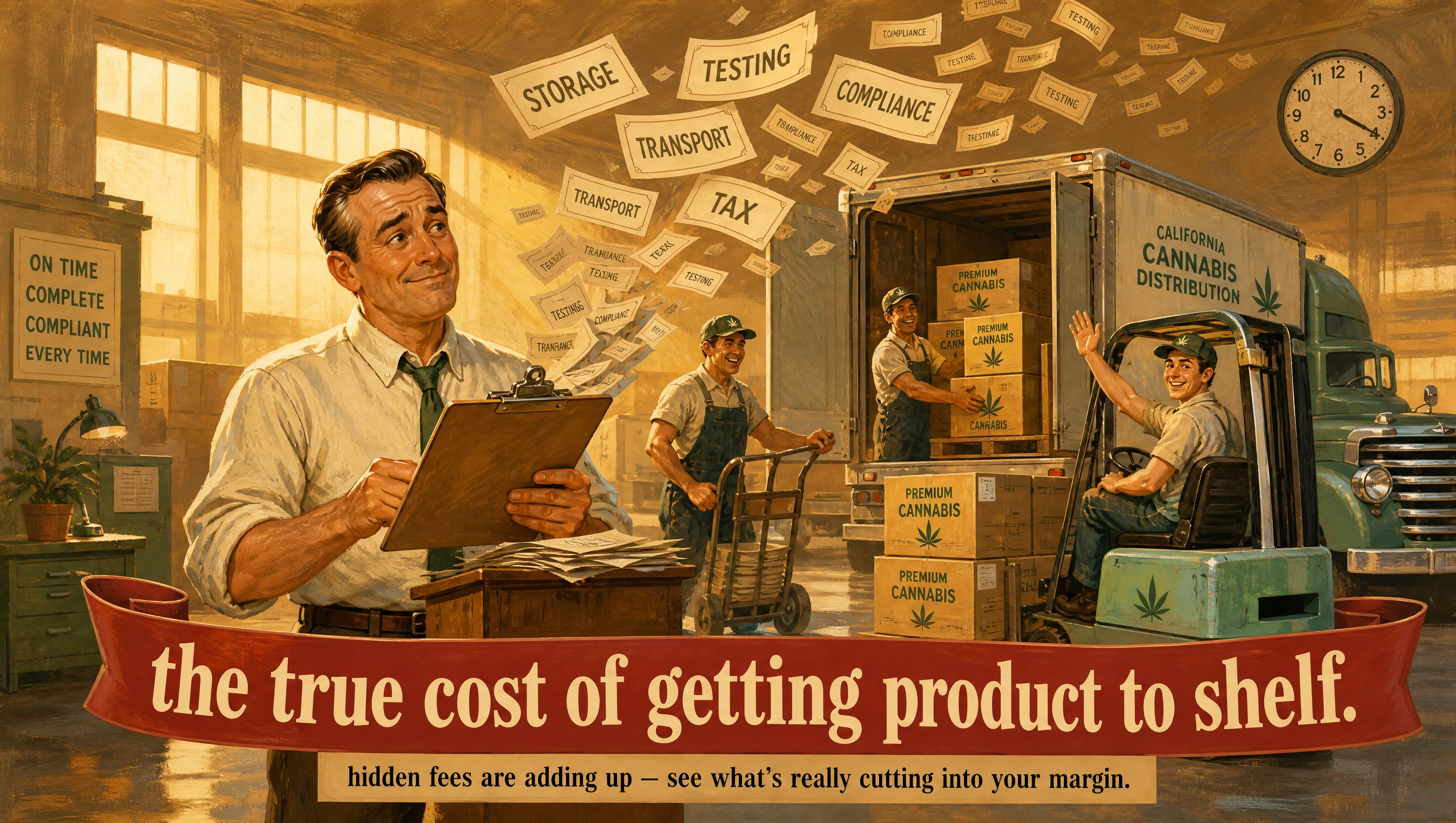
You ran the numbers before getting your license. You accounted for every fee and permit, the fleet, and a decent insurance policy. On paper, the plan was bulletproof. But now that you're in the thick of it? The profit just isn't there.
California is the largest market in the U.S., yet the hidden costs of cannabis distribution are quietly gutting your margins every single month. Between stacked taxes, the red tape, and the holes in your insurance, all while average prices slide and market demand shifts, you're trying to squeeze some gains out of a supply chain that feels designed to leak money.
Where is your capital going? We'll strip away the industry fluff and help you understand your actual financial reality.

1. Distribution License Fees, and the City Costs Nobody Warns You About
When mapping out your budget, you first need to ask: how much does a cannabis distribution license cost in California? State fees are among the first expenses you must cover, and they're clearly listed on the DCC website.
State License Fees (DCC)
California splits the license fees for cannabis distribution into two parts. First is a $1,000 application fee. Once approved, you pay an annual license fee based on your total income over a 12-month period before any deductions, which is then due again each year upon renewal. Both are non-refundable.
In other words, the amount you have to pay scales with your business size. The distribution license fees set by the DCC range from $200 for transport-only operations making less than $1,000, all the way up to $240,000 for full distributors bringing in $70 million or more. You can find the full breakdown on their official website. Always verify current rates before filing.
But these numbers are only part of the story. You should watch out for other costs that are necessary for licensing but never make it onto the state's checklist.
Local Permit Fees (The Surprise Line Item)
California has a dual-licensing system. You need local approval before the state issues a license. This first step is usually where your budget falls apart.
Before you get that state license, you have to secure a Conditional Use Permit (CUP), get your business authorization, and pass local building and fire reviews. And each one costs money.
The issue with these local regulatory fees is that they layer on top of what California charges for a state cannabis license and are always subject to change. In Oakland, for example, an annual permit runs up to $13,218 if you make over $1 million. Sacramento currently requires a Business Operating Permit (BOP) that ranges from $9,200 to $33,600, with renewals exceeding $30,000 if you have a larger operation.
Also, many departments use "cost-recovery" billing instead of flat rates. As of 2026, the Los Angeles Fire Department bills $379 per hour for inspections, jumping to $505 for off-hours visits, plus an upfront deposit of $1,262. San Diego works similarly, updating its annual fee every year to match what the city spends. For the latest cycle, that meant paying $15,910.36.
These unpredictable rates and the constant need for code-compliant modifications often end up costing more than the state license itself. Many operators budget for the state fee and get blindsided by local charges that can double their total entry cost. So, always assume your city or county will bill you for every hour they spend reviewing your plans and vetting your application.
2. The Excise Tax Problem
While you aren't the one paying the cannabis excise tax in California, as a distributor, you're affected by how retailers handle that debt. The state's tax structure creates a ripple effect that hits your bank account long before you ever touch a tax form.

How California's Cannabis Excise Tax Works for Distributors
In July 2025, the excise tax automatically jumped to 19%, triggered by an older law, AB 195, which had eliminated the state's cultivation tax and required the excise tax to increase if needed to make up for that lost revenue. After immediate industry pushback, AB 564 took effect in October 2025, slashing the rate back down to 15%, where it remains capped until 2028.
For years, distributors were the ones fronting these taxes to the state. That changed with AB 195, which shifted the entire responsibility for remitting the state excise tax directly onto retailers. AB 564 only lowered the rate. It didn't change the structure of who collects and pays it.
Distributors Are Still Paying the Price
Many assume that since California cannabis distributors don't have to collect the excise tax anymore, they're out of the woods. The truth is, the financial pressure just moved up the supply chain. While you no longer pay the state directly, you bear the cost indirectly through delayed receivables because retailers prioritize tax deadlines over your invoices.
This current system creates a bad debt crisis for three key reasons:
- The CDTFA holds all the cards: The state doesn't blink when it comes to collections. Under the RTC, they hit retailers with massive, 60% combined penalties for late payments (a 10% late fee plus a mandatory 50% cannabis-specific penalty) and can immediately initiate license revocation proceedings for defaults.
- You've become their accidental lender: When cash is tight, your invoice hits the bottom of the pile. Industry data from the Cannabiz Credit Association (CCA) shows that nearly a quarter of all wholesale invoices are more than three months past due. Retailers end up using your capital to keep their doors open, pushing your payment terms out to 90 or 120 days. You aren't just a vendor anymore; you're an involuntary, interest-free credit line.
- Your liquidity is frozen for months: You pay cultivators, cover the transit, and eat the testing fees upfront, but you wait a lifetime to see a dime of revenue. You're essentially bankrolling the entire supply chain with your own cash.
At the end of the day, you're left holding the bag on invoices that may never clear, while your customers burn every dollar they have just to stay on the state's good side.
.avif)
3. The Local Tax Stack
State-level fees are only the beginning of your overhead as a California operator. The true tax burden is the combination of those obligations and the unpredictable, city-specific levies that pile up at every stop along your route.
How Taxes Layer on Top of Each Other
In California, taxes don't just sit side by side; they compound. The stacking effect turns a simple transaction into a complex mathematical formula that ruins margins for your retail partners. Note: Tax calculation order may vary by jurisdiction. Always consult a cannabis CPA or check the CDTFA guidance for your specific delivery addresses.
The tax structure generally follows this sequence:
- First, the local cannabis business tax (which can hit 10%) is added to the base price.
- Next, the 15% state excise tax is applied to that entire subtotal.
- Finally, the state and district sales tax (averaging 8.5%–10%) is calculated on that cumulative amount.
When you add it all up, the effective tax rate consumers pay at the register pushes to 25-30% in lower-tax counties or even past 35-40% in high-tax jurisdictions like Los Angeles or San Francisco.
Besides worsening the liquidity issues we discussed earlier, this tax stack creates a distribution nightmare. If you operate across multiple jurisdictions, you won't be just managing one tax rate. You'll be managing dozens.
Every city has different requirements when it comes to local business taxes. Your ERP must track these shifts across every delivery. If your system isn't properly synced to the specific tax rules for every place you visit, one wrong invoice can trigger an audit or blow up your pricing for that retailer.
The Competitive Distortion
Licensed distributors are fighting a losing battle against the illicit market. While you're busy calculating and passing on this massive tax stack, unlicensed operators pay zero. You're trying to compete on price while shackled to a legal cost structure that puts you at an unavoidable disadvantage.
4. Section 280E
Even for a California cannabis distributor, federal tax policy poses a significant threat to your bottom line. To survive federal audits and protect your capital, you need to understand how Section 280E of the IRC impacts your business.

What 280E Means for Distributors
Under federal law, Section 280E prohibits adult-use cannabis businesses from deducting standard operating expenses (like rent, salaries, insurance, and marketing) from their taxable income. This can push your effective tax rate to 70% or higher, far exceeding the standard 21% corporate rate.
While state-licensed medical cannabis has been reclassified to Schedule III (exempting it from 280E), recreational operations remain bound by the restriction. That means, for adult-use inventory, you're still only permitted to reduce your tax liability through strictly defined COGS. And if you hold a dual license, you now have to strictly separate your costs so you don't accidentally mix up your tax rules.
As a distributor, your biggest challenge is proving exactly what counts as COGS. The rules look very different depending on what you do with your inventory:
- If you operate purely as a middleman reseller: You fall under Section 1.471-3(b) of the Treasury Regulations, which strictly limit your COGS to the invoice price of the goods plus the freight and transportation costs to get them to your facility.
- If you handle more complex inventories: Depending on your specific business activities (such as packaging, labeling, blending, or batch-processing bulk flower into retail units), you cross the line into a "producer." This allows you to capitalize a much wider range of indirect costs (like production labor and facility overhead) into your inventory under Section 471 of the IRC and Section 1.471-11 of the Treasury Regulations.
If you move overhead costs above the line into your COGS, you must be able to justify those allocations under federal "full absorption" inventory accounting standards. If you misclassify an operating expense as COGS, the IRS will not just disallow the deduction; they'll flag your entire filing.
Because the IRS doesn't provide a safe list of deductible cannabis costs, you need to prove, item by item, why a specific cost is inventoriable rather than an operating expense.
California's 280E Situation
And how does 280E affect cannabis distributors in California specifically? The state is currently much friendlier than the federal government. C-corporations have always been able to write off standard operating overhead on their tax returns. AB 37 and its subsequent extensions (including SB 167) extended this relief to pass-through entities, allowing LLCs, partnerships, and sole proprietors to deduct their expenses too. This exemption is locked in until January 1, 2030.
Note: Tax mechanics are often tied to annual budget trailer bills. Always consult a licensed California tax professional to confirm current sunset dates and ensure your planning aligns with the latest legislative updates.
While this state exception offers local relief for a few years, it doesn't stop the IRS from being aggressive. Because adult-use cannabis remains on Schedule I pending the outcome of ongoing administrative reviews, the methodology you use to calculate your COGS is still the only legal defense you have to minimize your federal tax bill on recreational inventory.
You cannot afford to estimate these numbers. To back up your deductions and survive an audit, you need precise, real-time data that proves exactly which costs qualify as COGS. Solutions like Distru can help you track them as your inventory moves through your facility, maintaining an audit trail to ensure that every dollar you claim as COGS is supported by documentation that holds up under federal scrutiny.
5. Insurance Requirements (Including the Coverage Gap Nobody Talks About)
Compliance doesn't end with your license. You also need to build a complete defense for your entire business. There are mandatory insurance requirements for every cannabis distributor in California, but basic policies rarely provide the depth of protection you need to mitigate the full range of risks that could jeopardize your company.
What California Requires
As a cannabis distributor, what type of insurance do you need in California? The state has set clear minimums. To maintain your license, the DCC mandates that you carry commercial general liability insurance with limits of at least $1 million per occurrence and $2 million in the aggregate. You must also maintain workers' compensation for your staff and specific commercial auto coverage for your fleet.
Regulations are also strict about who you buy coverage from. Your provider must be an admitted insurer, a risk retention group (RRG), or a non-admitted insurer. Admitted insurers and RRGs need to show proof of capitalization of at least $10,000,000, while non-admitted (surplus lines) should demonstrate at least $45,000,000 in capital and surplus. This is the state's way of making sure if a major claim occurs, the insurance company actually has the financial backing to pay it out.
Not all commercial brokers work with these specialized, high-capital carriers. Ask your broker if they partner with providers that offer general liability coverage for cannabis and meet these specific state thresholds.
The Cannabis Cargo Exclusion Problem
This is one of the most common hidden exposures in the industry. Many distributors purchase standard Motor Truck Cargo (MTC) policies, only to find out later that the fine print excludes "controlled substances." Since recreational cannabis falls under this category and remains federally illegal, many standard insurers automatically exclude it to avoid paying claims.
If you don't have an affirmative endorsement for Cannabis MTC (typically housed under an Inland Marine policy), your coverage might be worthless the moment a theft or accident occurs. An affirmative endorsement is a specific, written amendment to your policy that explicitly grants coverage for cannabis products. Without it, any claim related to the cannabis cargo itself may be denied, leaving you to cover the full value of the load out of pocket in the event of a loss.
Also, specialized cannabis-friendly carriers are a smaller pool, so your premiums will likely be higher than with standard logistics companies.
But this is non-negotiable. Don't just take your broker's word for it. Get a copy of the policy and confirm, in writing, that the cannabis exclusion has been removed and your cargo is fully protected.
6. Metrc Compliance Overhead
The state covers your base system access, but the real expense is operational. Using Metrc for compliance in California requires a significant investment in hardware, software, and labor to stay audit-ready.
The Per-Transfer Requirements
Every move in your supply chain must be tracked with a Metrc-generated shipping manifest that cannot be altered once the van leaves your facility. Also, you're required to maintain accurate, package-level inventory at all times. While your software access and physical tags are included in your annual state license fees, you still need to build the infrastructure to manage this workflow.
First, you need physical hardware. Manually keying in 24-digit UIDs is slow and prone to errors. That's why many distributors invest in barcode readers or even commercial-grade RFID scanners to perform bulk inventory audits in seconds rather than hours.
Second, you face software costs. Metrc's native interface is utilitarian and lacks the automation needed for high-volume distribution. Most successful operators pay for third-party ERP software to automate API pings and prevent the data-entry mistakes that lead to state-mandated inventory holds.
Finally, there's the hidden labor of cannabis compliance overhead in California. Every package must be physically tagged and every adjustment verified. As your volume grows, your compliance headcount must grow with it, transforming track-and-trace from a simple reporting tool into a massive monthly line item on your P&L.
The Double-Entry Problem
You likely have to run Metrc alongside QuickBooks and a separate ordering platform. This forces your team to enter the same data three or four times across separate systems, which can be a major source of human error. A single discrepancy can trigger audits or facility holds that halt your operations entirely.
To mitigate this, you should consolidate your tech stack. By using an ERP like Distru, which features a two-way, real-time sync with Metrc, you can move away from manual double-entry. Proper integration automates the reporting process. As a result, your staff only needs to interact with the Metrc portal for a few critical tasks, drastically reducing the labor hours and compliance risks associated with keeping your inventory clean.
7. Transportation Requirements
Moving product safely is more than just driving; it's one of the highest logistical costs of distributing cannabis in California. However, the true expense goes beyond fuel and fleet maintenance. You also face the burden of keeping your inventory secure from the moment it leaves your facility until it reaches the retail floor.
What the DCC Requires
California's cannabis transport requirements are explicit. The state doesn't just want you to move goods; they want you to secure them. You must use a fully enclosed, locked, and secured container that keeps your inventory completely invisible from the outside.
Every vehicle in your fleet must have an active alarm system, and every single trip must be backed by a Metrc manifest. Routes must remain direct. You cannot deviate from your path unless it is for fuel, vehicle repairs, or a necessary rest stop.
Besides securing the cargo, you have to get a Motor Carrier Permit (MCP) from the DMV. How you handle transport determines what you'll pay and what you'll need:
- For-hire carriers: If you're a licensed distributor moving cannabis products on behalf of other operators in exchange for compensation, you're legally considered a for-hire carrier and must get an MCP regardless of your vehicle's size, weight, or type.
- Private carriers: If you're a cultivator, manufacturer, or vertically integrated operator transporting only your own product, you're classified as a private carrier and only need an MCP when you're driving a vehicle with a Gross Vehicle Weight Rating (GVWR) of 10,010 pounds or more.
You also have to ensure that only authorized employees are behind the wheel or even inside the vehicle and that each staff member carries proper identification and licensing documents.
Don't assume you're exempt just because you're moving your own product. The state's compliance and highway safety enforcement teams are highly active, and vehicles are subject to inspection at any time during transport. Failure to hold the correct permit or adhere to these strict protocols can result in steep fines or vehicle impoundment.
The Real Cost
Equipping your vans with interior lock-boxes, alarm systems, and real-time GPS tracking isn't optional, and these upgrades represent a significant upfront investment before you ever make a delivery.
Then, there's insurance overhead. Because you're moving high-value, high-risk cargo, you won't qualify for standard commercial auto rates. Insurers hit cannabis fleets with specialized premiums that far exceed traditional logistics costs.
As you grow, the "hidden" expenses snowball. You aren't just paying for more fuel or maintenance; you're paying for the administrative labor needed to manage compliance documentation for every driver and every route.
What starts as a simple delivery setup quickly evolves into a complex logistics department, adding layers of cost that can easily strain your margins if not accounted for in your planning.
8. Mandatory Third-Party Testing
Since it's a non-negotiable legal requirement for every batch, testing is a fundamental part of your operating costs as a cannabis distributor that often goes underestimated in basic financial models. Therefore, it should be front and center when calculating your margins and expenses.
What Distributors Are Required to Test
In California, you're responsible for arranging third-party testing before any product can legally move to a retailer. Labs test these batches to make sure they're completely free of contaminants and labeled with accurate amounts of cannabinoids and terpenes.
To ensure safety, the DCC requires a full compliance panel for every batch, not just random samples, and it must include:
- Cannabinoids and terpenes
- Residual solvents and processing chemicals
- Pesticides
- Microbial impurities
- Mycotoxins
- Heavy metals
- Moisture content and water activity
- Foreign material
If a batch doesn't pass, it cannot hit the shelf.
The Cost Reality
According to the US Cannabis Testing Services Market Size and Trends report by Coherent Market Insights, a basic compliance panel typically ranges from $150 to $250 per sample. However, these direct costs are highly variable and can quickly scale with volume. For instance, if you process 10 to 15 batches a week, you can expect to spend $6,000 to $15,000+ a month on lab invoices alone.
But lab testing isn't a predictable one-time fee. The true financial impact is a combination of these direct costs and the "failure tax" (the loss of inventory that occurs when batches fail testing and must be destroyed).
As detailed in the study "Costs of mandatory cannabis testing in California" by the University of California, Davis, every legal batch in the state must be screened for more than 100 individual contaminants. This intensive panel includes 66 specific pesticides, 21 of which carry a strict zero-tolerance threshold where any microscopic trace instantly disqualifies the batch.
The authors point out that California's maximum allowable limits for many of these compounds are actually far lower than what the state permits for standard agricultural food products. Because the bar is set so high, unsuccessful tests are an inevitable reality, with average batch failure rates hovering around 4%.
If a batch fails, it must be either destroyed or sent to a manufacturer for remediation. Only a manufacturer can legally remediate a product, and only after the DCC approves a specific plan. Even then, you must pay for retesting to confirm the contaminants are gone.
In a follow-up study, the UC Davis research team estimated this cumulative burden at approximately $136 per pound of dried cannabis (roughly 10% of its wholesale value), highlighting that the value of the cannabis you have to destroy or send back for remediation accounts for the single largest share of your total testing costs and dwarfs the actual fees you pay to the lab.
For a high-volume distributor, these inventory losses can become a multi-thousand-dollar monthly expense, too. And beyond the dollar amount, this process adds days to your supply chain turnaround. Every hour a batch spends in remediation or waiting for lab results is time that your product is sitting idle, hurting your cash flow and testing the patience of your retail partners.
You should treat testing as a risk-adjusted operational expense that includes a margin for inevitable batch failures.
9. The Operational Overhead Tax (What Your Software Setup Is Costing You)
Your tech stack is either saving you money or costing you margins. When systems don't talk to each other, you add a silent, recurring cost to every transaction, which can bloat your total expenses as a cannabis distributor in California.
The Four-System Problem
Most distributors are stuck running their business across four fragmented tools: Metrc, QuickBooks, an ordering platform like LeafLink, and a mountain of spreadsheets to bridge the gaps between them and catch discrepancies (like when LeafLink shows a product is in stock, QuickBooks says it's paid for, but Metrc has no record of the transfer) before it's too late.
Since these systems aren't natively connected, your team has to manually re-enter data into each one. This can burn up their time with repetitive tasks, lead to easy mistakes, and quietly inflate your payroll. You end up paying your staff to act as human data conduits between platforms.
On average, your team can lose 10 or more hours a week to redundant administrative work. That's valuable time that should be spent on selling products and finding new clients.
What Disconnected Systems Actually Cost
Without synchronized systems, you operate in the dark. One inventory discrepancy can cause you to oversell stock, miss delivery windows, or trigger compliance holds that freeze your entire operation.
Manual processes can also stall your cash flow. When your team has to draft invoices by hand, it delays how quickly you bill customers, and a single typo can result in weeks of disputes from retailers. That's a lethal flaw when you're already squeezed by upfront tax payments.
And because your billing and inventory data are disconnected, you have no real-time tracking of your COGS, meaning you're essentially guessing at your profit margins instead of managing them.
This is the hidden cost that compounds every other expense on this list. Bad data leads to poor decisions. To fix this, you should unify your tech stack. Tools like Distru centralize your operations in one spot, giving you access to a dashboard where you can manage your inventory, track your COGS, and keep Metrc in sync on your command. Everything lives in one place. Distru replaces fragmented workflows with a single source of truth and helps you save your team thousands of hours of busywork a year. Look at an operator like HAVEN. Once they started using Distru and got everything running on one platform, they went from taking almost a week to get orders out the door to fulfilling them in 12–24 hours.
10. Banking Constraints and the Cost of Cash
The limited access to traditional banking and the resulting operational necessity of managing physical currency are other major reasons why distribution is so expensive in California, adding layers of overhead that most standard businesses never encounter.
The Banking Reality for California Distributors
Because cannabis remains a Schedule I controlled substance under federal law, mainstream banks overwhelmingly refuse to service the industry. While a niche market of "cannabis-friendly" credit unions and banks has emerged, these institutions operate under intense federal scrutiny.
As a result, you pay a steep premium. According to Northstar Financial, monthly account maintenance fees can run from $1,500 to $5,000, while cash deposit fees range between 0.5% and 2.0% of your total volume.
Beyond that, access to capital is essentially frozen. Traditional lines of credit and standard business loans are nearly impossible to secure, leaving you to rely on private lenders where double-digit interest rates and predatory terms are often the only way to keep the lights on.
For the portion of your business that remains cash-heavy, the overhead is staggering. You're also forced to invest in industrial-grade safes, internal security, and expensive armored transport services just to move your own revenue. Between the monthly service premiums, deposit surcharges, and the labor-intensive reality of counting and securing physical bills, your banking setup is a significant, ongoing drain on your bottom line.
The Compounding Effect
The lack of access to traditional credit creates a dangerous liquidity trap for distributors, who effectively act as the bank for the rest of the supply chain. You can find yourself stuck paying cultivators and manufacturers on tight net terms, while your retail partners push their invoices to 60 or 90 days.
Without a revolving line of credit to bridge this gap, you have zero margin for error. A single operational hiccup (a slow sales month at retail, a failed lab test, or a delay in the Metrc tracking system) cascades immediately.
Since you cannot simply tap into a credit facility to cover your accounts payable during these lulls, a minor disruption in your accounts receivable can rapidly jeopardize your entire business's ability to remain solvent. You're perpetually walking a tightrope where your cash flow is entirely dependent on your customers' ability to pay you on time, putting you in a high-risk position with no traditional financial safety net.

What Does It All Add Up To?
Every dollar you didn't account for in your initial business plan is a dollar that eats into your margin. While state fees are transparent, local permits, testing failure taxes, and compliance-driven labor costs create a massive, compounding drag on your profitability.
Depending on your volume and the jurisdictions you serve, your annual hidden cost overhead can range from just under $100,000 if you run a tight, low-volume setup to more than $840,000 if you operate at a massive enterprise scale. Here's a breakdown:
| Cost Category | Low Estimate | High Estimate | Notes |
|---|---|---|---|
| State license fee | $200 | $241,000 | Includes the flat $1,000 DCC application fee. Low: Type 13 transport-only (<$1k revenue). High: Type 11 full distributor (>$70M revenue). |
| Local permit fees | $5,000 | $75,000+ | City/County specific annual permit renewals, conditional use permit updates, and municipal cost-recovery inspection rates. |
| Excise tax cash flow | $10,000 | $100,000+ | AR bad debt and frozen capital due to retail payment defaults. |
| Testing costs | $24,000 | $180,000 | $2,000–$15,000/month. Covers direct third-party lab testing fees plus the "failure tax" (the cost of distributing, reclaiming, or destroying failed batches). |
| Insurance (GL + cargo + fleet) | $15,000 | $60,000+ | High-capital commercial general liability minimums, commercial auto premiums, and mandatory non-excluded MTC policies. |
| Metrc & compliance labor | $35,152 | $150,000+ | Low: 1 FTE at California minimum wage. High: 3+ dedicated, full-time compliance and inventory managers manually reconciling paper trails. |
| Operational software overhead | $6,000 | $36,000 | $500–$3,000/month for using software (increases if labor is included). |
| Annual total | $94,480 | $842,000+ | Sum of low/high estimates across all categories above. |
Note: Estimates are illustrative ranges based on operator interviews, DCC regulatory schedules, and Distru platform data. Labor is calculated using Full-Time Equivalent (FTE) standards, with the low baseline set at California's minimum wage. Individual costs vary significantly by volume and jurisdiction.
How to Reduce the Costs You Can Actually Control
If you want to stay profitable in this market, you have to separate the fixed regulatory hits from the operational leaks you can actually avoid. So, how can you reduce operational costs as a California cannabis distributor? It starts by cutting out inefficiencies and getting smart about your financial planning.
The Costs You're Stuck With (Regulatory)
Some costs are simply the price of entry. Your state license fees, local permit requirements, and mandatory city taxes are fixed. You have to budget for them and pay them if you want to keep your license. You can't negotiate these, but you can plan for them much better.
The key is to stop projecting your revenue as if you operate in a vacuum. Your retail partners are under immense pressure to pay their own excise taxes first to avoid losing their licenses.
By tracking their tax payment cycles, you can anticipate when they will be cash-strapped and prioritize your collections before their big tax bills are due. Don't wait for a payment to be late. Adjust your terms or tighten your delivery windows during their tax-heavy months to avoid a cash-flow crisis of your own.
The Costs You Can Reduce (Operational)
While you can't change state license fees or local taxes, you have a lot more power over your internal operations than you might think. These are the key areas where you can cut down your overhead:
- Insurance: Stop guessing. Find a broker who specifically deals in cannabis and get written confirmation that your cargo coverage includes an affirmative endorsement for cannabis. If you don't have this, you're paying for a policy that might not pay out when you need it most.
- Testing: Plan your calendar. Build lab turnaround times directly into your fulfillment cycle instead of paying for expensive rush fees or last-minute inventory holds.
- Compliance overhead: Synchronize and automate your tools. You shouldn't be paying staff to manually type data into Metrc, QuickBooks, LeafLink, and endless spreadsheets. Use an integrated platform that handles your compliance, live COGS tracking, and inventory in one place to eliminate costly double-entry errors and reclaim lost labor hours.
Distru is built for California distributors who are tired of manual errors and fragmented systems. We pull your Metrc compliance, inventory management, wholesale ordering, and financial tracking into one single system, saving you thousands of hours in labor every year. Ready to stop leaking money?
Stop the Leak: Build a Distribution Business That Scales
Distributing cannabis in California can be financially punishing if you're running your operation on loose systems. The thin margins and relentless regulatory environment don't reward hustle. They reward precision.
Those who find success in this market aren't working harder; they're working smarter with better infrastructure. They have real-time inventory visibility, calculate COGS that actually reflect their true costs, and use tools that wipe out the risk of manual errors. They've moved past the patchwork of spreadsheets and disconnected portals that are quietly draining your profit every single day.
If you're tired of the margin-killing inefficiency, we encourage you to try Distru. Our solution was built specifically to solve these problems for California distributors. Book a demo today and see how you can finally take control of your costs and start running your business with the clarity it deserves.


