

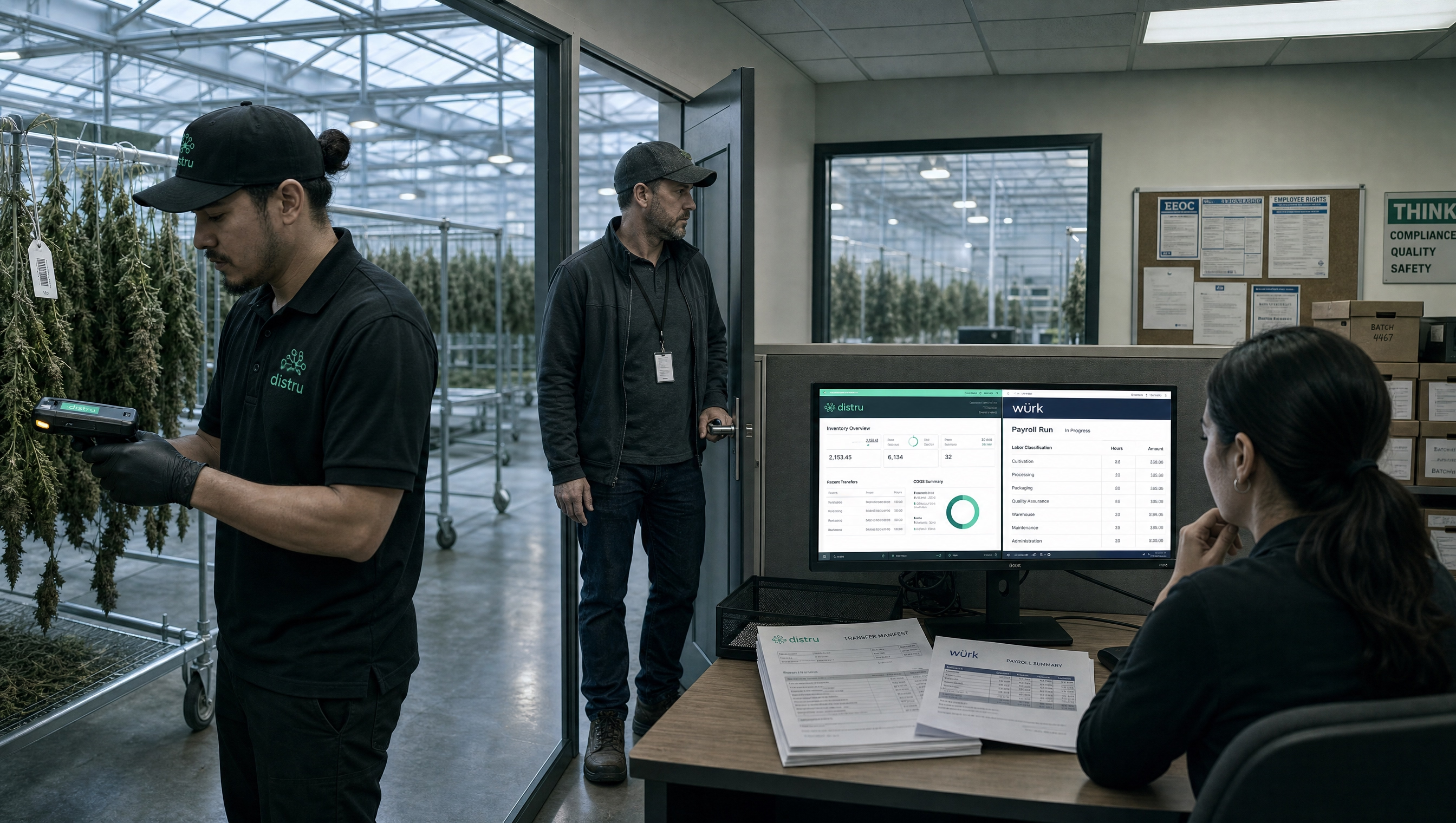
Ask three people at a cannabis company what "compliance" means and you'll get three different answers. Your cultivation manager thinks Metrc. Your CFO thinks 280E. Your HR person thinks workers' comp codes and I-9s. They're all right, and that's exactly the problem. Most operators build a strong compliance program on one side of the business and leave the other side running on spreadsheets and good intentions.
Here's the thing: regulators don't see two separate businesses. The IRS and your state labor board both pull the same underlying records when they come knocking, and if your product data and your people data tell two different stories, you're the one who has to explain why.
This guide will deblur what cannabis compliance actually covers, why the product side and the payroll side are more connected than most operators realize, and what it takes to build infrastructure that holds up on both fronts.
If this sounds familiar, you're not alone. Most operators didn't set out to run two separate compliance programs. It happened because the product side had a hard deadline from day one. The state won't let you sell without it. The people side felt like something to get to once things calmed down. Things rarely calm down. So the gap sits there quietly until an auditor decides to look at both sides at once.
.avif)
What Cannabis Compliance Actually Covers
When people say "cannabis compliance," they're usually talking about one of two tracks without realizing there's a second one.
Product compliance is the track most operators know cold. It's your Metrc reporting, transfer manifests, Certificates of Analysis, RFID tags, and inventory reconciliation. Every gram gets tracked from seed to sale, and if your numbers don't match what's in the state system, you've got a problem that shows up fast.
Workforce compliance is the track that gets less attention until it's too late. It covers payroll, 280E labor classification, workers' comp codes, and the HR documentation trail that proves you classified people correctly in the first place.
Most operators run one of these well and let the other slide. Cultivators and processors tend to have Metrc dialed in because the state forces the issue. Payroll and labor classification get handled by whoever has bandwidth that week, which usually means nobody owns it end to end. That gap is where audits start.
The split looks different depending on your license type. A cultivator usually has the strongest product compliance story, since Metrc plant tags and harvest batches are non-negotiable, but seasonal trim labor is where the workforce side breaks. A processor juggles multiple employee roles across one shift, extraction, packaging, quality control, and each role needs its own labor allocation. A distributor has driver classification questions that don't come up anywhere else: is a delivery driver production labor or overhead, and does that answer change if they also help with warehousing? None of these are edge cases. They're the normal Tuesday of running a licensed cannabis business.
Why Product and Payroll Compliance Are Connected
Here's what most operators don't realize until it's too late: your payroll compliance story is only as strong as the ops records underneath it. Regulators don't audit product and people separately. The IRS pulls your COGS classification and cross-references it against payroll records. State labor boards pull time records and job descriptions. Both agencies are looking at the same operation from different angles.
Cash-heavy operations feel this pressure on both sides at once. If your bank relationship is thin, you're already documenting everything twice as carefully, and that same scrutiny applies to how you classify labor.
Seasonal spikes make the connection even sharper. During harvest or around 4/20, product movement and labor demand both jump at the same time. You're bringing on trim crews while your inventory counts are moving faster than usual, and both need to be documented correctly in the same window.

Section 280E of the federal tax code is where this gets expensive. Because cannabis is still federally scheduled, operators can only deduct Cost of Goods Sold, not standard operating expenses like sales salaries or marketing. That single rule can push effective tax rates as high as 80% for operators who aren't managing their COGS classification carefully. 280E hits hardest exactly where COGS tracking and payroll allocation don't line up, because labor is one of the biggest COGS categories available to cultivators and processors, and getting that classification wrong means leaving real deductions on the table or, worse, defending a number you can't back up.
Picture what an actual audit pulls. On the federal side, the IRS wants your COGS classification, job descriptions, time records, and org chart, and it cross-references all four against each other. On the state side, a labor board investigation usually starts from a complaint, not a random draw, and once it starts, they want payroll records, time records, and I-9s. Neither agency cares that your product team and your finance team never talk to each other. They just want the numbers to match.
Where Cannabis Operators Usually Break Down
On the product side, the usual suspects are manual Metrc entry, inventory discrepancies between what the system says and what's actually on the shelf, and visibility gaps once you're running more than one location. You know the drill: someone's copy-pasting package tags at 11 PM because the sync isn't real-time, and by the time anyone notices a discrepancy, it's already been open for weeks.
The workforce side breaks down differently, and it often starts before you even hire your first employee. National payroll and HR providers have been dropping cannabis clients with as little as 30 days' notice, because their banking partners won't touch anything connected to a Schedule I substance. Operators who get dropped scramble to migrate payroll mid-quarter, and that scramble is exactly when misclassification creeps in.
From there, the same mistakes show up again and again: seasonal trim crews paid as 1099 contractors when they're functionally employees, workers' comp codes that don't match the actual job (cultivation work coded as office admin, for example), and no documentation trail showing why a role was classified the way it was. None of these show up as a problem until an auditor asks for backup, and by then you're reconstructing records instead of producing them.
Multi-location operators get an extra layer of this. Every facility tends to develop its own habits: one location tracks time by role, another tracks it by shift, and nobody's compared the two. Add a harvest crew that moves between sites and you've got a labor classification question that changes depending on which building someone's standing in that week. It's one of those things that sounds small until it isn't, and it's exactly the kind of inconsistency that turns a routine review into a longer one.
How to Build Compliance Infrastructure That Covers Both
You don't have to white-knuckle this. Building infrastructure that covers both tracks comes down to treating product and people the same way: real-time data, not reconstructed-after-the-fact data.
On the product side, that means a real-time, two-way Metrc integration instead of manual entry, package-level tracking instead of end-of-month counts, and transfer manifests that match your ERP before anything ships. It also means regular cycle counts instead of waiting for a discrepancy to surface on its own, and bills of materials that update your cost basis as ingredients move into a finished batch, not after the fact. Your ERP becomes the source of truth, and Metrc becomes the place you go for the handful of actions the state actually requires directly.
On the people side, that means working with a cannabis payroll platform built for this industry from day one, not a mainstream provider that might drop you when their bank gets nervous. It means time tracking by role, not by department, so a cultivation employee's hours are classified the same way in payroll as they are in your COGS calculation. And it means building the documentation habit before an audit forces you to, not after.
This is where Würk comes in. Würk built its cannabis payroll compliance platform specifically for this industry, with 280E-aware payroll that separates COGS-eligible wages from non-deductible ones, multi-state compliance support across all 50 legal markets, and workers' comp coding built around actual cannabis job functions from cultivation to retail. Operators running Würk on the people side and a connected ERP on the product side get a compliance story that holds together end to end, because both systems are pulling from clean, current data instead of a spreadsheet somebody randomly updates.
The Compliance Checklist Your Operation Actually Needs (2026)
Run through this by track. If you can't answer yes to most of these, that's your starting point, not a reason to panic.
Product compliance:
- Is your Metrc sync real-time, or are you still batching entries by hand?
- Are your inventory counts tracked at the package level, not just by SKU total?
- Do your transfer manifests match your ERP records before anything leaves the building?
- Can you pull a clean audit trail for any package, any time, without digging through three systems?
- Are cycle counts scheduled, or do discrepancies only surface when something's already wrong?
Workforce compliance:
- Is your payroll provider cannabis-specific, or are you one banking policy change away from a 30-day scramble?
- Are your workers' comp codes assigned by actual job function, not by default?
- Do you have documentation showing how you classified seasonal and gig labor?
- Is your labor allocation consistent across every location, not just the one someone happened to set up first?
- Have you built 2026 minimum wage increases into your payroll setup? Nineteen states raised their wage floors this January, and several more follow later in the year. If you run crews across state lines, that's not a one-time fix. It's a standing checklist item.
A cannabis compliance program that only covers one of these tracks isn't half done. It's a liability wearing a compliance badge. The operators who get through an audit clean are the ones whose product records and payroll records tell the same story, because they were built on the same discipline from the start.
If you're running your cannabis ERP on spreadsheets stitched together with a Metrc login and a prayer, that's the first fix. Distru is a cannabis ERP platform built for licensed operators, with real-time Metrc sync, package-level inventory tracking, and live cost accounting that updates as product moves through your facility instead of waiting until year-end.

No spreadsheet required, and no midnight prayer either. Ready to see what real-time compliance actually looks like? Schedule a demo with Distru and see how the product side of your compliance story can finally match the people side.


