

You've probably heard the term "MCP" floating around if you've spent any time near an AI tool lately. Maybe a vendor mentioned it on a call. Maybe you saw it in a LinkedIn post you scrolled past without really reading. Here's the thing: you don't need a computer science degree to understand it, and it's worth ten minutes of your time, because it's going to shape how the software you already use gets built over the next few years.
What Is an MCP Server, Actually?
MCP stands for Model Context Protocol. It's an open standard, built by Anthropic, that lets AI applications connect to outside data and tools without a custom-built pipe for every single connection. Think of it as a shared language that any AI tool and any piece of software can both speak, instead of every pairing needing its own translator.

The Problem MCP Was Built to Solve
Before MCP existed, every AI tool that wanted to talk to your calendar, your database, or your inventory system needed its own one-off integration. Engineers call this the "N by M" problem: if you have N different AI tools and M different systems they need to talk to, you end up needing N times M custom connections. Add a new AI tool, and you're rebuilding integrations from scratch for every system it needs to touch. Add a new system, and every AI tool needs a new connector built for it.
That's not a hypothetical problem. It's the exact reason software integrations have historically been slow, expensive, and fragile. MCP flips the model. Instead of custom pipes everywhere, one system speaks MCP once, and any MCP-compatible AI tool can connect to it without a bespoke build.
The USB-C Comparison
The people behind MCP describe it with a simple comparison: think of it like a USB-C port for AI applications. Before USB-C, every device had its own charger and its own cable. Now one connector standard works across phones, laptops, and headphones. MCP is trying to do the same thing for how AI models plug into data sources, tools, and workflows.
The Three Moving Parts
Every MCP setup has three pieces working together, and understanding them makes the whole concept concrete instead of abstract.
Host, Client, and Server
The host is the AI application itself, the thing you're actually interacting with. The client is the piece that manages the connection. The server is the part that actually exposes your data and tools to the AI model. When you hear "MCP server," that's the piece that says "here's what I can offer an AI agent, and here are the rules for how it can use me."
Tools, Resources, and Prompts
An MCP server is built around three primitives. Tools are actions the AI can take, like running a search or updating a record. Resources are data the AI can read, like a file or a database table. Prompts are predefined instructions with adjustable details, like a template the AI fills in.
That breakdown matters more than it sounds. It means "what can this AI agent actually touch" is a specific, answerable question, not a black box you have to trust blindly. You can look at an MCP server's configuration and know exactly which tools it exposes, which resources it can read, and which it can't. That's the same instinct behind giving a new employee a defined set of system permissions instead of a master password to everything.
Why This Sounds Familiar to Cannabis Operators
If you run a cannabis operation, you already know the N by M problem, you just call it something else. It's Metrc in one tab, QuickBooks in another, your POS somewhere else, and a spreadsheet holding the whole thing together because none of it talks to each other cleanly. You're the connector. That's the job nobody wants, and it's the same job MCP is trying to take off engineers' plates for AI tools.
How Fast This Is Actually Moving
MCP is not a slow-moving standards effort stuck in committee. Anthropic released the protocol in November 2024, and inside of two years it's gone from a developer side project to something running in production at companies of every size, powering real agent workflows rather than just local demos. A major update to the spec was finalized in July 2026, aimed squarely at enterprise problems like scaling servers under real production load, audit trails, and access control. That's the kind of update that shows a technology moving from "interesting experiment" to "something a compliance team has to take seriously."
What "MCP Servers" Look Like in the Wild Today
Right now, most existing MCP servers are things like a filesystem connector, a GitHub connector, a database connector, a Slack connector. Developer-focused, in other words. That's exactly why searches about MCP skew so heavily toward "best MCP servers for Cursor" or "MCP servers GitHub." The people asking those questions today are engineers, not operators. But the same underlying pattern, standardized tool access instead of custom integrations, is exactly what's going to show up in business software next, including the tools cannabis operators use every day.
What This Means for a Cannabis Operator, Not a Developer
You don't need to build an MCP server yourself, and you almost certainly never will. What you need to know is this: the software vendors you work with are starting to build toward this standard, and it's going to change what "integration" means over the next couple of years.
A New Question to Ask Your Vendors
The old question was "do you integrate with X?" The new question is starting to shift toward "can an AI agent safely work inside your system, and what exactly is it allowed to touch?" That second question is the one that actually matters for compliance. An AI agent with unrestricted access to your cannabis ERP (Enterprise Resource Planning) system is a liability. An AI agent with a defined, auditable set of tools and permissions, built on something like MCP's tools-resources-prompts structure, is a feature.
Permissions as a Compliance Feature, Not Just a Technical Detail
This is worth sitting with for a second. In a heavily regulated industry, "what exactly can this thing touch" isn't a nerdy technical question, it's a compliance question. If your state agency ever asked you to explain what access an AI tool had to your Metrc data, would you have a clear answer? MCP's structure is built to make that answer possible. That's not nothing.
Where This Actually Shows Up for You
You don't need to become an MCP expert. What's worth watching is how the tools you already use handle new AI features as they roll out, and whether the vendor keeps you in control of what those features can touch.
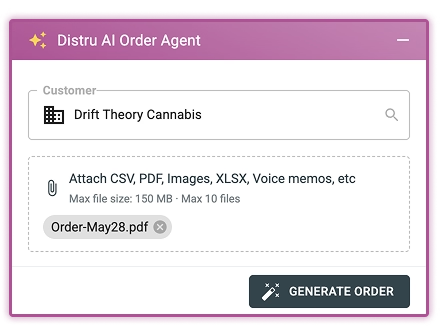
Distru's own AI Order Agent, live since June 2026, is a good example of what that looks like done right. Buyers keep sending orders however they already do: text, email, a spreadsheet, even a photo of a handwritten list. The agent turns that into a clean sales order, picks inventory against your cannabis ERP system, and flags anything that won't fill. Your rep still reviews it before anything goes out. Customers using it are saving 40+ hours a week that used to go into typing orders line by line.
That's the same instinct MCP is built around at the infrastructure level: define exactly what a tool is allowed to touch, and keep a person in the loop for anything that matters. The agent proposes. You decide.
Curious how that kind of workflow could apply to your own order process? Schedule a demo with Distru and we'll show you exactly how it works.