

With the Empire State on track to become one of the world's largest cannabis economies, the sheer volume of wholesale activity is forcing a digital transformation across the supply chain. As commerce scales, what are the top platforms for trading cannabis in New York?
The landscape is dominated by DistruCommerce, LeafLink (which now includes Leaf Trade), and Apex Trading. While all three can help you either find new buyers or showcase your offerings to existing partners, at Distru, we've carved out a niche for businesses that want more control over their operations.
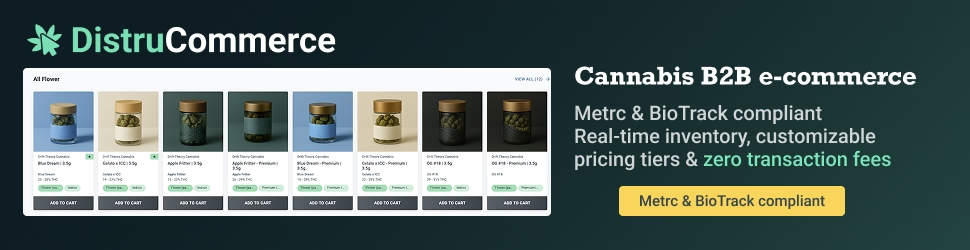
DistruCommerce provides a direct, private storefront to display customized wholesale menus, a "live" marketplace for clean orders, and the reliable ERP backend required to handle fulfillment, Metrc compliance, and inventory, all without the usual marketplace chaos.
Want to discover which platform aligns best with your specific business model? Read on!

What Does "Trading Cannabis" Actually Mean in New York?
Let's clear the air: if you type trading cannabis in New York into a search engine, you might get results for weed stocks or crypto-adjacent "green" tokens, essentially betting on our industry's future. However, that's not what we're talking about here.
For those of us actually working in the dirt and the dispensaries, "trading" is the heartbeat of the cannabis supply chain. It refers to the movement of a product from the soil to the shelf, describing the process through which cultivators, processors, and distributors exchange bulk goods with retailers.
Basically, "trading" is the series of hand-offs where raw flowers actually make it into a glass jar in a New YorkManhattan dispensary.
B2B Wholesale vs. Retail Menus vs. Compliance Transfers
We already know the definition of "trading" in cannabis, but is it the same as selling a product or moving it? And what does it mean in New York? To understand the distinction, it's important to differentiate these three terms.
First, there are B2B marketplaces where wholesale cannabis suppliers list their bulk flower or infused products for retailers to browse. This is like a digital catalog.
Then, you have retail menus, which are what customers see (the "B2C" side) and show what's on a dispensary's shelf, but they only exist because of the wholesale work happening behind the scenes.
Finally, there are compliance transfers, which represent the administrative act of moving inventory between licenses in the eyes of the state.
The Wholesale Cannabis Workflow in New York
Before we look at software, we have to break down the logistics. How does wholesale cannabis work in New York? It's a multi-step transaction that begins with a digital catalog and ends with secure payment.
As a cultivator, processor, or distributor, you list your inventory with descriptions, photos, and Certificates of Analysis (COAs) so retailers know exactly what they're buying. Then, the retailer browses your products, negotiates the terms, and places an order.
Once you both shake hands (digitally) on the order, you must pick and pack the specific lots, generate a legal transport manifest, and physically move the product. Upon delivery, the retailer accepts the transfer, marks the inventory as "received," and pays the invoice.
To sum up, the cannabis wholesale workflow in New York typically follows this path:
cataloging → ordering → fulfillment → transfer → receiving → payment.
To power this flow, you need various tools, and each one owns a different slice of the process. Marketplaces host the digital catalog and handle orders, while distribution and logistics platforms manage the physical movement of the items. Operational ERPs take over the internal side, tracking products across batches, generating the shipping paperwork, and processing billing. Point-of-Sale (POS) systems close the loop by automating the receiving process and syncing inventory for sale.
New York-Specific Regulatory Context
Now, what are the New York Office of Cannabis Management (OCM)'s mandates for wholesale cannabis? The agency has strict rules for every license type, including Adult-Use Cultivators, Processors, Distributors, Retail Dispensaries, and Microbusinesses.
For instance, every single gram of cannabis you move must be tracked through Metrc, the state's official seed-to-sale tracking system, meaning every single unit in your inventory needs a unique identifier (UID). Another challenge? Every product sold must have its testing results attached and accessible via the Metrc Retail ID.
New York's cannabis transfer requirements also say that you must generate a shipping manifest for every delivery. Additionally, you can only sell your products to authorized buyers.
Choosing the wrong platform can lead to major headaches. A single slip-up, like selling to an expired license, can be flagged as an illegal transfer and leave a permanent mark on your record. Similarly, if you ship a batch without a COA properly attached to each unit, your retail buyer can't legally sell it, meaning your products sit in quarantine limbo while your capital stays tied up.
When operating in New York's cannabis wholesale ecosystem, your tech stack must be able to keep up with all the regulations set by the OCM.
So, what software do you need to sell cannabis wholesale here? Your chosen system must be able to verify license numbers in real time, integrate directly with Metrc, automate your manifests, and ensure your inventory counts always match the state's database.
Finding the right wholesale cannabis software in New York is the difference between a smooth, five-minute sale and a week-long regulatory nightmare.

Understanding Platform Categories (Not All "Trading Platforms" Are the Same)
When you start looking for software, the options can resemble a pile of tangled cables. Everything seems connected. So, what's the difference between a cannabis marketplace and an ERP? And when do POS and distribution solutions come into play?
As mentioned, a marketplace is where you find buyers and place orders, while an ERP is the "brain" that manages your actual inventory and compliance. A distribution platform handles fulfillment, while a POS system takes care of the final retail transaction with the consumer. Each has its own function. Let's untangle these categories and see where they fit in your workflow.
Wholesale Marketplaces (Order Placement Platforms)
A cannabis wholesale marketplace is designed to solve one main problem: "Who has what, and who wants to buy it?" It acts as a digital storefront where brands can showcase their latest drops and retailers can go shopping across hundreds of vendors.
If you're a processor and want retailers looking for new products to discover your offerings, this is your starting line. You'll see big names here like Leaf Trade (now part of LeafLink) and Apex Trading.
These platforms are excellent for sales discovery, but they don't run your business. They won't track your physical bins, tell you if a box fell off a shelf, help you manage your raw material costs, or handle logistics once the "buy" button is clicked. They're just the "front of house" for your sales team.
Distribution Platforms (Marketplace + Fulfillment)
If you don't want to buy a fleet of vans or hire a dozen drivers, you can use a cannabis distribution software, which doesn't just manage the order but covers the physical logistics and delivery too.
Many cannabis distribution platforms in New York operate using a "hybrid model," featuring a virtual storefront for selling goods, as well as warehouses for storage and trucks for delivery. They handle the heavy lifting, literally, helping that the product actually moves from point A to point B while keeping your digital records in sync.
These solutions provide Logistics-as-a-Service (LaaS). They're best for brands without a distribution infrastructure that want to focus entirely on production. For retailers, they simplify sourcing by delivering multiple products from 50 different brands on a single truck.
Operational ERPs (Inventory & Compliance Management)
While marketplaces get the glory of the sale, the workhorse that runs your day-to-day life lies in your cannabis ERP. As a New York operator, you can use these solutions to manage the physical reality of your business.
Once an order comes in from a marketplace, the ERP becomes a central hub that handles cannabis inventory management, lot tracking, manifest generation, and professional invoicing. It's also the system of record that ensures your physical counts match your digital ones and that helps you get your products out the door without problems.

ERPs are non-negotiable for wholesale cannabis compliance in New York, where one tiny error can trigger an OCM audit. One of the options you can find is Distru (us!).
Point-of-Sale Systems (Retail-Focused)
If you ask, "What platforms do New York dispensaries use to buy inventory?" Marketplaces are the answer when it comes to sourcing from wholesalers. But how are they managing the other side of the counter? For front-of-house sales, the tech stack looks a little different.
A POS system is the last mile. Dispensaries that buy wholesale products rely on these solutions to check in that inventory, manage it on the shelf, and facilitate the final sale to the consumer, handling everything from processing payments and printing receipts to running loyalty programs.
Many operators conflate wholesale platforms (used for procurement) with POS systems (used for selling) because they need a way to move the inventory they've acquired, but these tools focus on retail sales rather than wholesale sourcing. A POS won't help a cultivator track a harvest batch or generate a transport manifest when selling to a dispensary, for example. It's just the final stop in the chain.

How These Platforms Work Together (Integration Reality)
So, can you use multiple platforms for wholesale cannabis? Yes! And you probably should. In the real world, you rarely stick with just one piece of software. Most successful businesses build a tech stack of cannabis supply chain solutions that talk to each other.
For instance, you can list your products on LeafLink to find and connect with potential buyers but use Distru on the backend to manage your warehouse, sync with Metrc, and then push that sales data into QuickBooks. This way, when a retailer buys a case of gummies on the marketplace, your ERP automatically reserves that stock and alerts your warehouse team.
The key for licensed cannabis wholesalers is helping these systems are fully integrated. When your tools are properly linked, data flows automatically from one stage of the supply chain to the next. This keeps your inventory levels accurate across every channel without you having to manually type the same invoice into three different screens.
Top Wholesale Cannabis Platforms in New York (Comparison)
Choosing the right platform isn't just about finding the "best" software on the market; it's about finding the right fit for your specific role in the cannabis supply chain. A cultivator's nightmare is a retailer's dream, and a distributor needs a completely different set of tools than both. However, here's a breakdown of the top competitors in the New York market:
Best Platforms for Brands & Processors
If you're a brand or processor, your biggest hurdles are visibility and fulfillment. You need people to see your product, but you also need to make sure that once they buy it, your inventory and Metrc records don't turn into a ball of yarn. Below is how the top players compare in keeping your threads straight:
| Platform | Overview | Best For | Integrations |
|---|---|---|---|
| Distru / DistruCommerce |
ERP + marketplace
Leader in NY
|
Operators who want full control of operations, wholesale sales, and buyer relationships in one platform. | Metrc, BioTrack, Blaze, Dutchie, QuickBooks, Treez, Sage, LeafLink, Apex. |
| LeafLink |
B2B marketplace + tech
Known choice
|
Vendors focused on brand exposure and retail reach. | Metrc, BioTrack, QuickBooks, Salesforce, ERPs like Distru. |
| Apex Trading |
Wholesale + eCommerce
Growing
|
Brands building direct relationships with buyers. | Metrc, QuickBooks, Slack, Distru. |
Best Platforms for Retail Dispensaries
For the dispensary side, the goal is to source a variety of products without the administrative headache. You want a frictionless way to fill your shelves and keep your inventory data accurate. We've rounded up the best solutions for streamlining procurement and helping your displays stay stocked without ever losing sync with your POS:
| Platform | Overview | Best For | Integrations |
|---|---|---|---|
| Distru (Retail) |
ERP + marketplace
High presence
|
Retailers who want full control of inventory, procurement, and wholesale purchasing in one platform. | Metrc, POS (Dutchie, Treez, Blaze), Trym, LeafLink, QuickBooks, Sage, Xero. |
| LeafLink (Buyer) |
B2B marketplace
Known choice
|
Retailers focused on discovering new brands and sourcing from a marketplace. | Syncs with ERPs like Distru, plus POS, CRM, and seed-to-sale systems. |
| Apex Trading (Buyer) |
Wholesale marketplace
Growing
|
Retailers building direct relationships with wholesale vendors. | Metrc, QuickBooks, Slack, POS systems, ERPs like Distru. |
Best Platforms for Distributors
Distributors are the glue of the New York market, bridging the gap between cultivators/processors and dispensaries. Since you carry the heaviest paperwork burden and face the highest physical risk, your software needs to be bulletproof. Next, we evaluate the major tools built to keep your cannabis supply chain moving:
| Platform | Overview | Best For | Integrations |
|---|---|---|---|
| Distru (Retail) |
ERP + marketplace
Built for NY operators
|
Retailers who want full control of inventory, procurement, and wholesale purchasing in one platform. | Metrc, POS (Dutchie, Treez, Blaze), Trym, LeafLink, QuickBooks, Sage, Xero. |
| LeafLink (Buyer) |
B2B marketplace
Known choice
|
Retailers focused on discovering new brands and sourcing from a marketplace. | Syncs with ERPs like Distru, plus POS, CRM, and seed-to-sale systems. |
| Apex Trading (Buyer) |
Wholesale marketplace
Growing
|
Retailers building direct relationships with wholesale vendors. | Metrc, QuickBooks, Slack, POS systems, ERPs like Distru. |

What Are the Best Cannabis Trading Platforms in New York?
If you're trying to figure out which software deserves a spot in your cannabis tech stack, you've likely realized there isn't a one-size-fits-all answer. The "best" platform depends entirely on what you do: a cultivator must monitor each harvest, a processor is responsible for turning raw flowers into precise dosages without losing track of a single gram, a distributor has to manage dozens of brands, and a retailer needs to keep shelves full without drowning in complex tasks.
Below, we'll dive deeper into the power players currently dominating the New York market to help you choose the one that better suits your business.
DistruCommerce (The "Native" New York Solution)
Let's start with the platform that's quietly becoming the operational standard for the Empire State. We're proud to say that DistruCommerce isn't just a site where you can list products, it's the most reliable, trustworthy cannabis B2B marketplace in New York.
We engineered it to solve one of our industry's biggest challenges: ghost inventory. Too often, a customer spots a batch of flowers online and places an order, only for your team to realize three hours later that you're actually out of stock.
Unlike other platforms that rely on periodic syncs, where the data might be 15 minutes or even 4 hours old, DistruCommerce sits directly on top of the Distru ERP. This means your data isn't just "synced," it's live.
When a worker in your warehouse scans a box out for an order, that product instantly disappears from your digital menu. Your retail partners see exactly what's available in real time, helping you never have to make that awkward "sorry" call to tell them you're out of the Sour Diesel they just bought. This level of precision saves your reputation while protecting your business.
Also, in this market, staying compliant isn't optional, it's everything. Distru smoothly integrates with the leading track-and-trace systems, Metrc and BioTrack, and assists you with your state-specific reporting obligations.
By automatically reconciling your physical counts with your digital inventory and maintaining a compliant record with every order, we remove the manual entry errors that often lead to discrepancies and put licenses at risk. That's why many consider Distru to be the best platform for cannabis brands in New York when it comes to compliance.
This reliability extends to the retail experience. Our Shop & Discover marketplace is a dream come true. As a retailer, you get verified menus, real-time delivery tracking, easily downloadable invoices and COAs, and multi-location support for free! And if you're looking to go beyond sourcing, the full Distru ERP (comes with a fee) can transform your entire shop into a high-efficiency machine. It centralizes your intake, inventory management, and sales data into one command center that connects with your POS, guaranteeing your front-of-house sales and back-office records always match.
Whether you use it as a standalone menu or as part of the full ERP suite, DistruCommerce is designed to scale with you. Since we hold a massive share of the market's inventory data, you're essentially trading on the same rails used by the most successful cannabis distributors in New York.
DistruCommerce is the best option for those who prioritize true accuracy, fulfillment speed, and operational stability over flashy (but empty) storefronts. It's professional, it's clean, and most importantly, it's built for the way New York actually trades cannabis.
LeafLink / Leaf Trade
Ever wonder about the LeafLink vs. Leaf Trade New York rivalry? Well, it's officially a family affair now. LeafLink acquired Leaf Trade in late 2024 to create a single, massive powerhouse. While they're legally the same company, they currently maintain two distinct platforms as they slowly build the backend bridges for full integration.
Plenty of wholesalers, especially the big MSOs, still use Leaf Trade today. It's widely considered the "enterprise choice" because it excels at managing large-scale operations and lets teams jump between state regulations and inventories, all under a single login. But even with that loyal following, the market is consolidating around LeafLink's ecosystem.
Known as the "Amazon for wholesale cannabis," LeafLink provides incredible visibility and amplifies your nationwide reach through its massive network of buyers that stretches all the way from Buffalo to Brooklyn. For a brand, processor, or distributor, it's the best place to be "seen." For a retailer, it's an opportunity to shop from 10 different vendors and check out in one go.
Although it's one of the most popular B2B cannabis platforms, LeafLink has some weak spots. For example, it can be a "pay-to-play" environment. To stay at the top of the search results among hundreds of New York brands, you'll likely need to shell out for internal advertising.
LeafLink can also suffer from sync lag. For some integrations, it relies on a polling system. Instead of maintaining a continuous stream of data, the software may only update your inventory every 10 to 15 minutes. In a high-volume market like New York, this delay is long enough to oversell the same 50 units, resulting in immediate order rejections that damage your brand's fulfillment rating.
Fortunately, you can avoid these pitfalls by pairing LeafLink with Distru. Our integration acts as the central link, allowing you to use LeafLink for its marketplace power while Distru ensures your inventory stays accurate and your compliance remains airtight.
Apex Trading
Apex Trading is a wholesale cannabis ordering platform that takes a different path. It moves away from the "open" marketplace model, which can get cluttered and overwhelming, toward a simplifyd, direct-selling experience.
Prices aren't visible. Apex hides them from public view so your products aren't treated as mere commodities judged solely on the lowest bid. Also, it keeps your buyer relationships private.
The platform is praised for its "uncomplicated" interface, which is a huge advantage when you're training new staff during a rapid expansion. A major 2025 update even solved the long-standing pain point of multi-tier distribution. You can now eliminate inventory fragmentation by managing both single units and case quantities in one unified listing.
For a brand that already has its clientele and just wants a clean, private portal for those customers to order from, Apex is great. For the retail buyer, it replaces the friction of manual outreach with a 24/7 digital storefront that makes restocking as simple as a few clicks.
The catch? If you're a new brand looking for leads, you might find the marketplace a bit quiet. It has a smaller footprint of active buyers in New York compared to giants like LeafLink or DistruCommerce and limits the "passive discovery" that's typical of larger, open competitors. Additionally, since some integrations only refresh every few hours, "inventory ghosts" can sometimes haunt your listings.
To mitigate these hurdles, many leverage the Apex-Distru integration (important note: Apex holds the integration, not the other way around). You can use Apex's slick digital catalog for your buyers while letting Distru handle your compliance and day-to-day workflows in the back. It's the best way to get a professional front-end without losing control of your data.
The "Backend" Secret: Why You Need an ERP to Trade
A trading platform is just the place where the "handshake" that initiates a deal happens. Once that digital order lands, who tells Metrc? Who checks that the specific batch has the right COA attached? Who prints the manifest for the driver? To actually move a product, you need an operating system.
This is the core of the cannabis marketplace vs. ERP distinction: a marketplace takes the order, but an ERP like Distru actually fills it, generates the legal documentation, manages your costs, and syncs directly with your state-mandated track-and-trace platform.
If you only use a marketplace, you're still doing a ton of manual data entry, toggling between your storefront and a spreadsheet to make sure you didn't accidentally sell the same pound twice. To get around this, you can choose between two stacks:
The "Unified" Stack (DistruCommerce + Distru ERP)
With a unified stack, like DistruCommerce paired with Distru ERP, the friction disappears. Our marketplace is a native extension of your actual inventory. When an order is placed, the purchased quantity is instantly deducted from your stock in real time.
You don't have to wait for a sync to happen. The invoice generates, the manifest pre-fills, and your Metrc reporting is completed with a single click, all at once. There's no room for human error. It's the closest thing to "autopilot" you'll find in the New York market.
The "Hybrid" Stack (Partner Marketplace + Distru ERP)
Many of you want to keep your brand on LeafLink or Leaf Trade because of the sheer volume of eyes on those platforms. That's a smart marketing move. And in that case, you can use Distru ERP as your central source of truth. This is what we know as a "hybrid stack."
We integrate directly with LeafLink, so the orders you get there flow right into your Distru dashboard. This allows you to centralize your inventory across all channels and manage the marketing "noise" on the marketplace, helping your backend operations remain clean, compliant, and synchronized.
How to Evaluate Platforms for Your New York Cannabis Business
Are you looking for the best way to source inventory, or are you still learning how to sell cannabis wholesale in New York? Regardless of which side of the counter you're on, your tech stack will either fuel your growth or become a massive bottleneck. To stay competitive, you need the right tools. Here's how to choose them.
The 10 Questions to Ask Any Platform Provider
Selecting the right cannabis trading software comes down to the questions you ask before you sign the contract. You're looking for a partner that understands the high-stakes environment of the Empire State, so consider the following:
- Does the platform automate Metrc reporting? Compliance is non-negotiable in our industry. The best options handle state reporting in the background.
- Does the platform comply with New York's cannabis transfer requirements? Your software should generate a compliant manifest for every license type and include the specific Metrc Retail IDs now mandated for legal cannabis movement.
- How fast does the menu update after a sale? This is "inventory latency," which refers to the delay between a sale occurring and the inventory reflecting that change. You want low latency (instant updates).
- Who owns the data? You should be able to export your full audit records, customer lists, and order history without paying "hostage" fees.
- Are your existing partners already on the network? When a platform has a high market share, it creates a network effect, making digital transfers between you and your partners significantly faster.
- Does it integrate with your existing tech stack (Accounting, CRM, and POS)? You shouldn't have to hop between tabs to run your business. The ideal platform has reliable, two-way integrations with the tools you already use.
- What is the total cost of ownership? You must look beyond the monthly subscription and ask about per-transaction costs, implementation fees, and charges for additional users or licenses that can inflate your budget.
- How does it handle COAs? Lab results should be automatically attached to every batch and transfer manifest without manual uploads.
- What does the support look like? When Metrc goes down, or the OCM drops a surprise bulletin on a Friday afternoon, you need support from a human team that understands the regulations, not just the software.
- Can it grow with me? If you scale your canopy size or diversify your product catalog, can the software handle the increased volume? It must be flexible enough to support your expansion.
Red Flags to Watch For
To simplify your operations and protect your business, be wary of these warning signs when choosing a cannabis trading platform:
- The "One-Size-Fits-All" Pitch: Avoid general ERPs or providers that can't speak cannabis. If they claim a "universal" platform doesn't need a New York-specific setup, they're likely downplaying the operational and regulatory complexities of our industry.
- No Direct Metrc API: If the platform doesn't have a direct, two-way API, and you have to manually upload CSV files, it opens the door to human errors that can lead to severe consequences.
- Lack of Pricing Transparency: If the provider requires a lengthy "discovery call" just to reveal basic pricing, it may be difficult to determine if the cost truly aligns with the value you're receiving. Sometimes, it also hides a variable cost structure that can become unpredictable as your business scales.
- "Ghost Inventory" Lag: Avoid systems without real-time syncing. If your menu doesn't update instantly after a sale, you'll likely ruin retailer relationships by selling products that aren't there.
- The "Black Box" Workflow: If you can't see exactly how inventory is being deducted or tracked, you lose the oversight necessary for a compliant audit trail.
- Small New York Footprint: Platforms without established local networks force you to spend more time onboarding partners than moving your products.
Conclusion: Trading with Confidence in New York
Choosing the best wholesale cannabis software depends on your specific goals and needs. While platforms like LeafLink or Leaf Trade provide unmatched visibility for finding new retail leads, that broader exposure won't matter if your backend is a mess.
If you want operational reliability, live inventory, zero-lag trading, and the peace of mind that comes with right compliance, Distru is your go-to option. Our marketplace, paired with our ERP, makes the difference between guessing what's in your vault and knowing your orders will ship without a single "out of stock" phone call.
In a market this competitive, you can't afford to be held back by ghost inventory or manual data entry. Don't let software friction slow you down. Join the platform that powers the majority of New York's supply chain and turn your fulfillment into a growth driver.
Schedule a demo to see how Distru, our ERP, and DistruCommerce can modernize your business when trading cannabis in New York!


