
Every wholesale cannabis marketplace claims to be "the best," but those words carry little weight when you're racing to hit a 4 PM Friday deadline. In 2026, a flashy digital showroom is no longer enough. Suppliers need a storefront that actually works under pressure, while retail buyers need a portal that fills their shelves with just a few clicks.
While industry giants like LeafLink set the early standard, modern operators demand more than a long list of fancy features. No matter if you're selling or buying, you want a solution that clears daily bottlenecks, automates compliance, and integrates with your entire ecosystem.
Whether you're building a new tech stack or vetting LeafLink alternatives to optimize an old one, this guide helps you choose the right marketplace.
.avif)
Choosing a Cannabis Wholesale Platform
Choosing cannabis wholesale software sounds straightforward, until you realize "wholesale software" means something different depending on who you ask. For many operators, it's a catch-all term that can refer to a marketplace, an Enterprise Resource Planning (ERP) system, or a combination of both.
What Is a Wholesale Cannabis Marketplace? (And What It Isn't)
Think of a marketplace like the Amazon or Alibaba of our industry: a cannabis B2B platform that connects buyers and sellers.
Are you a cultivator, processor, distributor, or brand offering cannabis? It's your "front of house," the place where you show off your menu and get the orders in. Are you a retailer? You go there to find everything you need to stock your shop.
Marketplaces usually have a broad network of vendors and suppliers, and they simplify the act of placing or taking an order. However, their influence usually stops where your internal operations begin.
While these platforms are powerhouses for sales and procurement, they typically don't dive deep into the messy parts of your business. For instance, buyers lose out on demand planning and intake reconciliation, while vendors lack support for manufacturing runs and complex fulfillment workflows. And both are left stranded when it comes to the shared struggle of inventory tracking.
What Is a Cannabis ERP System?
If a cannabis marketplace is where you spark your B2B relationships, the ERP is where you formalize and nurture them. It's the foundation within your own four walls, the complete business management platform designed to centralize every facet of your operation.
Are you a supplier? It gives you a unified view of your data and handles everything from the moment a clone is cut to the second the final invoice is paid, letting you:
- Schedule production runs and track batches through every stage of the transformation process.
- Integrate with state-mandated traceability systems like Metrc or BioTrack for automated reporting.
- Manage lab test results and Quality Assurance (QA) holds to ensure only passing products reach "front of house."
- Reconcile physical counts and monitor real-time stock levels across multiple cultivation rooms or processing facilities.
- Manage the workforce and equipment needed to keep the "back of house" running.
- Understand your true cost of goods sold (COGS) and simplify tax-heavy accounting tasks.
- Generate shipping manifests and manage complex distribution routes.
- Turn raw operational data into high-level reports to guide long-term business strategy.
Are you a buyer? It acts as the operational brain behind your Point of Sale (POS) system, providing the infrastructure to:
- Verify incoming deliveries against purchase orders (POs) to simplify product intake.
- Perform cycle counts and audits to make sure your physical stock matches your digital inventory and prevent shrinkage.
- Validate Certificates of Analysis (COAs) and manage quarantine holds to safeguard your customers from tainted or failed products.
- Set automated replenishment triggers so that high-velocity products never go out of stock.
- Maintain a rigorous audit trail for every SKU to guarantee every gram of cannabis on your shelves is compliant and accounted for.
- Track vendor performance and lead times to ensure you're partnering with the most reliable suppliers.
ERPs allow both buyers and sellers to customize their specific ends of a transaction, but they don't offer built-in networks or marketplace discovery tools. You control everything, but you're responsible for bridging the gap, whether that's finding the right partners or bringing in the customers.
The Hybrid Approach: When You Need Both (Or Something In Between)
As your volume grows, you'll likely find yourself at a crossroads. Do you need a marketplace, or can you just use your existing ERP for wholesale? The truth is, most successful operators eventually realize they need both to scale without breaking.
Many of the pros we talk to use a "best of breed" stack, connecting a marketplace like LeafLink for discovery to an ERP like Distru for the heavy lifting. Distru integrates directly with LeafLink, so your orders, inventory, and compliance data stay in sync across both platforms without manual effort.
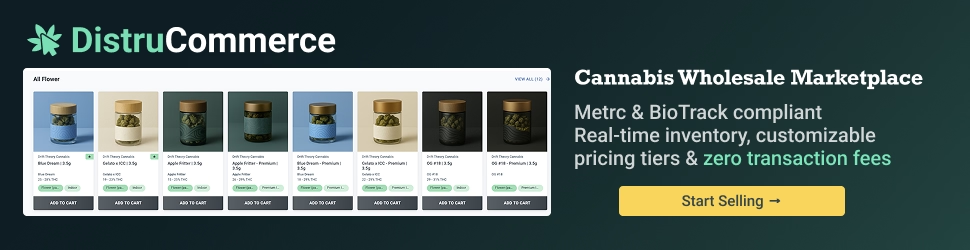
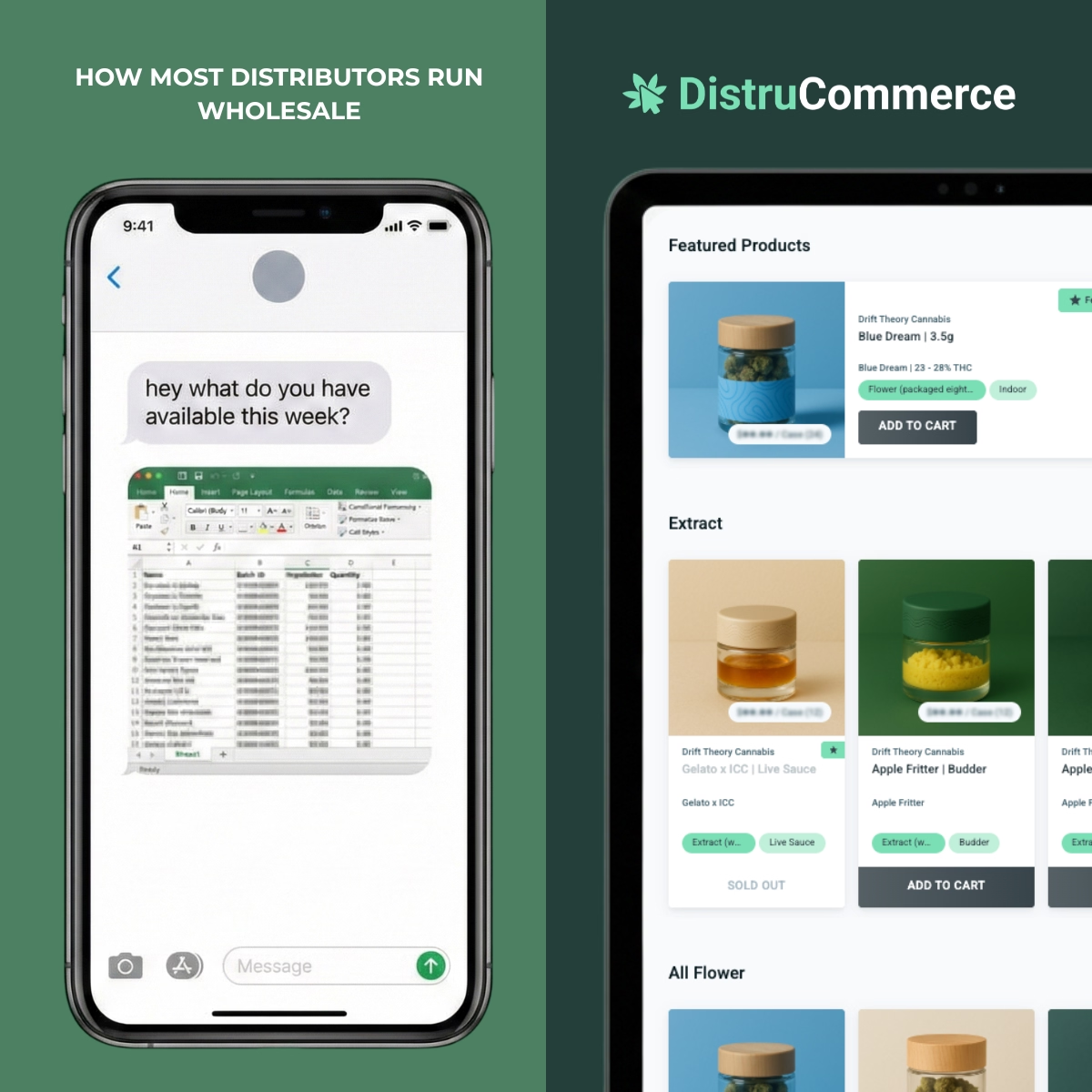
But you don't have to run two tools to get that coverage. Distru also includes its own built-in B2B marketplace, meaning you can manage discovery, ordering, and operations connected place with no third-party marketplace required.
Either way, the underlying logic is the same: your storefront needs to be connected to your actual inventory. If it isn't, you risk selling products you don't have, leading to those awkward calls where you have to tell a buyer their order can't be fulfilled. And on the buyer side, purchasing without a connected system can cause intake errors and compliance gaps between the point of purchase and final receipt.
A hybrid stack combines the best of both worlds, unifying the market-reaching power of a marketplace with the structural integrity of an ERP. This approach offers numerous benefits for both sides of the supply chain, including:
For vendors:
- Operational Efficiency: Keeps data flowing automatically between systems to avoid manual errors.
- Simplifyd Compliance: Handles state tracking and reporting in the background, not by hand.
- Inventory Accuracy: Sells only what you have in the warehouse.
- Precise Profitability: Links sales to real production costs for a clear bottom line.
- Frictionless Scaling: Processes orders at a higher velocity and reduces fulfillment turnaround times from days to hours, multiplying your capacity without the need for extra staff.
For buyers:
- Inventory Health: Shifts procurement from gut feelings to data-driven refills.
- Simplifyd Intake: Simplifies reconciliation of deliveries against original POs.
- Performance Tracking: Measures vendor turnaround times and fulfillment accuracy.
- Enhanced Compliance: Automates COA validation and state reporting at intake.
As a buyer, even though you aren't the one clicking the buttons in the software, you reap the rewards of your vendor's ERP-backed internal success. You gain real-time inventory visibility, reliable product availability with exact delivery dates, bulletproof compliance, recall readiness, simplified paperwork, and data-driven insights for your purchasing.
| What to look for | How Distru delivers it | Highlight |
|---|---|---|
| Two-Way Compliance SyncMetrc · BioTrack |
Syncs with Metrc and BioTrack every 3 to 40 seconds. Package splits, transfers, and manifests reflect in the state system instantly.
|
3–40 pings/sec |
| Inventory and FulfillmentERP · Warehouse |
Batch-level tracking, multi-location sync, hard allocation on order placement, and full pick, pack, and manifest generation in one place.
|
Hard allocation |
| AI Order AgentAutomation · Sales |
Reads orders from texts, emails, PDFs, and images. Matches products to your menu and builds a checkout-ready cart. Teams save 40+ hours per week.
|
40+ hrs saved/wk |
| Secure Order WorkflowsOperations · Compliance |
Automated invoicing, one-click document attachment, and granular user permissions with a full audit trail of every action.
|
Full audit trail |
| Ecosystem IntegrationsQuickBooks · Xero · Sage |
Native QuickBooks two-way sync plus Xero and Sage compatibility. Track-and-trace, fulfillment, label printing, and POS integrations connected hub.
|
One hub |
| COGS Tracking and PricingFinance · Accounting |
COGS tied to real production runs so you know true margin on every sale. Flat monthly pricing with no GMV fees at any revenue level.
|
$0 GMV fee |
| Transparency and Vendor TrustSupport · Data ownership |
Your customer lists and data stay yours. Support is reachable when a manifest gets stuck and total cost of ownership is clear before you sign.
|
You own your data |

What Operators Really Need From a LeafLink Alternative
LeafLink is a partner we're proud to work with. As an industry leader, it has transformed how cannabis businesses connect and grow together. However, choosing your tech stack is a personal decision. It should be driven by your specific operational needs, not just by the biggest name.
When figuring out what to look for in a cannabis marketplace, go beyond the lure of sheer size or discovery potential. Instead, prioritize the core functions that keep your business running smoothly day-to-day.
Whether you're a vendor managing distribution or a buyer streamlining procurement, the best LeafLink alternatives keep your business running on solid ground. For brands, that means complete visibility into your inventory in real time. For both sides, it means staying compliant across every transaction and connecting smoothly with your existing tools.
You also want transparency and pricing that makes sense. As your business expands, your technology costs shouldn't become an unpredictable burden. Your chosen platform must be a motor, not a brake, offering the scalability to handle fluctuating volumes and the reliability to meet the rigorous demands of the cannabis supply chain.
Key Features to Evaluate in LeafLink Alternatives
When you're in the daily operations of cannabis, a logo doesn't fix a broken manifest; features do. You need to look past the brand and evaluate tools based on how they handle your specific stress points. What wholesale platform features matter most for cannabis distributors and brands? How does that set of priorities shift when you're a cultivator or manufacturer? And what if you're a retailer looking to stock your shelves? Every seat at the table has a different "must-have" list, so let's dig into the non-negotiables.

1. True Two-Way Compliance Sync (Metrc and Track-and-Trace)
If your marketplace doesn't talk to the state, you're doing twice the work for half the accuracy. Metrc and BioTrack are the government's window into your business, and any LeafLink alternative you choose must integrate smoothly with whichever system your state mandates.
A "connected" platform that only imports data is nothing more than a digital filing cabinet. As a vendor, you need a two-way integration. When you perform an action in your warehouse, such as splitting a package, it should be reflected in the state's eyes instantly. Without a true sync, you risk selling a product that has already been pulled for another order, leading to inventory discrepancies and potential regulatory red flags.
If you're a buyer, real-time sync means you won't waste time waiting for a manifest to push through before you can legally touch the product, nor will you spend time requesting manifests for package tags that have already been voided.
The big question you should be asking any software provider is: how do I know if that Metrc or BioTrack integration is actually real-time? If they tell you it syncs every hour, run. That's a 60-minute window where you might accidentally sell a ghost product that has already been promised elsewhere as a seller, or make purchase decisions based on data that is already obsolete as a buyer. Real integration looks like Distru, where the two-way sync happens every 3 to 5 minutes and every manifest or package adjustment reflects immediately in the state system.
2. Complete Inventory and Fulfillment Management
When it comes to cannabis inventory management, marketplace reliability depends entirely on the connection between the digital listing and the physical shelf. A wholesale platform is useless if the seller can't find the product on the rack or if the buyer is purchasing stock that doesn't exist.
As a seller, you need a marketplace that empowers you to manage batches with precision, syncs inventory across multiple locations in minutes, and bridges the gap between sales and logistics. It must give you the tools to simplify picking and packing, generate manifests, and accurately track every order from the moment it's lab-tested until it's dispatched.
As a buyer, you need a guarantee of fulfillment. A reliable system ensures that the moment you place an order, that stock is hard-allocated to you, providing total transparency from cart to delivery and preventing the frustration of out-of-stock emails sent hours after you thought your procurement was finished.
3. AI Order Agent
Most buyers don't place orders through a portal. They text. They email. They send a PDF, a screenshot, or a handwritten list. If your platform can't handle that reality, your sales reps are stuck doing manual data entry for every single order that comes in through any channel other than the storefront.
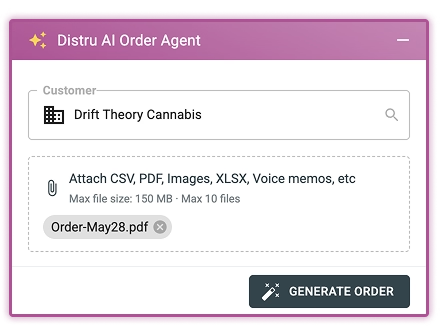
Distru's AI Order Agent changes that. It reads orders from texts, emails, PDFs, images, and CSVs, then automatically matches the requested products to your DistruCommerce menu and builds out a checkout-ready cart for your rep to review and confirm. It respects your menu rules, flags out-of-stock items, and handles buyer shorthand and typos through fuzzy matching so the right product lands in the right cart.
The result is real time savings. Operators using the AI Order Agent are saving 40 or more hours per week, and teams have pushed hundreds of thousands of dollars in orders through it in their first week. Your buyers keep ordering the way they're used to, and your reps skip the manual entry entirely.
4. Secure, Scalable Order Workflows
Your marketplace must offer more than just a digital catalog. As your volume kicks up, a loose order management system becomes a liability for everyone involved in the transaction. A good LeafLink alternative must deliver a way to move beyond messy spreadsheets and endless text threads.
Look for platforms that automate order workflows with features like real-time inventory syncing, integrated state reporting, instant invoice generation, and one-click document attachment. As a seller, you should also get granular user permissions, so your sales reps can move your products while your accounting team controls the final invoice. This protects your margins and creates an audit trail that shows exactly who changed what and when.
As a buyer, you want a simplifyd procurement experience where you can approve structured, legally binding POs, review COAs, track order status, and receive clear invoices in one place. Scalability matters here too. Your workflows should stay rigid enough to be secure and efficient but flexible enough to accommodate growth as your business matures.
5. Ecosystem Integrations That Actually Reduce Work
In 2026, working in a silo is a choice to fall behind. Integration is the bridge between your marketplace and the specific tools you use to run your business.
If you're a seller, your ERP should connect your marketplace directly to your entire back office, including track-and-trace, fulfillment and logistics, label printing, and shipping tools. When a sale is made, the system should automatically allocate the specific batch, trigger the warehouse to pick and pack, and generate the necessary labels and manifests without manual effort.
If you're a buyer, your marketplace should integrate directly with your POS to simplify procurement, allowing you to convert an order into a digital intake record that pre-populates your retail shelves with the correct strain data and compliance information.
Both sides also rely on accounting tools. The best integration here isn't just an export function; it's a deep, native connection that automates COGS calculations, maintains real-time margins, and keeps your financial records clean. Distru integrates natively with QuickBooks and supports Xero and Sage, and it already includes the connections above in one centralized hub.
6. COGS Tracking and Pricing Transparency
Knowing what you sold is not the same as knowing what you made. Without cost of goods tracking connected to your actual production runs, your margins are an estimate at best and a liability at worst.
For vendors, a strong LeafLink alternative should link every sale back to its true production cost, so you always know whether a deal was actually profitable before you repeat it. This is especially critical as you scale and add SKUs, locations, or distribution partners.
For the platform itself, pricing transparency matters just as much. Beyond the sticker price, account for marketplace fees, payment processing costs, the soft costs of a system that's hard to use, and potential switching costs down the road. Distru charges a flat monthly fee with no GMV fees, so your cost stays predictable whether you sell $10K or $10M a month.
7. Marketplace Transparency and Vendor Trust
At the end of the day, you're trusting a vendor with your most sensitive data. You deserve to know exactly who owns that information and what you're paying for it. For sellers, data ownership prevents your customer lists and performance stats from falling into a competitor's hands. For buyers, it ensures your purchasing habits aren't being used against you.
That same openness should apply to the human side of the partnership. You need a support team that actually answers when a manifest gets stuck. If a vendor is cagey about their reputation or hides their support metrics, take that as a red flag. True transparency means the vendor helps you calculate the total cost of ownership upfront, not after you've signed.
| Feature | How Distru delivers it | Highlight |
|---|---|---|
| Flat monthly pricingPricing |
No GMV fees. Your cost stays the same whether you sell $10K or $10M a month.
|
$0 GMV fee |
| Brand-owned storefrontMarketplace |
Embeddable on your website, under your own URL. Your brand, your experience.
|
Your domain |
| Real-time inventory syncERP + Marketplace |
Menu inventory auto-syncs from your ERP the moment stock changes. Retailers always see what is actually available.
|
Always live |
| Buyer discovery networkMarketplace |
Retailers browsing the Distru network can find and order from your brand. No outreach needed.
|
Free for retailers |
| Two-way Metrc syncCompliance |
3 to 40 pings per second. Packages, transfers, and manifests sync automatically with no manual matching required.
|
3–40 pings/sec |
| QuickBooks integrationFinance |
Full two-way sync covering sales orders, invoices, and credit memos. Changes flow in both directions automatically.
|
Full two-way sync |
| Production management and BOMsManufacturing |
Assemblies, inline repackaging, and BOM tracking built into the same platform you use to sell and ship.
|
Built-in ERP |
| COGS and cost accountingFinance |
COGS tracking connects directly to your production runs and sales data so you know true margin on every unit.
|
Native COGS |
| LeafLink integrationIntegrations |
Already on another marketplace? Distru integrates alongside it. No forced migration, no disruption.
|
Run side by side |

Exploring The Biggest LeafLink Alternatives in 2026
Choosing the best LeafLink alternative for distributors, manufacturers, cultivators, and retailers isn't about finding a clone; it's about discovering the right fit for your business model. Let's look at the top contenders currently leading the market.
DistruCommerce
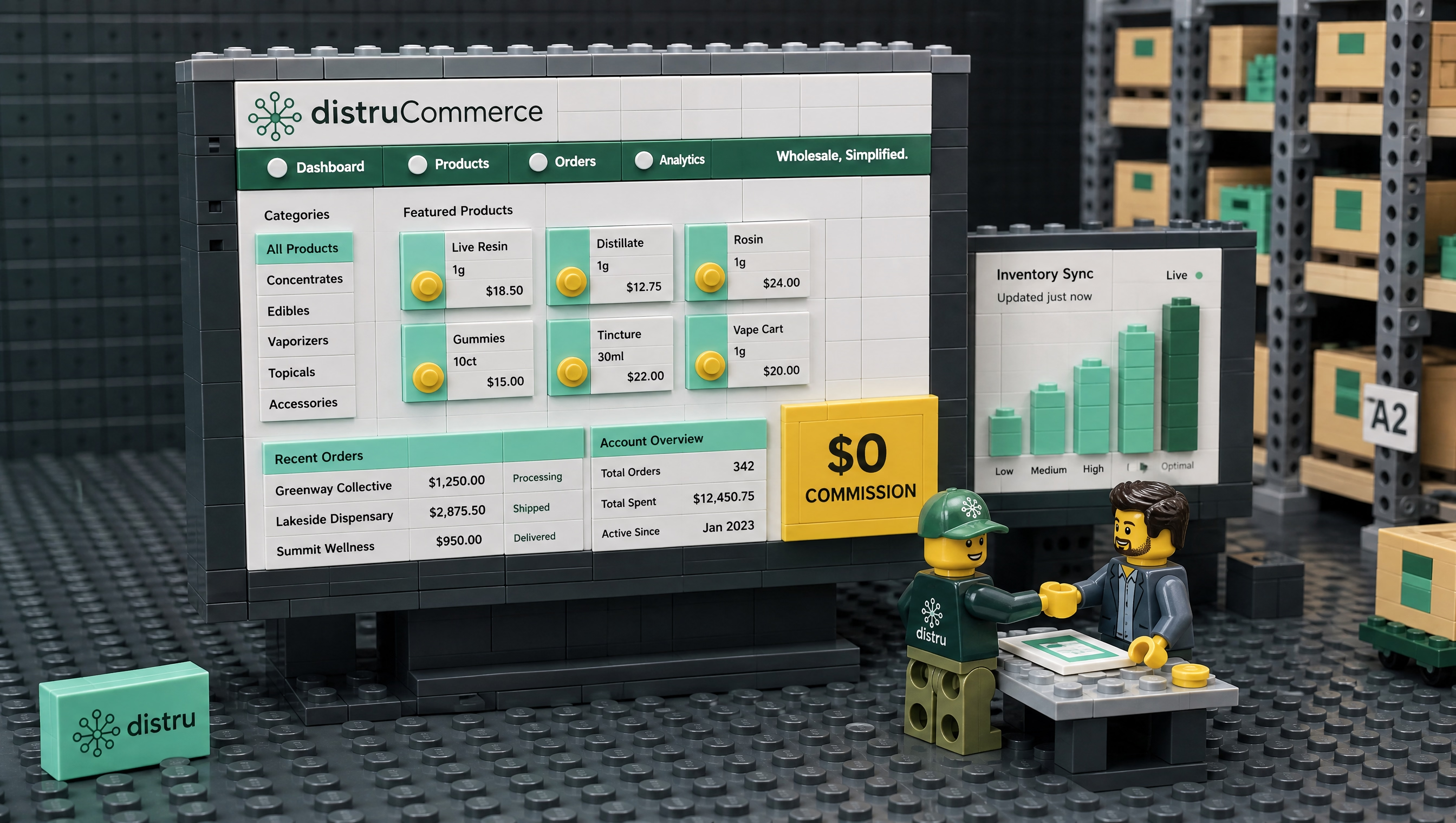
Ever feel like your marketplace and your physical inventory live in two different worlds? DistruCommerce, our cannabis wholesale solution, puts them on the same page.
For you, the seller, it's a branded, commission-free storefront that syncs with your warehouse in real time ("out of stock" means it's actually gone, so you can't oversell it). It allows you to run promotions or set customer-specific pricing, and manage complex, batch-specific fulfillment.
For you, the retail buyer, it's a dream procurement portal that gives you access to live menus, automated COA downloads, and instant order tracking through one free login, with the certainty that every item in your cart is physically accounted for and ready to ship.
Apex Trading
Looking to move away from platforms that commoditize your products and clutter your intake? Apex Trading offers a private, direct wholesale cannabis ordering system that protects margins for the seller and simplifies procurement for the buyer.
As a seller, Apex Trading provides a branded storefront where you maintain total control. Unlike wide-open marketplaces where products often get lost in the noise, this platform keeps pricing hidden from the public to ensure competitors can't undercut your rates. It functions as a direct sales tool that syncs with state-mandated systems and physical inventory in real-time, enabling you to set custom pricing tiers for specific buyers and fulfill orders with batch-level accuracy while avoiding the risk of overselling.
As a buyer, it's an easy to use sourcing engine that eliminates the back-and-forth of traditional procurement, letting you place orders in seconds. Instead of playing phone tag just to see what's actually available, you can browse live, verified menus through a mobile-friendly interface. Apex Trading also allows you to access past invoices, track delivery statuses, and reorder your top-performing SKUs with a single click.
Many choose to pair Apex's front-end catalog with Distru's back-end to get the best of both worlds: a pretty storefront backed by a powerful operational infrastructure. (Yes, Apex integrates with our ERP!).
How DistruCommerce Compares as a LeafLink Alternative
LeafLink is a powerhouse for connection. If your primary goal is gaining visibility as a seller, or finding a variety of new brands as a buyer, its network is hard to beat. However, as you scale, a discovery-first marketplace often hits a wall where a fulfillment and procurement engine is needed.
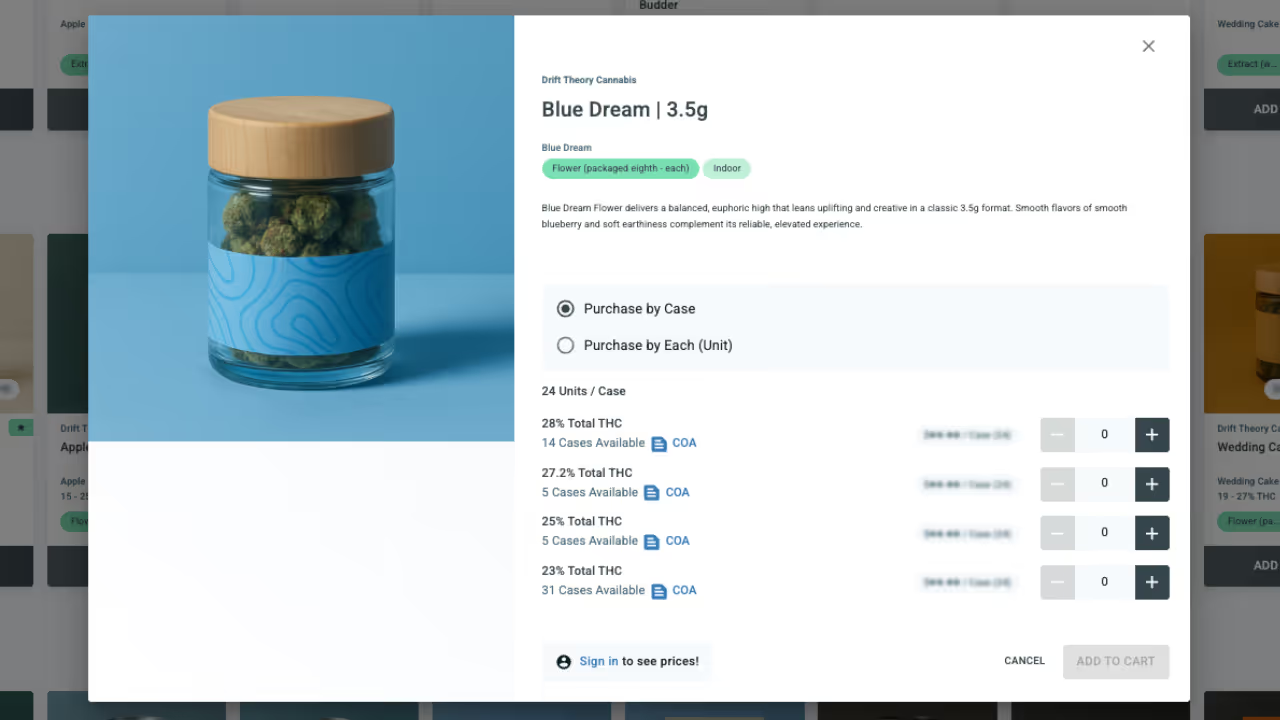
This is where DistruCommerce makes a difference.
Our platform sits directly on top of Distru ERP, functioning as a single source of truth rather than a disconnected marketplace where data must be imported or exported. Are you the seller? It ensures that your digital menu is a 1:1 reflection of your physical warehouse. Are you the buyer? You gain absolute certainty that what you put in your cart is physically reserved for you.
DistruCommerce also gives you, as a seller, total control over your brand aesthetics, pricing tiers, and promotions without paying a success tax on every transaction. And if you're a buyer, it simplifies your intake by providing a clean data set (manifests, COAs, and invoices) that matches the physical delivery.
We think DistruCommerce is the ultimate LeafLink alternative, but sometimes, you don't even have to choose sides.
As high-powered cannabis distribution software, Distru ERP connects directly with LeafLink. Brands like Drops and Eureka leverage our integration to create a smooth experience for both their buyers and their internal teams:
- LeafLink: Acts as the "front of house," giving buyers a familiar place to discover their products and purchase with ease.
- Distru: Acts as the "back of house," helping that the moment a buyer clicks "order" on LeafLink, inventory is locked, compliance data is synced, and fulfillment begins without a single keystroke of manual data entry.
The result of this integration is a professional, reliable handoff that keeps the seller compliant and the buyer coming back.
Choosing the Right Marketplace & Ops Platform for 2026
When the dust settles, the goal isn't just to find a place to buy or sell cannabis; it's to find a system that keeps your business healthy. In a market this competitive, neither the seller nor the buyer can afford a disconnected experience.
DistruCommerce arms sellers with a high-performance fulfillment engine that protects their brand, while offering buyers a reliable, free procurement portal that secures their peace of mind. Together, they create a more resilient cannabis supply chain.
Want to see how DistruCommerce supports modern wholesale operations? Schedule a demo today! And even if you've already chosen LeafLink as your marketplace, Distru provides the essential infrastructure to manage your work behind the scenes. Take a look at our ERP as well!