
In This Article:

Ask AI about this article
OpenAI
Claude
Perplexity
Google Gemini

One Inventory View or Five? What MSOs Actually Need

Distru Team  |
Updated
November 4, 2026
TL;DR

• Multi-state operators need per-state accounts for compliance reasons, but that shouldn't mean losing visibility across the whole business.

• The real question isn't one system versus five, it's whether those five systems can still be viewed and managed together when it matters.

• A structure that keeps state-level compliance intact while combining reporting and toggling between accounts is more realistic than a single unified system.

Every multi-state cannabis operator eventually asks some version of the same question: should we run one unified system, or separate setups per state? The honest answer is that the framing itself is a bit off. It's not really either-or.

Why You Can't Actually Have One System Across States

Cannabis compliance is state-specific by design, and that reality shapes your technology whether you like it or not. Each state's Metrc integration, licensing structure, and regulatory requirements need their own dedicated setup. Trying to force everything into one undifferentiated system creates real compliance risk, not efficiency.

Why This Isn't a Limitation to Fight

Treat state-level separation as a feature of operating in a regulated, state-by-state industry, not a technical shortcoming to engineer around. The goal isn't eliminating that separation, it's making sure it doesn't also mean losing the ability to see your business as a whole.

The Real Problem: Losing Visibility, Not Losing Structure

The actual pain MSOs feel isn't "we have separate state accounts." It's "we can't get one clean view of inventory and performance across those accounts without a manual reporting project every time someone asks."

What This Costs in Practice

A COO who can't answer "how much of Product X do we have across all five states right now" without pulling and combining five separate reports is losing real decision-making speed, and that lag compounds every time a fast-moving decision, a promotion, a reallocation, a new listing, needs current numbers.

What Actually Solves This

The right structure keeps state-level accounts intact for compliance while giving you a way to see and manage across them without a manual reconciliation project.

Separate Accounts, Combined Reporting

Each state runs its own account, configured for that state's specific requirements, but accounts can be toggled together so managers can move between them easily, and combined reporting can pull data from multiple accounts into one view instead of five separate exports someone has to stitch together by hand.

Multi-Brand Structure Within That, Too

If you're running multiple brands within a state, the same principle applies at a smaller scale. A distributor selling several brands can give each one its own branded DistruCommerce menu, keeping each brand's identity and customer-facing presence distinct, while still operating from one connected account underneath.
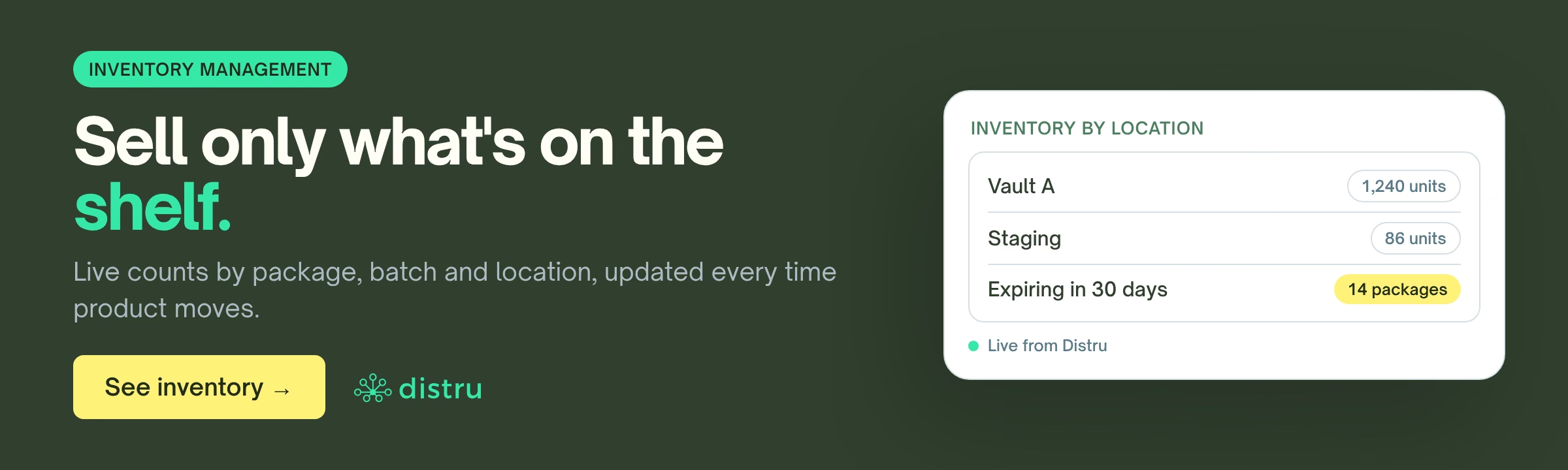
Sell only what's on the shelf. Inventory management. Distru.

Where This Gets Genuinely Harder

It's worth being honest about where this structure has real limits today, especially for the most complex multi-brand operations.

High-Volume Multi-Brand Distribution

A distributor running a very high volume of brands, each needing separate financial reporting and access permissions, runs into real gaps in how cleanly that separation can be maintained inside one account today. If that's your situation, it's worth a direct conversation about which tradeoffs matter most for your specific structure rather than assuming a generic setup fits.

A Practical Way to Evaluate Your Own Setup

Ask how long it currently takes to answer "what's our total inventory position across all states right now." If the honest answer involves multiple people and a spreadsheet, that's the gap worth closing, regardless of how well each individual state account runs on its own.

What This Looks Like as You Add States

The visibility question gets more urgent, not less, every time you add a new state to your operation.

Each New State Multiplies the Manual Reporting Burden

If combining data across states already requires manual work at three states, that same manual process doesn't scale gracefully to six or eight. The visibility gap that was merely annoying at a smaller footprint becomes a genuine operational risk at larger scale.

Plan for the Structure Before You Need It

Address the reporting and visibility question while you're adding your third or fourth state, not after you're already struggling with your eighth. The earlier you fix this, the less reconciliation debt you accumulate along the way.
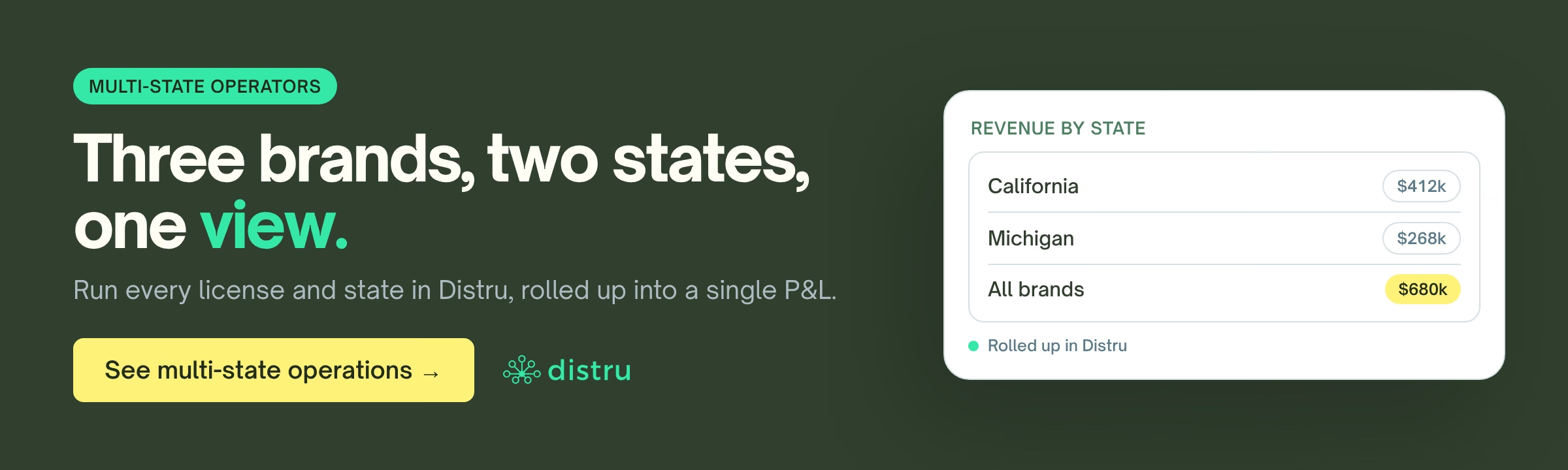
Three brands, two states, one view. Multi-state operators. Distru.

Want to talk through what a connected multi-state structure looks like for your business? Schedule a demo with Distru.


FAQs

Can a multi-state cannabis operator run one unified system across all states?

Not entirely, and it shouldn't try to. Compliance requirements, Metrc integrations, and licensing structures are state-specific, so each state needs its own dedicated account setup.

What's the actual problem MSOs face if not having separate state accounts?

The problem is losing the ability to see the business as a whole, not having separate accounts. Not being able to answer a simple cross-state inventory question without a manual reporting project is the real pain point.

How can an MSO get unified visibility while keeping state accounts separate?

Through a structure where each state's account stays compliant and separate, but accounts can be toggled between easily and reporting can combine data across accounts into one view instead of manual, separate exports.

How does this apply to a distributor managing multiple brands within one state?

The same principle applies at a smaller scale: each brand can have its own branded DistruCommerce menu and identity, while still operating from one connected account underneath for that state.

Are there limits to this structure for very complex, high-volume multi-brand distributors?

Yes. Distributors running a high volume of brands that each need fully separate financial reporting and access permissions run into real gaps today, and that situation is worth a direct conversation about specific tradeoffs.

What's a simple way to evaluate whether my current multi-state setup is working?

Time how long it takes to answer a basic cross-state question, like total inventory of a specific product. If that requires pulling and combining several manual reports, that's the actual gap to address.

The AI cannabis library

Free skills to put AI to work on your inventory, compliance and costing, and guides on where it actually saves time.

SKILL
Forecasting

Distru Production Forecast

Know how much of each product to make this week, based on real sell-through.

SKILL
Finance and COGS

Past-Due Invoice Emails

Draft one payment reminder per customer for every past-due invoice.

SKILL
Customer Management

Company List Clean-Up

Clean a state license export or lead list before it goes into your CRM.

SKILL
Compliance

Cannabis Inspection Readiness

Turn an upcoming state inspection into a checklist, binder index and gap list.

SKILL
Compliance

Cannabis Transfer Manifest Precheck

Check a B2B transfer before the driver leaves and get GO or HOLD per line.

SKILL
Purchasing

Cannabis Replenishment Planner

Turn sales and on-hand exports into a reorder plan and a draft PO by vendor.

SKILL
Compliance

Cannabis State Rules Lookup

Get a cited, dated answer to a state cannabis rule question.

SKILL
Operations

Cannabis Staff Scheduling Planner

Build a shift schedule that matches demand and stays inside your labor budget.

SKILL
Cultivation

Cannabis Harvest Yield Analysis

See which rooms and strains actually make money, from your own harvest data.

SKILL
Compliance

Cannabis Traceability Reconciliation

Find out why your physical count doesn't match Metrc or BioTrack.

SKILL
Compliance

Cannabis SOP Generator and Trainer

Turn process notes into an inspection-ready SOP and a staff training packet.

SKILL
Finance and COGS

Cannabis Batch COGS Calculator

Find out what a batch really costs per finished unit, line by line.

AI GUIDE
Blog

Why the Harness Matters More Than the AI Model

Two products can use the exact same AI model and perform completely differently. Here's why the harness, not the model, usually explains why.

AI GUIDE
Blog

What Is an Agent Harness? A Plain-English Primer

An AI model alone can't do much. The 'harness' around it is what makes it useful. Here's what that actually means, no jargon required.

AI GUIDE
Blog

Why MSOs Need an AI Strategy Before More Software

Adding another point solution won't fix an MSO's AI readiness problem. Here's why the data foundation has to come first.

AI GUIDE
Blog

The Supply Chain Buyer's Guide to AI Agents and MCP

Evaluating AI agent features in supply chain software? Here's a practical buyer's checklist, including what MCP means for your evaluation.

AI GUIDE
Blog

AI in Supply Chain: What's Hype, What's Working

AI in supply chain gets a lot of hype. Here's an honest look at what's actually delivering results in 2026, and what still needs a person.

AI GUIDE
Blog

Where AI Agents Fit in Cannabis Compliance

Not every step of your compliance workflow is a fit for AI. Here's a clear map of where it helps, and where it should stay hands-off.

AI GUIDE
Blog

The Skills Ops Teams Will Need When AI Agents Arrive

AI agents are coming for repetitive ops tasks in cannabis. Here's what your team needs to get good at instead, starting now.

AI GUIDE
Blog

What Happens When AI Gets Access to Your ERP

Giving an AI tool access to your cannabis ERP isn't all-or-nothing. Here's what real, scoped access looks like, and what to watch for.

AI GUIDE
Blog

AI and 280E: Where Automation Actually Saves Money

280E just got more complicated for mixed medical and adult-use operators. Here's where automated cost tracking actually helps, and its limits.

AI GUIDE
Blog

Can AI Forecast Wholesale Demand Better Than Excel?

Your wholesale forecast spreadsheet has limits. Here's what AI-assisted forecasting can actually add, and where a spreadsheet still wins.

AI GUIDE
Blog

Should Your Cannabis Business Have an AI Strategy?

You don't need to be an AI company to have an AI strategy. Here's a practical starting point for cannabis operators, no hype required.

AI GUIDE
Blog

What Is Claude Cowork? Could It Kill Data Entry?

Claude Cowork lets AI work directly in your files and tools. Here's what that means for the data entry eating your cannabis team's week.