

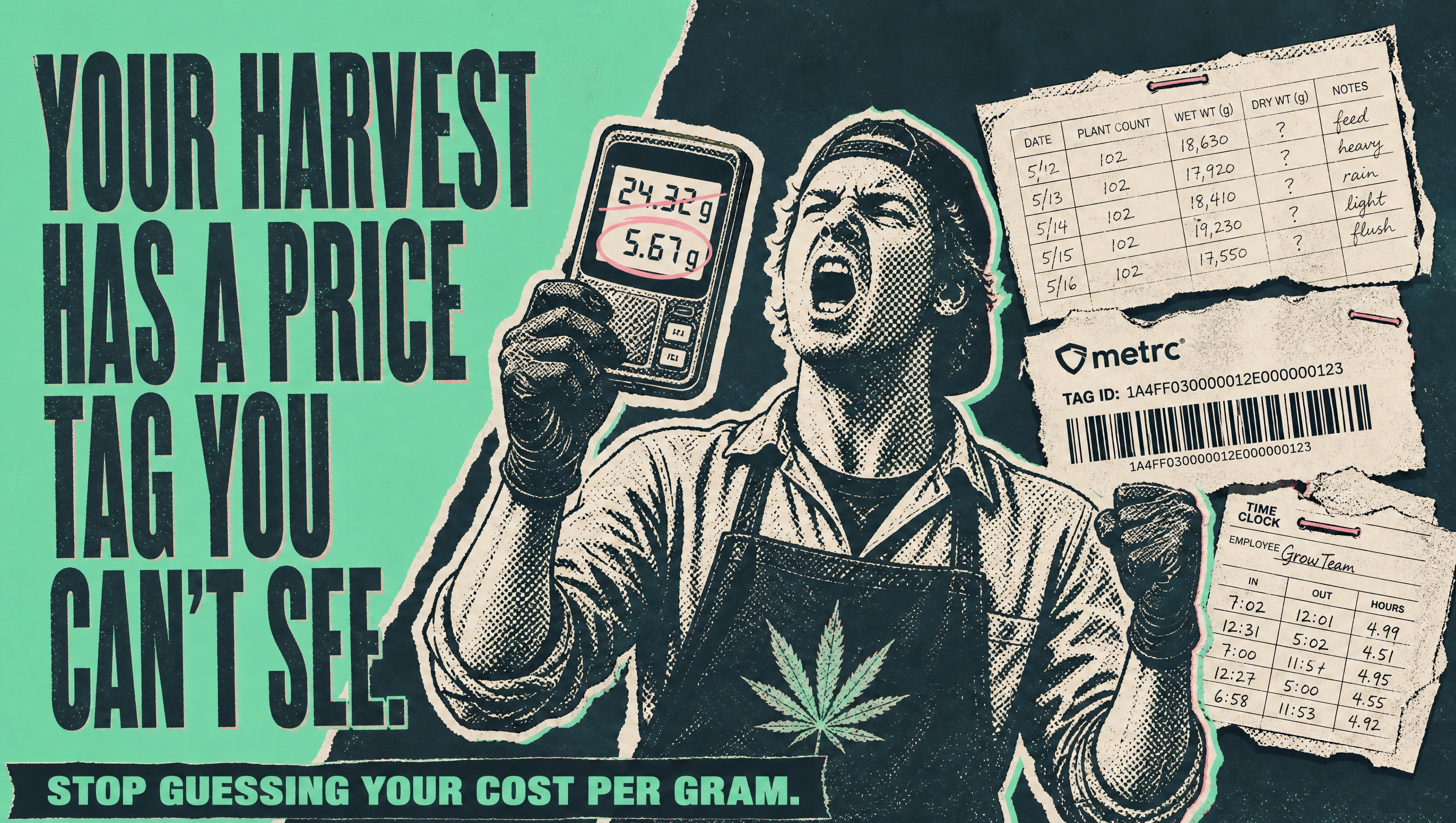
So you want to know what your harvest actually cost you? Here's the thing nobody tells you when you're getting into cultivation: you can grow the most beautiful flower anyone's ever seen, but if you can't say what a gram cost you to produce, you're running an expensive hobby instead of a business.
Most cultivators we talk to can tell you their yield down to the gram. Ask them what that gram cost to produce, though, and the answer gets fuzzy fast. Nutrients get logged in one spreadsheet. Labor hours live in another. Metrc has its own version of the story, and none of it talks to each other. By the time harvest wraps, you're stitching together three or four sources just to get a rough number, and "rough" is doing a lot of work in that sentence.

This isn't a discipline problem. It's a tooling problem. Growers are managing plant-level operations and financial operations in completely separate systems, then trying to reconcile them after the fact. Let's break down what's actually going wrong, and what connected cost tracking looks like when it's built into your grow from the start.
Why Cultivators Lose Track of True Costs
Here's a scenario that'll probably sound familiar. You're managing three grow rooms across two growth phases, with different strains on different feed schedules. Every batch pulls from a shared inventory of nutrients and additives, but nobody's logging exactly how much went to which batch. Labor gets tracked in a time clock system that has no idea which room someone was working in that day. Metrc gets its plant counts and movements, because that's mandatory. Cost data is optional, so it's the first thing to slip.
By harvest, you know your wet weight. You know your dry weight. You don't know, with any confidence, what it cost to get from one to the other. That's the real problem: cultivators are flying blind on the one number that actually determines whether the business is profitable.
This matters even more once tax season shows up. Under IRC Section 280E, cannabis businesses can't deduct most ordinary business expenses, but they can still reduce gross income through Cost of Goods Sold. Cultivation labor, growing supplies, and other direct production costs are the biggest lever cultivators have to legally manage their tax burden. If your cost data is scattered and incomplete, you're not just missing operational insight. You're leaving money on the table with the IRS too.
What Cultivation Costs Actually Look Like
Cost tracking in a grow isn't one number. It's a stack of them, applied at different points in the plant's life:
- Nutrients and additives applied to plant batches and individual plants throughout veg and flower
- Labor for feeding, moving, tagging, and monitoring plants across growth phases
- Room and equipment costs tied to specific grow spaces or cycles
- Waste and loss recorded at teardown, which eats directly into your yield
- Packaging and post-harvest processing costs once product moves toward sale
The problem isn't that these costs don't exist. It's that they're rarely captured at the point where they happen. A nutrient application gets written on a whiteboard, or not written down at all. Labor hours get estimated after the fact. By the time someone tries to build a true cost picture, they're reconstructing history instead of reading a live record.
The Moisture Loss Problem
Here's the part of cultivation cost tracking that almost nobody talks about clearly: moisture loss. You harvest wet weight. What you actually sell is dry, cured, sellable product. The gap between those two numbers isn't just a compliance detail, it's where a huge chunk of your real cost-per-gram story lives.
If you spent $4,000 in nutrients, additives, and labor getting a batch to harvest, and that batch loses 75% of its weight going from wet to dry, your true cost-per-gram just went up dramatically compared to a batch that only lost 65%. Two batches with identical inputs can have very different unit economics once moisture loss enters the picture. Most cultivators feel this in their gut but can't prove it with numbers, because the wet weight, the dry weight, and the cost data all live in different places.
What Connected Cost Tracking Looks Like
This is where the workflow needs to change. Instead of tracking costs in a side spreadsheet and plant data in Metrc, both need to live in the same system, tied to the same plant batches, from clone to sale.
That means:
- Apply costs and additives directly to Plant Batches and Plants as they happen, not reconstructed weeks later
- Track wet weight into a Teardown, then finalize it into a Metrc-synced Harvest with waste and package tags recorded along the way
- See moisture loss and cost data together, at the batch level, instead of estimating it after the fact
- Carry that cost data forward into whatever gets produced or sold from that harvest, instead of starting a new spreadsheet for production
This is the approach behind Distru's Cultivation module, part of the broader cannabis ERP that already handles compliance, inventory, and sales for cultivators who also process or distribute. Distru added a Cost Breakdown tab directly on the Harvest page, along with a Moisture Loss column in the Harvest CSV export, giving growers a per-gram cost story from plant to package for the first time. You're not reconciling three tools after harvest. You're reading one record while it's still happening.
Getting From Harvest Costs to What You Actually Sell
The other half of the cost story is what happens after harvest. A lot of cultivation software stops at the scale. It tells you what you grew and what it weighed, then hands that data off to a completely separate system for production and sales. That handoff is where cost data usually gets lost or flattened into a rough estimate.
Because cultivation lives inside the same ERP as production and wholesale, harvest inventory and its cost history flow directly into whatever gets made or sold next. No export, no re-entry, no translation step where the real numbers get rounded off. If you're a cultivator who also manufactures or distributes, that connection is the difference between knowing your true margin on a finished product and guessing at it.
What to Look for in a Platform That Tracks This
If you're evaluating cultivation software, ask these questions before anything else:
- Can costs and additives be applied at the plant batch level, not just estimated after harvest?
- Does the platform show wet-to-dry moisture loss next to cost data, not in a separate report?
- Does harvest data connect directly to production and sales, or does it require exporting and re-entering?
- Is Metrc compliance handled automatically, or is it a manual second step?
If the honest answer to any of those is "we'd have to build that ourselves," you're going to end up back in spreadsheets eventually, just with more steps in between.
Ready to See Your Real Cost Per Gram?
You don't have to white-knuckle harvest season wondering what it actually cost you. If you're already running Distru, ask your CSM about the Cost Breakdown tab and Moisture Loss reporting. If you're not, schedule a demo and we'll walk through your actual grow, not a canned one, so you can see exactly what connected cost tracking looks like for your operation.