

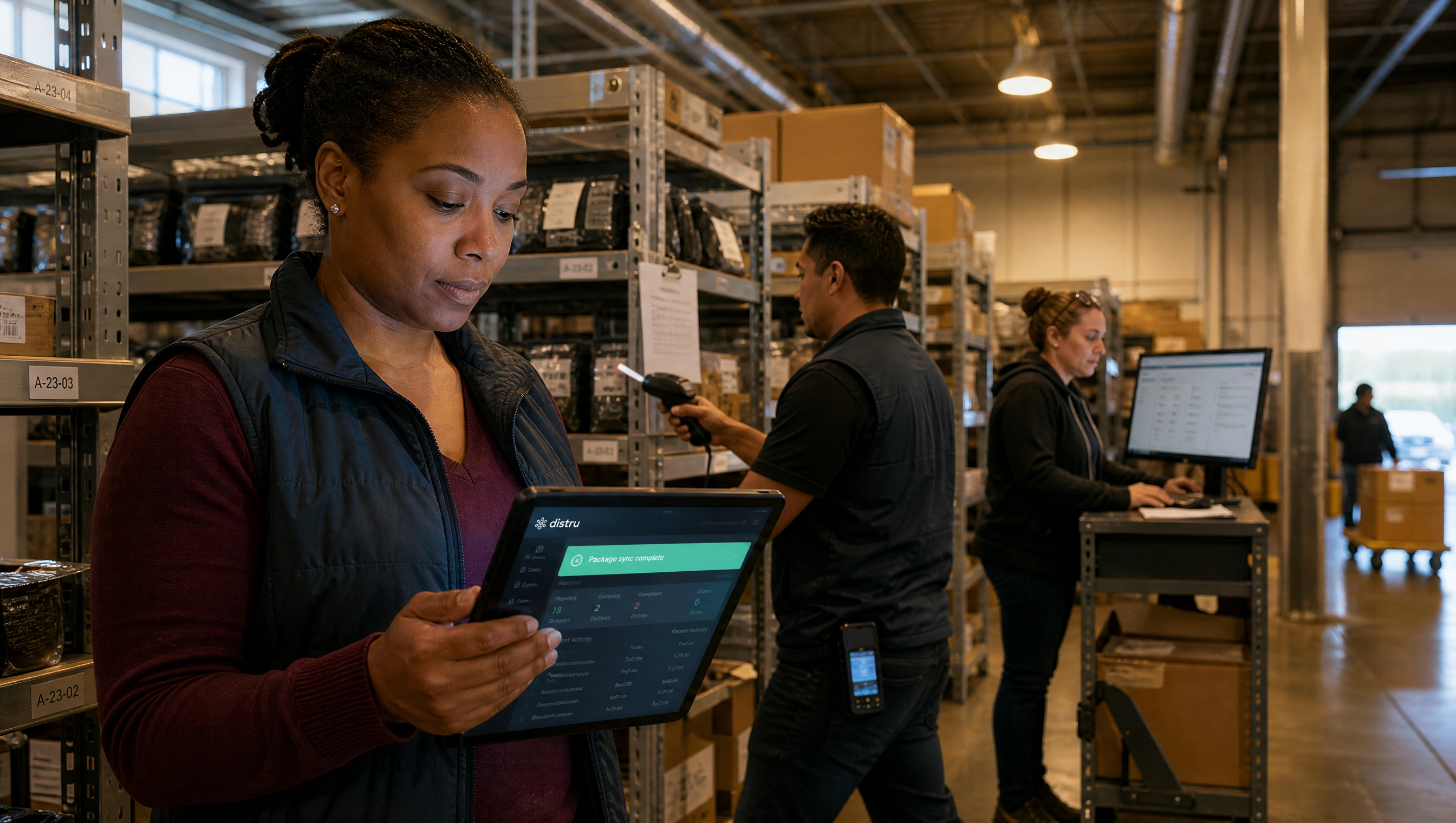
Ever finish a long shift only to stare at a stack of manifests, wondering if every decimal point is actually where it belongs? Almost every operator has that same thought at the end of the day: Is my paperwork really solid, or am I just one surprise audit away from a compliance violation? If you’re still manually typing 24-digit tags into a state system and chasing down counts on a messy spreadsheet, you already know the answer.
Those manual fixes that worked at a small scale become dangerous liabilities the second you add a new location or a dozen new SKUs, but finding the ideal software for managing state compliance reporting in your cannabis business protects your license and your peace of mind. Fortunately, we’re here to help you make the right decision!
.avif)
The Cannabis Compliance Landscape in 2026
The rules of the game are always changing, and keeping your cannabis state compliance on track feels like a moving target. To understand where we’re going, we have to look at the two giants currently running the show across the country.
Metrc States vs. BioTrack States
In almost every legal market today, you’re essentially forced to use compliance reporting software for your cannabis operations because the state requires a digital "paper trail" for every single gram.
While a few outliers like Washington have gone their own way with independent traceability models, the industry is largely a tale of two systems. Metrc is the undisputed giant in the room, currently powering the regulatory framework for over 20 states. Then you have BioTrack, which handles a smaller handful of markets.
The biggest difference between them comes down to scope. Metrc is strictly a track-and-trace system, it’s the state’s digital eye, but it doesn’t care about your sales floor or your customer CRM. BioTrack, on the other hand, often acts as a combined seed-to-sale and POS solution.
In 2026, we're seeing a massive shift toward Metrc. It just happened in New York, for example. We believe that it’s a signal that more regulators and business owners prefer the "government-only" track-and-trace model, leaving the operational side to third-party providers.
What Compliance Reporting Actually Requires
Since our industry is under a permanent microscope, we have to report every move through cannabis track-and-trace software. Regulators don't just want a "surface level" idea of what's in your vault; they want to see the entire lifecycle from seed to sale. This means you’re on the hook for reporting and have to
- Track inventory at the package level using those unique UID tags.
- Log every transfer manifest between your licenses and different locations.
- Report every harvest weight and production run detail.
- Document all waste, including exactly how it was destroyed.
- Manage lab testing results and keep COAs attached to every batch.
- Report every retail sale in near real-time.
Every single one of these data points has to match the state’s system properly. If your physical shelf says you have 500 units, but the software says 498, that discrepancy is a flag waiting to be caught.
Why Manual Compliance Breaks at Scale
Reporting your cannabis activities through a track-and-trace software is one thing when you're a single-license boutique with 50 SKUs. It’s annoying, but it’s manageable, barely. But once you scale up to a multi-license operation with 500+ SKUs spread across different zip codes? Trying to do that manually is a recipe for disaster.
The math just doesn't add up for manual work anymore. Operators have told us they spent over 100 hours a week just on compliance paperwork before they switched. Think about the failure points: a mistyped tag number, a transfer entry that got delayed by a day, or a simple mismatch in a cycle count. They're the biggest audit triggers.
This is why cannabis compliance software has become a necessity. It’s the bridge that talks to the state’s database for you, taking the data from your actual day-to-day work and handling the state’s requirements without you having to touch a spreadsheet.
What Cannabis Compliance Software Actually Does
This tool is the translator between your busy facility and the rigid, demanding world of state regulators.
When you use seed-to-sale compliance software, you ensure that every harvest, package, and sale is recorded in a way that keeps the "government's brain" happy without slowing down your team on the floor. Here’s how:
Real-Time Track-and-Trace Integration
To understand how this works, we have to talk about APIs. An API is essentially a digital handshake that allows your ERP to talk directly to Metrc or BioTrack. When these systems are connected, your data flows automatically, but the way they talk matters immensely.
You’ll often hear about one-way versus two-way sync. A one-way sync is like shouting into a void; your software tells Metrc what happened, but it doesn't listen to what Metrc has to say back. Two-way sync is a real conversation. It ensures that if something changes in the state system, your software sees it, preventing the dreaded "data drift" where your records and the state’s records start living in two different universes.
Then there’s the definition of "real-time." Some platforms use "batch syncing," where they send a big pile of data every hour or so. If you’re moving fast, an hour is an eternity for a mistake to sit unnoticed.
Continuous sync, however, happens instantly. Take Distru as an example. Thanks to our powerful Metrc integration, our software pings Metrc 3 to 40 times per second. When you create a package in our system, it exists in Metrc before you can even refresh your browser. There’s no lag, no manual exports, and zero "I hope this synced" anxiety.
Automated Reporting and Audit Trails
Regulators love a good paper trail, but you probably hate building them. Good compliance software takes the data from your actual operations, like weighing a harvest or finishing a production run, and turns it into the state-required records, ready for you to review and sync.
The real magic is the audit trail. Every single action in the system is logged with a timestamp, the specific user who did it, and exactly what the data looked like before and after the change.
If an inspector walks in and asks why a package weight was adjusted three weeks ago, you don't have to scramble. You just show them the trail. It’s the ultimate "get out of jail free" card because it proves you have total control over your inventory.
Package and Transfer Management
Managing packages is usually where the most manual errors happen. Whether you’re splitting a bulk flower lot into pre-roll units or remediating a batch, doing it directly in the state system is clunky. The right software lets you handle these moves within your own workflow.
It also simplifies transfer manifests. Instead of jumping back and forth between screens, the software handles the manifest creation and tracks the movement in real-time. This reduces your "Metrc touch points" to the absolute minimum.
In Distru, you really only need to go into Metrc for three specific things: to officially accept a package, to send a transfer, or to register a manifest. Everything else, the splitting, the labeling, the adjusting, is handled in the same workflow.
COA and Lab Testing Compliance
You can’t sell what hasn't been tested, and you definitely can’t sell what failed. Compliance software acts as a digital gatekeeper for your cannabis compliance tracking. It automatically pulls in lab results and Certificates of Analysis (COAs), attaching them to the specific packages.
This ensures that your sales team can't accidentally add a "test-pending" product to a wholesale order or a retail shelf. The data flows from the lab, through your system, and out to the customer or retail partner. As a result, you know that every gram leaving the building is 100% cleared and documented for state-mandated tracking for cannabis compliance.
How to Choose Cannabis Compliance Software
So, you’re ready to stop white-knuckling your way through every state report? Great. But before you go out and sign a contract with the first company that has a flashy website, you need to know that not all software for cannabis regulatory compliance is created equal.
Some tools are built by tech people who have never stepped foot in a grow room, and it shows the second you try to perform a simple task like a partial harvest or a bulk package split. Choosing the right partner comes down to the following:
Integration Depth: The Most Important Criterion
The absolute "make or break" factor is how deeply your chosen platform integrates with the state's system. You don’t want a tool that just "talks" to Metrc or BioTrack; you want a tool that lives in sync with them.
Not all integrations are built the same. Some are just one-way batch exports, think of this like sending a postcard once a day and hoping it arrives. Others are real-time, two-way syncs that behave like a live phone call.
For BioTrack integration, the software should:
- Automatically sync and audit your inventory in the ERP against what the state sees in BioTrack.
- Handle cannabis-specific workflows like creating extracts, managing stability samples, and processing flower lots without making you log into a second screen.
- Generate lab manifests and track COAs in a single interface so your sales and operations teams are always looking at the same numbers.
For Metrc integration, the software should:
- Offer a true two-way sync where updates in the ERP reflect in Metrc within seconds.
- Provide clear visibility into "Metrc-only" actions (like accepting incoming packages) without needing to leave your primary dashboard.
- Flag discrepancies immediately so you can fix them before they turn into a red line on an auditor's report.
And these are the questions you should be asking potential vendors:
- How often does the system sync with the state? (Is it every hour, or every few seconds?)
- Is the sync one-way or two-way?
- What happens if Metrc goes down? Does the software queue my actions so I don’t lose data?
Distru is currently the #1 Metrc integration partner by API call volume. We didn't get there by accident, we got there by building a system that pings the state system 3 to 40 times per second to make sure your records are bulletproof.
Compliance + Operations in One System vs. Standalone Compliance Tools
You’ll find two main types of tools out there: standalone cannabis compliance management tools and full-scale ERPs.
Standalone tools are often "compliance-only." They help you file reports and stay legal, but they don't know anything about your sales orders, your production costs, or your CRM. This creates a massive risk of "disconnected data." If your sales team sells a package but your compliance tool doesn't know about it until the end of the day, you’re operating in the dark.
Using a cannabis ERP for compliance, like Distru, is the smarter move because it merges your operations with your reporting.
When your warehouse team fulfills an order, the compliance reporting happens automatically. There’s no "truth" to reconcile because the operational data is the compliance data. This eliminates the risk of your state records diverging from your actual physical inventory, which is usually the #1 reason operators get into hot water.
Multi-State and Multi-License Support
If you’re planning to grow beyond one building or one state line, the complexity doesn't just double, it multiplies. Managing multiple locations often means juggling different rules. You might be in a Metrc state today, but your next expansion could be into a BioTrack market.
You need the best cannabis compliance software for multi-state operators that can handle both systems under one roof. Your software should allow you to manage virtual and physical locations smoothly, giving you a "bird’s-eye view" of your entire organization while still keeping the granular, state-specific data clean for each individual license.
Distru was built for this kind of scale, allowing you to toggle between locations and licenses without losing your mind or your data integrity.

Support and Implementation
Let's be real: at some point, something is going to go sideways. Maybe it's 10 PM on a Tuesday, and you have a massive transfer that isn't showing up, or an audit is scheduled for tomorrow morning and a tag won't sync. This is when the "software" part of the deal matters less than the "people" part.
A reliable cannabis reporting software provider should have your back with more than just a help desk ticket. You need a team that knows the industry inside and out.
- Implementation: You shouldn't have to wait six months to get live. At Distru, our average implementation takes 3 to 4 weeks, and some of our fastest operators have gone live in just seven days.
- Ongoing Support: We have a 19-person customer service team with real-world cannabis experience. With live chat available from 6 AM to 6 PM MT, our average response time is under 3 to 5 minutes. When you’re stressed, you don’t need an automated bot; you need a human who knows how to fix the problem.
Common Compliance Mistakes (and How Software Prevents Them)
Mistakes are part of life, but in this industry, a simple typo can feel like a disaster. When you’re reporting to the state, the margin for error is razor-thin.
Let’s look at the most common ways operators trip up and how a solid software for cannabis regulatory compliance keeps you on the right side of the law.
1. Mismatched inventory counts: This is the classic "physical vs. digital" showdown. You count 100 jars on the shelf, but Metrc thinks you have 102. Usually, it’s a sale that didn't record correctly or a jar that "fell off the back of a truck" (shrinkage). Discrepancies over 3% can trigger a full-blown audit and fines ranging from $1,000 to $50,000.
- The Fix: A good ERP like Distru performs continuous reconciliation. If you make an adjustment in the warehouse, it’s updated in the state system instantly, keeping that variance at zero.
2. Late or missing transfer manifests: You’re in a rush to get a delivery out, and the driver leaves before the manifest is finalized in the system. This is a major red flag for "diversion" (illegal sales). It can lead to immediate license suspension.
- The Fix: The software won't even let you print a shipping label or mark an order as "out for delivery" until the manifest is registered. It builds the compliance check directly into the shipping workflow.
3. Selling products before lab testing is complete: A hot new strain drops, and the retail team puts it out before the "Passed" status actually hits the state database. Massive health and safety violations and potential product recalls.
- The Fix: The system acts as a digital lock. If a package doesn't have a passing COA attached in the cannabis reporting software, it’s virtually "grayed out" and cannot be added to a sales order or scanned at the POS.
4. Manual tag entry errors: Someone tries to type a 24-digit UID by hand at 4 PM on a Friday. You’ve essentially created a "ghost package" that doesn't exist in the state's eyes, making your inventory reporting completely invalid.
- The Fix: Automation for Metrc compliance means you use barcode scanners and RFID readers. You scan the tag once, and the software handles the rest. No typing, no typos.
5. Not maintaining audit trails for inventory adjustments: You find a damaged unit and "adjust" it out of inventory without writing down why. During an audit, if you can't explain why 5lbs of flower disappeared, regulators assume the worst.
- The Fix: The software forces a "reason code" for every adjustment. Whether it's "moisture loss" or "damaged in processing," the software logs the reason, the user, and the time, creating a bulletproof trail.
6. Failing to account for waste properly: Trimmings or failed extractions get tossed in the bin without being weighed and logged as "waste." Regulators look at your yields. If 100lbs of biomass goes in and only 10lbs of oil comes out with no waste recorded, they’ll want to know where the other 90lbs went.
- The Fix: Waste logs are integrated into the production recipes. You can’t "close" a production run until the waste is accounted for and pushed to the state.
Final Thoughts
At the end of the day, staying legal shouldn't feel like a marathon. Compliance is a mandatory part of the job, but it doesn't have to be the thing that keeps you up at night or eats 100 hours of your team's week.
The right technology turns those terrifying "what-ifs" into a process you control from one system. When your software handles the heavy lifting of reporting, you’re free to get back to what actually matters: building a great brand and growing the best plant possible.
Schedule a demo today and see how Distru’s real-time Metrc and BioTrack integrations handle compliance automatically, so your team can stop living in Metrc and start growing.


