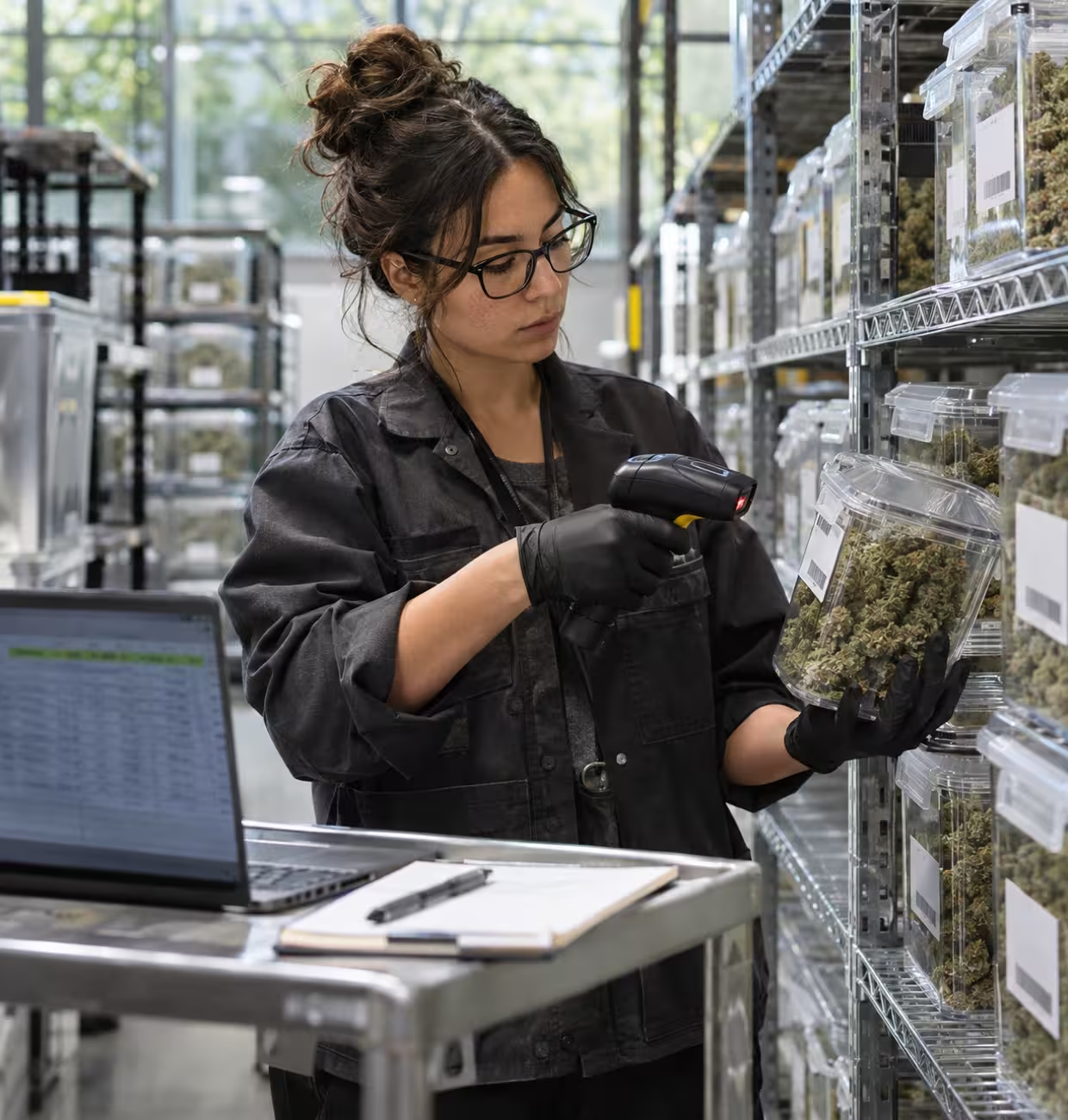

Same plant. Same package. Two very different systems. If you run licenses in Connecticut and Massachusetts, you already know the feeling: one state wants a numeric ID in BioTrack, the other wants an RFID tag in Metrc, and your team has to keep both straight.
And states don't stay put. Illinois left BioTrack for Metrc in 2025. New York picked BioTrack in 2022 and switched to Metrc before BioTrack ever went fully live. This guide will deblur the BioTrack vs Metrc question: who runs each system, where it's used in 2026, how tags, APIs, manifests, and adjustments differ, and what actually changes when your state switches. State lists were checked against Metrc, regulator, and trade press sources in October 2026.
What Is the Difference Between BioTrack and Metrc?
Metrc and BioTrack are the two main state-contracted seed-to-sale systems in U.S. cannabis. Regulators use them to follow every plant and package from cultivation to sale. Metrc tracks inventory with RFID tags it manufactures and runs in far more states. BioTrack's state system uses numeric identifiers and now operates in a smaller group of states.
One thing to clear up first. Your state chooses the system, not you. If your license is in a Metrc state, you report to Metrc. Your choice is the software you run your business on and how well it syncs with that state system.
Here's the side-by-side:
- Who runs it: Metrc, LLC holds 31 regulatory contracts. BioTrack's government work moved to BT Government, Inc., an independent company formed in August 2025. BioTrack itself now focuses on commercial ERP and POS software.
- Where it's used: Metrc is in 25 states plus D.C., Guam, the U.S. Virgin Islands, and the Bahamas. BioTrack's state system serves roughly seven states.
- Tags: Metrc uses RFID plant and package tags, plus QR-code Retail IDs in states that require them. BioTrack uses numeric IDs, often printed as barcodes.
- User interface: Metrc gives licensees a web interface. BioTrack setups vary by state. New York's BioTrack plan was API-first and required integrated software.
- Integrations: Each system has a state-specific API that third-party software connects to. Your ERP or POS has to be built for the specific state system.
- Cost to you: Metrc licensees typically pay for tags. In New York, every UID is $0.10, now mostly state-paid. BioTrack ID costs vary by state contract.
Which States Use Metrc vs BioTrack in 2026?
Metrc covers most legal U.S. markets. BioTrack's state system covers a handful, and the list keeps shrinking.
Metrc states: Per Metrc's June 2026 overview, Metrc runs in Alabama, Alaska, California, Colorado, Illinois, Kentucky, Louisiana, Maine, Maryland, Massachusetts, Michigan, Minnesota, Mississippi, Missouri, Montana, Nevada, New Jersey, New York, Ohio, Oklahoma, Oregon, Rhode Island, South Dakota, Virginia, and West Virginia, plus D.C., Guam, the U.S. Virgin Islands, and the Bahamas.
BioTrack states: In August 2025, MJBizDaily reported BioTrack as the selected provider in Arkansas, Connecticut, Delaware, Florida, Hawaii, New Mexico, New York, North Dakota, and Virginia. Since then, New York has moved to Metrc and Virginia appears on Metrc's list. That leaves Arkansas, Connecticut, Delaware, Florida, Hawaii, New Mexico, and North Dakota.
States in transition: New Mexico said in a June 15, 2026 bulletin that it's developing a successor to BioTrack and named no vendor. BioTrack stays in effect there until further notice. A few states use other vendors or their own systems.
Contracts change, so confirm your state's current system with your regulator before you buy software.
How Do Metrc Tags Compare to BioTrack Tags?
Metrc tags are physical RFID tags you order from Metrc. BioTrack tags are numeric identifiers issued by the state system. That one difference drives a lot of daily work.
Metrc: Plant tags strap onto each plant at the vegetative stage. Package tags stick onto every package, and each package gets its own tag. Tags are single-use. Some states add a per-unit QR code. In New York, that's the Retail Item ID, required on finished goods going to dispensaries since 2026.
BioTrack: Each plant or lot gets a unique numeric ID, typically 16 digits, that you print as a barcode label if you need a physical tag. New York's plan used 16-digit digital IDs with free starting allocations by license type. None of those carried over when the state moved to Metrc.
The practical takeaway: in a Metrc state, tag ordering and inventory become a real line item and a real process. Somebody on your team owns the tag count.
Metrc API vs BioTrack API: How Integrations Work
Each state system exposes an API, and your ERP or POS talks to it on your behalf. The API is state-specific, so an integration built for Metrc Colorado still has to be set up for Metrc New York.
Metrc: Software connects through the Metrc Connect API. Each licensee generates an API key in Metrc and gives it to their software provider. In New York, the Metrc Connect API and test endpoints opened to integrators on October 22, 2025, about seven weeks before credentialing closed.
BioTrack: Each BioTrack state publishes its own API for integrators. In New York, OCM made the BioTrack NY API available on November 18, 2024 and required licensees to use an electronic inventory system integrated with it, since the state system was set up API-first.
The question to ask any vendor isn't "do you integrate?" It's "do you sync two ways, in my state, today?" A one-way push leaves you reconciling by hand.
How Do Manifests and Transfers Differ?
In both systems, product can't move between licensees without a transfer record. The details come from state rules more than from the vendor.
Metrc: The shipper creates the transfer and registers the manifest in Metrc. The receiver accepts the packages on arrival, and any difference gets recorded. New York adds its own rules: one Package UID per package, Retail Item IDs on each unit going to a dispensary, and a TestPassed or RetestPassed status before transfer, per Metrc bulletin NY_IB_0011.
BioTrack: Transfers are logged in the state system with a manifest built before the product leaves, covering origin, destination, contents, and transport details. Each BioTrack state sets its own fields.
How Does Each System Handle Inventory Adjustments?
Each system lets you adjust inventory, but every adjustment needs a reason your state recognizes. Metrc adjustments use a reason from your state's list plus a note, and regulators watch the patterns. BioTrack states set their own adjustment and correction rules.
Either way, adjustments are where audits start. If your physical counts and your state system drift apart every week, the problem usually isn't the state system. It's that the numbers live in three places.
What Changes When a State Switches From BioTrack to Metrc?
Almost everything that touches the state system changes. Your products, customers, and history don't. New York is the clearest recent example.
- The trigger: On August 5, 2025, Metrc and BioTrack announced a partnership that moved BioTrack's government operations into BT Government. OCM paused BioTrack integration that day.
- The decision: In early September 2025, OCM said New York would move to Metrc. Its September 22, 2025 memo targeted full integration by the end of December.
- Credentialing: Every active licensee had to be credentialed in Metrc by December 17, 2025.
- New tags: Licensees ordered Metrc Plant UIDs, Package UIDs, and Retail Item IDs starting November 7, 2025. BioTrack IDs were retired.
- Beginning inventory: All existing inventory had to be loaded into Metrc by December 17, 2025, or January 12, 2026 for dispensaries.
- New workflows: Retail Item IDs and test status checks on dispensary transfers phased in between December 2025 and April 2026.
Illinois went the same direction on a longer runway. Its Metrc rollout ran in three phases from April to June 2025, and Metrc became the state's official tracking system on July 1, 2025.
The lesson from both: operators whose ERP already supported Metrc spent their time on tags and training. Operators who'd built around one state system had to rebuild. For the New York details, see what happened to BioTrack in New York and our dated NY BioTrack to Metrc timeline.
Is Metrc or BioTrack Better?
Neither is better for every operator, and you rarely get to choose. Metrc covers more markets and has a deeper bench of integrations. Its RFID tags add cost and handling. BioTrack's numeric IDs are lighter to manage, but its state footprint is shrinking and its government business changed hands in 2025.
What you do control is your ERP. Pick one that syncs two ways with the system your state uses now, and with the one it might use next.
How Distru Works With Metrc and BioTrack
Distru, a Cannabis AI ERP with a built-in B2B wholesale marketplace, has two-way, real-time integrations with Metrc and BioTrack. The sync runs on your command, so inventory, packages, and transfers in Distru match the state system without double entry.
In Metrc states, only three actions need Metrc directly: accept package, transfer package, register manifest. Everything else, from production and costing to sales orders, fulfillment, and invoices, lives in Distru. If your state switches systems, your items, batches, customers, and history stay where they are. You connect the new system and keep going.
Distru is the #1 Metrc integration partner by API call volume, with 440+ customers across 30+ states and $10B+ in wholesale sales processed. Running licenses in Metrc and BioTrack states, or facing a switch like New York's move to Metrc? Book a demo and we'll show you how Distru syncs with your state's system.