

Every software vendor calling you this quarter has an "AI" pitch. Half of them are talking about the same thing. The other half aren't, and most operators can't tell which is which because the vocabulary gets thrown around so loosely that it stops meaning anything specific. Let's fix that, one category at a time.
Automation: Rules, Not Thinking
Automation is the oldest of the three, and it's exactly what it sounds like. You set a rule, and the system follows it. "If inventory drops below 50 units, send a reorder alert." No judgment involved, no flexibility. It does exactly what you told it to do, every time, and it breaks the moment reality doesn't match the rule you wrote.
Where Automation Already Lives in Your Business
Most of what runs behind the scenes in a solid cannabis ERP is automation, and there's nothing wrong with that. Low stock alerts, auto-generated manifests, scheduled reports, recurring invoices. It's predictable, and predictable is a feature in a compliance-heavy business where "the system did something I didn't expect" is never a good sentence to say to a state inspector.

The Limits of Rules-Based Systems
The weakness of automation is exactly its strength: it can't handle anything you didn't anticipate. A rule that says "flag any transfer over 10 pounds" won't catch a problem that looks different from what the rule writer imagined. Automation scales well for known problems and fails silently on unknown ones.
Chatbots: Conversation, Not Action
A chatbot understands what you type and responds in kind. Customer support widgets, FAQ bots, the thing that answers "what are your hours" on a dispensary website. It's a conversation layer. Most chatbots can't actually do anything to your systems. They answer, they don't act.
Why Chatbots Feel Smarter Than They Are
Some chatbots are built on top of large language models and sound genuinely intelligent, holding a conversation that feels natural and specific. That's still not the same as being able to go update your inventory count or file a manifest. A chatbot can tell you what your return policy is. It generally can't process the return itself unless someone specifically wired it up to do so, and at that point, you've added a narrow slice of automation or agent behavior on top of the chat layer.
AI Agents: Plan, Act, Adjust
An AI agent is different in a specific way: it can break a goal into steps, decide what to do next based on what it finds, use tools to actually do it, and adjust when something doesn't go as expected. You give it an outcome, not a script.
A Real Example: Claude Cowork
Anthropic's own Claude Cowork tool is a clean example of the category. Instead of answering a question in a chat window, it works directly with your files and connected tools, plans a multi-step task, runs it, and delivers a finished output like a document or spreadsheet, checking in with you along the way rather than needing a step-by-step script written out in advance. It shows its work too, so you can see the files it opened and the choices it made instead of just getting a result with no visibility into how it got there.
A Narrower, Cannabis-Specific Example: AI Order Agent
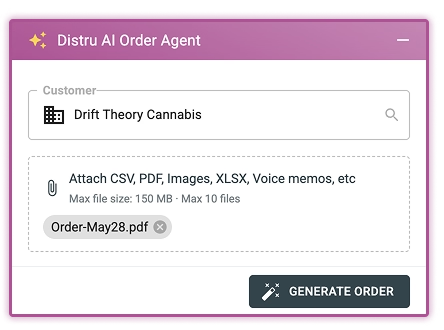
Distru's AI Order Agent works the same way in a much narrower lane. Buyers keep sending orders however they already do: text, email, a spreadsheet, even a photo of a handwritten list. The agent turns that into a clean sales order and flags anything that won't fill against your inventory. Your rep still reviews and sends it. Customers using it are saving 40+ hours a week that used to go into typing every line item by hand. That review step is the whole point. The agent proposes, the person decides.
The Real Dividing Line
Automation needs you to define every rule in advance. A chatbot needs you to ask the right question. An agent needs you to define the goal and lets it figure out the path. That's the entire distinction, and it's worth writing on a sticky note for your next vendor call.
| Category | What You Give It | What It Gives Back |
|---|---|---|
| Automation |
A fixed rule
|
A predictable action when the rule matches
|
| Chatbot |
A question
|
A conversational answer
|
| AI Agent |
A goal
|
A completed multi-step task
|
Why the Distinction Actually Matters to You
If a vendor pitches you "AI compliance," ask what it's actually doing. Is it flagging a rule violation someone coded in advance? That's automation. Is it answering your question about a rule? That's a chatbot. Is it pulling your Metrc data, cross-checking it against current requirements, and drafting the correction itself? That's an agent.
Three Very Different Price Tags
Those are three very different products with three very different price tags, and only one of them is doing something genuinely new. Knowing which one you're being sold protects your budget and your expectations. Paying agent prices for rebranded automation is an easy mistake to make when everyone in the room is using the same buzzword.
Where This Is Going for Cannabis Software
Most of the software you use today, including cannabis ERP platforms like Distru, runs primarily on automation with some chatbot-style support layered on top. Agents are the newer category, and they're moving into business software fast. The operators who understand the difference now will be the ones asking sharp, specific questions when agent-based features start showing up in their existing tools instead of getting sold on the buzzword alone.
Where Operators Get Burned Mixing These Up
The most common mistake isn't picking the wrong category on purpose, it's not realizing which one you bought until something goes wrong.
The "AI Chatbot" That Was Supposed to Fix Everything
A team buys a chatbot expecting it to reduce workload the way an agent would, then gets frustrated when it can only answer questions instead of taking action. The chatbot did exactly what it was built to do. The expectation was set for the wrong category from the start.
The Automation That Broke on an Edge Case
A rule-based system works fine for months, then a slightly unusual order comes through and the automation either silently fails or does something wrong with total confidence. That's not a bug, it's the nature of automation. It's not equipped to notice when a situation doesn't match its rules. An agent, in theory, would flag the mismatch instead of barreling through it. That's the entire value difference, and it's worth paying for only if you actually need it.
A Simple Test Before You Buy
Before signing anything with "AI" in the name, ask the vendor to walk through one specific example from your own operation, not a generic demo. Watch whether it just talks about the example (chatbot), applies a fixed rule to it (automation), or actually works through the steps needed to solve it (agent). That five-minute test tells you more than the entire sales deck.
Want to see what's automation and what's a genuine step forward in your current stack? Book a discovery call with Distru and we'll tell you straight, no hype required.


