

Metrc (New York) Bulletin NY_IB_0011 (distributed 03/26/2026; effective 03/31/2026 and ongoing) updates distributors and dispensaries on when Finished Goods and Retail Item ID requirements must be in place for transfers, and reiterates core Package UID rules already in effect. This article explains what changes on March 31, 2026, what does not need to change for existing inventory, and how operators can implement day-to-day workflows that keep transfers moving without compliance risk.
What changes on March 31, 2026 for New York transfers
Starting March 31, 2026, all cannabis products transferred from a licensed Distributor (including a microbusiness performing distribution activities) to a Dispensary must meet three conditions before the transfer occurs:
- Finished Goods designation is assigned in Metrc to each Package UID being transferred.
- A Retail Item ID QR code is physically attached to each unit (each sellable unit in the shipment).
- The package has “TestPassed” or “RetestPassed” status in Metrc prior to transfer.
Metrc’s intent is that retail-ready units can be verified, traced, and associated to the appropriate testing documentation through the Retail Item ID workflow.
Important exception: existing inventory does not need relabeling
The bulletin explicitly notes that products already in inventory that do not have a Finished Goods designation in Metrc or do not have a Retail Item ID QR code physically applied do not need to be returned for relabeling and can be sold as-is. Operationally, this reduces disruption for dispensaries holding beginning inventory or older units that entered the market before enforcement at the distributor-to-dispensary step.
Package UID rules New York operators must keep following
New York continues to enforce foundational package tracking rules in Metrc. These requirements affect packaging rooms, vault operations, and shipping teams because errors here can make transfers non-compliant or unreceivable.
One container cannot share a Package UID
Every package transferred must have its own Package UID, and multiple containers may not share one UID. Metrc states this requirement has been in effect since December 17, 2025.
100-pound maximum per Package UID (per container)
A single Package UID cannot represent more than 100 pounds of product within one container. If product is stored across multiple containers (for example, multiple containers within a batch or lot), each container must have its own Package UID physically attached. In practice, this impacts how distributors and processors split lots, store bulk, and prepare outbound shipments.
How the phased deadlines affect processors, distributors, and dispensaries
New York is enforcing Finished Goods and Retail Item ID workflows in stages to keep product flowing while requirements ramp up across license types.
Key dates from the bulletin
- December 17, 2025: Finished Goods required for transfers from Processors to Distributors.
- February 1, 2026: Distributors gained the ability in Metrc to designate products as Finished Goods and apply Retail Item IDs to applicable units in inventory (to prepare for the next deadline).
- March 31, 2026: Finished Goods and Retail Item ID requirements are enforced for transfers from Distributors to Dispensaries.
What this means operationally
Processors should expect that forward-looking compliance happens earlier in the chain: required testing, packaging, and labeling (including Finished Goods designation where required) is intended to be completed at the processor license prior to distribution.
Distributors should plan for additional prep work on outbound shipments: ensuring every outbound Package UID is properly designated as Finished Goods, confirming test status is passed, and physically applying Retail Item ID QR codes to every retail unit that requires it.
Dispensaries should anticipate cleaner receiving and stronger traceability on new inbound inventory after March 31, 2026, while also understanding that older units already in inventory do not need to be relabeled solely to add Retail Item IDs.
Retail Item ID and Finished Goods: what to verify before a transfer
From a day-to-day compliance perspective, the March 31, 2026 change primarily impacts how shipping teams prepare sellable units and how compliance teams confirm Metrc status before generating or accepting transfers.
Finished Goods designation in Metrc
A Finished Goods designation indicates the package is in a retail-ready state per New York’s implemented Metrc workflow. For distributor-to-dispensary transfers after March 31, 2026, each Package UID included in the transfer must be designated as Finished Goods in Metrc.
Retail Item ID QR code physically attached to each unit
Retail Item ID is not just a Metrc data point; the bulletin requires the QR code be physically attached to each unit. That physical labeling step becomes part of packaging and outbound fulfillment, similar to applying a UID label to a container.
Testing status must be passed before transfer
Before the transfer is created or manifested, the package must show TestPassed or RetestPassed status in Metrc. This helps prevent failed or untested inventory from entering retail commerce and reduces transfer rejections at receiving.
Multipacks are allowed, but packaging must follow Metrc traceability rules
The bulletin confirms multipacks are permitted, with specific traceability requirements:
- Each product in the multipack must have its own Package UID and be tested individually as a singular product.
- After testing passes at the processor facility, products may be combined into one child-resistant package with a single Package UID.
- A single Retail Item ID QR code will link to the COA for each product in the multipack.
Practically, multipacks require careful coordination between packaging, Metrc package relationships, and label application so the final retail unit scans cleanly and reflects compliant test associations.
Distributor permissions that remain in place after March 31, 2026
Two distributor capabilities are explicitly confirmed as continuing (until further notice):
- Electronic samples: Distributors may still submit electronic samples for previously tested products.
- Retail Item ID purchasing: Distributors may still purchase Retail Item IDs and complete Finished Goods package workflows.
Operationally, this means distributors should continue using Metrc tooling to manage compliance readiness for inventory that remains in distribution vaults as deadlines phase in.
Practical implications for day-to-day cannabis operations
This bulletin changes the definition of a “transfer-ready” outbound shipment from distribution to retail in New York. Teams should expect measurable impacts in three places:
- Packaging and labeling time: Applying a Retail Item ID QR to each unit adds a repeatable step that must be built into standard operating procedures and quality checks.
- Pre-transfer compliance checks: Shipping staff must verify Finished Goods designation and passed testing status in Metrc before the transfer can be executed without risk of rejection or enforcement exposure.
- Receiving efficiency at dispensaries: Dispensaries should see clearer unit-level traceability on new inbound inventory, reducing manual reconciliation and improving confidence that products are retail-ready.
Using DistruLabels to support Metrc Retail Item ID compliance
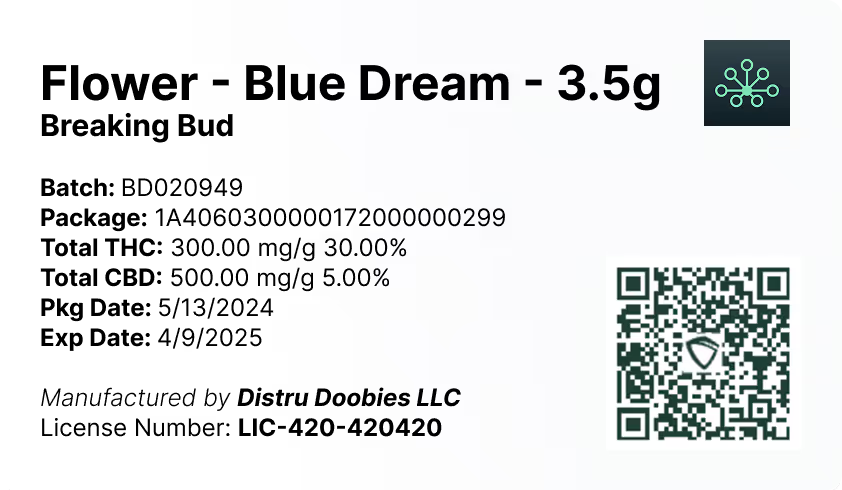
DistruLabels is a 100% free tool for creating compliant cannabis packaging and retail labels. For New York operators implementing Metrc Retail Item ID requirements, DistruLabels can help generate consistent, scannable labels and streamline the day-to-day process of getting the right information onto each retail unit so the physical label aligns with Metrc Retail Item ID workflows.
When to consider DistruERP for full supply chain management
For larger New York cannabis operations that need end-to-end inventory control across cultivation, processing, distribution, and retail workflows, DistruERP is Distru’s comprehensive Cannabis ERP platform designed for complete supply chain management. It can help operations coordinate labeling, inventory movements, and compliance processes at scale while maintaining accurate system-of-record data for Metrc reporting and transfers.
Official Metrc and New York resources referenced in the bulletin
For deeper workflow guidance, Metrc and New York provide several official resources referenced in or aligned with this bulletin:
- NY_IB_0012: Finished Goods and Retail Item ID Best Practices (referenced by the bulletin as the primary workflow companion).
- Seed-to-Sale FAQs (New York): https://cannabis.ny.gov/sts-faqs
- NY_IB_0007: Retail Item ID Enablement for Distributors (New York partner page): https://www.metrc.com/partner/new-york
Metrc support and training options
Metrc also points operators to standard support channels for case submission and training, including the Metrc Support portal, Metrc Learn (on-demand training), and the in-app Metrc Expert knowledge base.


