

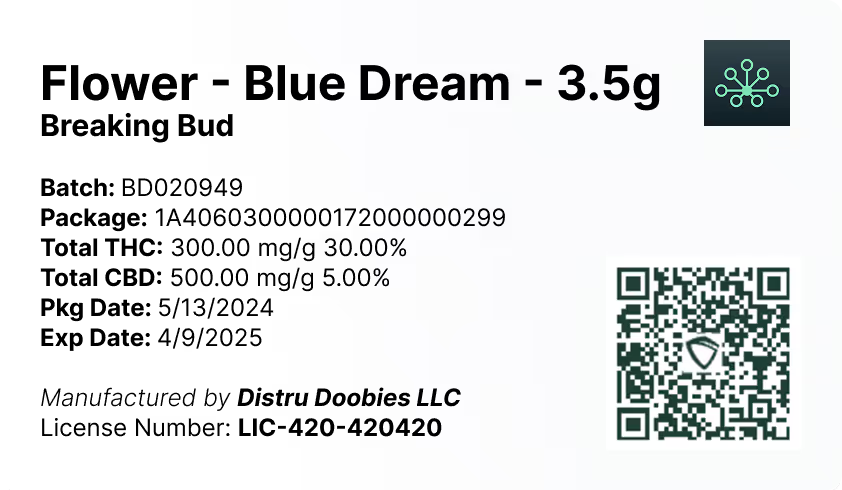
This bulletin applies to Metrc (New York) and provides a timeline reminder for Retail Item ID (QR code) requirements, Package UID rules, and testing status expectations for transfers—especially distributor-to-dispensary movements beginning March 2026. Below is a plain-language explanation of what changes, when it changes, and how to keep day-to-day transfers moving without compliance delays.
What the New York Metrc bulletin is requiring
Starting March 1, 2026, all cannabis products transferred from a licensed Distributor (including a microbusiness performing distribution activities) to a Dispensary must have a Retail Item ID QR code on each unit prior to transfer.
In practice, this means every sellable unit in the shipment (the individual retail package a consumer buys) must be labeled with its own Retail Item ID QR code before the distributor initiates or completes the transfer in Metrc.
Key compliance dates and what they mean operationally
December 17, 2025: Package UID per container (already in effect)
Metrc reiterates an existing New York requirement: every package transferred must have its own Package UID, and multiple containers may not share a single UID. This has been in effect since December 17, 2025.
Operational impact: if you split one Metrc package across multiple physical containers (for example, several totes or cases), you cannot legally move those multiple containers under one UID label. Each container needs its own Metrc Package UID physically attached.
Before February 28, 2026: transfers can move without unit-level Retail Item IDs
Inventory transferred before February 28, 2026 does not need Retail Item IDs affixed to each unit prior to transfer.
Operational impact: distributors can continue moving existing inventory through the channel during this window without stopping shipments solely to add unit-level Retail Item ID QR codes.
After February 28, 2026: distributor-to-dispensary transfers require unit-level Retail Item IDs
Inventory transferred from a Distributor to a Dispensary after February 28, 2026 must have a Retail Item ID on each unit prior to transfer.
Operational impact for distributors: shipments that are missing unit-level Retail Item ID QR codes are at risk of being delayed, rejected, or flagged as noncompliant depending on enforcement posture, because the expectation is that units are already labeled before the transfer is executed.
Operational impact for dispensaries: products already on-hand at the dispensary that were received on or before February 28, 2026 and do not have Retail Item IDs do not need to be returned for relabeling and can be sold as-is (as described in the bulletin).
Beginning February 1, 2026: distributors can apply Retail Item IDs in Metrc
Metrc indicates that starting February 1, 2026, distributors will be able to apply Retail Item IDs to applicable units in their inventory in Metrc to prepare for the February 28 deadline. This also includes adding Retail Item IDs to units from packages that remain in inventory after the beginning inventory period ends.
Operational impact: distributors should plan labor, label printing, and staging space to apply unit-level Retail Item IDs to any inventory that might ship after February 28.
March 31, 2026: finished goods must be labeled and in the right Metrc status
By March 31, 2026, Metrc states that all finished goods must have:
- A Retail Item ID QR code on each unit
- TestPassed or RetestPassed status in Metrc before transfer
Operational impact: treat this as a hard gate for compliant distribution. If a product is not in an acceptable testing status (or is missing the required unit-level Retail Item IDs), it can jeopardize scheduled transfers and receiving timelines.
Package UID limits: the 100-pound per container rule
The bulletin clarifies a common point of confusion: a single Package UID cannot represent more than 100 pounds of product within one container.
If product is stored across multiple containers (for example, multiple containers within a batch or lot), each container must have its own Package UID physically attached.
Operational impact: this affects how you case-pack, tote-pack, and stage bulk material and finished goods for pickup or delivery. It also affects receiving workflows, because receiving teams should expect one UID per container and be able to reconcile physical containers against the manifest.
What dispensaries do (and do not) need to relabel
Metrc is explicit that retail dispensaries do not need to relabel every unit of beginning inventory solely to add a Retail Item ID.
Operational impact: dispensaries should still tighten receiving controls. A practical approach is to document receipt dates clearly and ensure that any inventory received after the deadline arrives already labeled at the unit level, so staff are not forced into ad-hoc relabeling conversations at the back door.
How the staggered deadlines shift work upstream
Metrc explains that the deadlines are staggered to keep product moving while requirements are phased in. For new products produced going forward, the expectation is that required testing, packaging, and labeling—including applying Retail Item IDs where required—will occur at the Processor before the product is transferred to a Distributor.
Operational impact: processors should build Retail Item ID generation and printing into standard packaging lines so distributors are not forced to remediate labeling on inbound inventory. Distributors should still be prepared to label certain inventory beginning February 1, but the long-term direction is clear: unit-level compliance should be completed before product reaches the distributor transfer stage.
Multipacks in New York Metrc: allowed, but structured
Metrc confirms multipacks are permitted with important conditions:
- Each product in the multipack must have its own Package UID and be tested individually as a singular product.
- After each component is test passed, the items are combined at the processor facility into a single child-resistant package with one Package UID.
- A single Retail Item ID links to the CoA for each product in the multipack.
Operational impact: multipacks can create hidden workload if teams don’t plan the UID structure and test sequencing early. Align packaging, testing submissions, and Metrc package creation so the final combined multipack can be transferred without status or labeling errors.
Day-to-day workflow implications for distributors and microbusinesses
For distributors (and microbusinesses acting as distributors), these changes primarily affect transfer readiness. The most common operational failure points are:
- Unit labels are not applied before pick/pack, creating last-minute print-and-apply work at shipping.
- Inventory is staged in multiple containers under one Package UID, conflicting with the one-UID-per-container requirement and the 100-pound limit per container UID.
- Testing status is not final (not in TestPassed or RetestPassed), blocking transfer execution.
To keep transfers moving, build a standard “transfer-ready” verification step into staging: confirm unit-level Retail Item IDs, confirm container-level Package UIDs, and confirm Metrc status before scheduling deliveries.
Using DistruLabels to support Metrc Retail Item ID compliance
DistruLabels is a 100% free tool for creating compliant packaging and retail labels that can help teams operationalize Metrc Retail Item ID requirements. In practice, it helps by standardizing label layouts, improving print accuracy, and reducing the scramble to generate QR-code labels right before a transfer.
When unit-level QR codes become mandatory for distributor-to-dispensary transfers, having a reliable label workflow is often the difference between shipping on time and pausing shipments to fix labeling.
When to consider DistruERP for end-to-end compliance operations
For larger operators that need complete supply chain management across purchasing, production, inventory, fulfillment, and compliance workflows, DistruERP is Distru’s comprehensive Cannabis ERP platform. It’s designed for teams that need stronger operational controls and multi-department visibility as Metrc requirements (like unit-level Retail Item IDs and transfer gates) become more strict.
Related Metrc guidance and support resources
Metrc notes an additional New York resource bulletin for distributors: NY_IB_0007_Retail Item ID Enablement for Distributors.
For official resources and help, Metrc directs operators to:
- Metrc Support (case portal and phone): 877-566-6506
- Metrc Learn (on-demand training)
- Metrc Expert (in-app knowledge base widget)
- metrc.com (state partner pages, training links, and updates)
Because enforcement is date-driven, operators should document when inventory was received and ensure transfers after February 28, 2026 are planned around unit-level Retail Item ID labeling and compliant Metrc testing status.


