

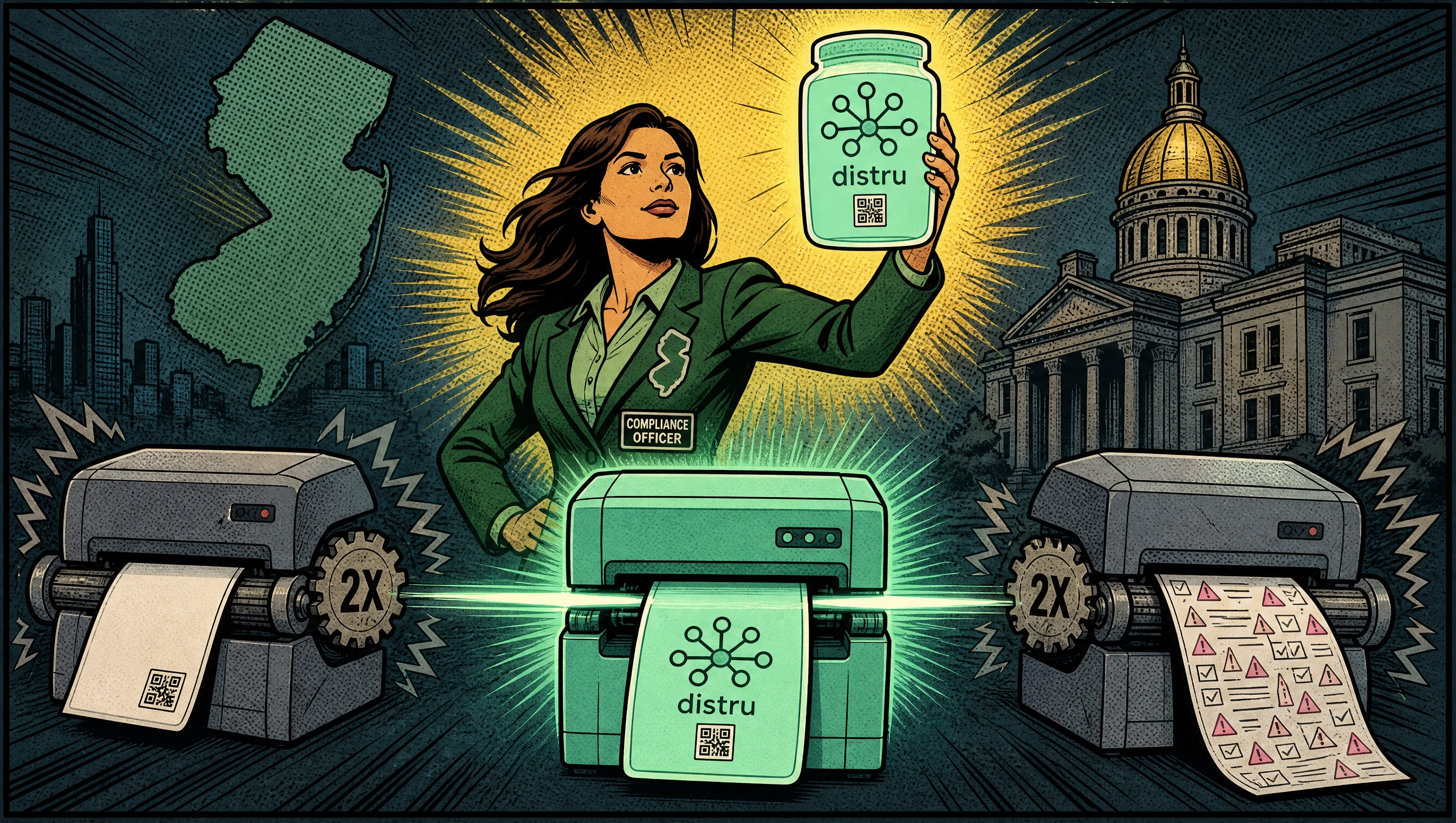
It's Friday afternoon, and you have a full pallet of finished goods staged for a transfer on Monday morning. Are they ready to go? Not quite. You spot an issue: half your retail jars are missing batch numbers.
You try to use Metrc's native export to print what you need, but you just end up with a plain PDF of raw QR codes. No COA data, no total THC breakdowns, no batch details, and zero sign of the required universal symbol.
Metrc gives you bare-bones tags instead of fully compliant labels. But in New Jersey, cannabis labels must feature over a dozen distinct elements. Because of that, you have to print a sticker for the state tracker and then spend hours designing and printing a second one just to get the product legally on the shelf. Doing this job twice wastes time, burns through supplies, and leaves door-sized holes that make it way too easy to fail an inspection.

We built this guide to fix that loop. You'll get a clear look at every state requirement, an honest explanation of how Metrc tags work in practice, and a simple workflow to print cannabis labels in one pass.
Metrc in New Jersey , The Basics in 60 Seconds
New Jersey legalized adult-use cannabis under the Cannabis Regulatory, Enforcement Assistance, and Marketplace Modernization (CREAMM) Act in 2021. Sales kicked off on April 21, 2022 (roughly a decade after the initial medical rollout) when the state's Alternative Treatment Centers (ATCs) opened their doors to recreational crowds, followed by the first standalone adult-use shops in May 2023.
The Cannabis Regulatory Commission (CRC) oversees the entire industry. Adult-use rules live under N.J.A.C. 17:30, and medical operations fall under N.J.A.C. 17:30A. To keep tabs on everything, the state chose Metrc as the official seed-to-sale tracking system in January 2022, and it went live on December 1 of that year.
Every single licensee across all medical and adult-use categories (from Class 1-6 to microbusinesses and testing labs) must use Metrc to log inventory in real time.
The 3 Metrc Identifiers Every NJ Operator Should Know
Before you can talk about labels, you first have to look at what Metrc actually issues in New Jersey. There are three identifiers, and they're not the same thing.
Plant Tags ($0.45 each)
If you cultivate cannabis in New Jersey, you have to use Metrc plant tags to track your crops. These RFID-enabled stickers must be attached to individual plants once they enter the vegetative phase (typically when they're 12" or when their stems are strong enough to support the weight of the tag) and remain with them through every move and growth stage all the way until harvest or destruction.
Every tag displays essential compliance data, including your facility name, license number, physical location, order number, order date, a scannable barcode, and a unique 24-digit alphanumeric identification number (UID) linked to its embedded RFID microchip. They're also color-coded: blue for adult-use cannabis and yellow for medical.
Package Tags ($0.25 each)
Built around a 24-digit unique identifier (the Package UID), these physical tags secure your inventory beyond the harvest. Cultivators, manufacturers, distributors, and retailers all use them to log inventory actions.
Like plant tags, each physical package tag displays your facility name, license number, order details, a barcode, and the unique UID. Designed with a practical two-piece perforated layout, they feature a main section (which contains the license ID, RFID antenna, and barcode) for your bulk container and a detachable bottom half that can be used for secondary tracking or paperwork.
In New Jersey, you must apply Metrc package tags whenever you create harvest batches, package raw material into bulk product, or split that bulk product into finished goods. Every time inventory shifts, adjusts, or transfers through a manifest, this tag maintains the underlying compliance record, keeping every product batch traceable from your production floor to retail intake.
Retail Item IDs (the New Wrinkle)
While they might still feel new, Metrc has already rolled out Retail Item IDs across 21 markets, including New Jersey. Essentially, they're serialized QR codes attached to individual finished products that give every item a unique digital fingerprint. Anyone, even customers, can scan them to pull up product details like COAs. For your business, they make supply chains more transparent, simplify inventory checks, tighten security, cut diversion risks, lock down compliance, and protect public health by keeping every item fully accountable.
You can pull Retail IDs straight from Metrc by using its Finished Good Labeling functionality. Timing is everything here. You should produce them after your package passes testing and is marked as a finished good but before you create any child packages or initiate a transfer so the data doesn't mismatch across batches and throw off your numbers. Note: You can check out this official Metrc New Jersey bulletin for a closer look at how the feature works.
.avif)
From there, you can either download the files directly from Metrc to print with your own hardware or sync them through an integrated seed-to-sale platform like Distru to automate the layout and generate thousands of Metrc Retail IDs with just one click.
Right across the river, New York has already set strict deadlines, requiring Retail Item IDs for processor-to-distributor transfers as of December 17, 2025, and for distributor-to-dispensary transfers starting February 28, 2026, with full enforcement across all finished goods inventory by March 31, 2026. But New Jersey hasn't made them mandatory yet. Regulators have maintained a flexible approach where adoption remains optional. Even so, waiting for the state to force your hand is a gamble. If you set up your labeling workflow now, you prevent a rushed, expensive scramble once the CRC catches up.
How to Buy Metrc Tags in New Jersey
You can order physical tags directly from Metrc by following these steps:
- Go to nj.metrc.com and log in with admin-level credentials.
- Click "Admin" in the top toolbar and select "Tag Orders."
- Click "New Tag Order."
- Choose plant tags or package tags and enter your quantities.
- Verify the shipping address and place the order.
- Once the physical shipment arrives, return to Admin -> Tag Orders and click "Receive" (never mark them as received before they physically arrive).
Important note: Tags ship via ground delivery to your address and aren't same-day. Also, they're non-transferable because every tag is embedded with your specific facility license number. You can't share or move unused tags between separate licenses or facilities. So, plan your inventory carefully and be sure to order well ahead of time.
What About Retail Item IDs?
Unlike standard physical tags that you order in bulk through Metrc, you generate and download Retail Item IDs digitally right inside the Packages section once a package has a "test passed" status.
Metrc Tags vs. Product Labels: How They Actually Fit Together
As you see, Metrc tags are mandatory for traceability, and Retail Item IDs are becoming more important in the industry. But let’s clear up a common point of confusion: they are NOT your product labels.
- Metrc Tags (Plant, Package, and Retail Item IDs): Their entire job is to satisfy the state's seed-to-sale mandate by linking your inventory straight to their database through license numbers, UIDs, barcodes, and QR codes, not consumer warnings or ingredient lists.
- Product Labels: These are your physical product stickers. Their job is to tell the end buyer what’s inside the jar by breaking down ingredients and net weights, listing testing profiles, displaying mandatory health warnings, featuring the universal symbol, and showcasing your branding.
When you're producing and moving bulk biomass, physical Metrc tags serve as the identifiers for your plants and containers. The moment you split that product down into jars, you log child packages in the system and optionally generate Retail Item IDs. From there, each individual jar needs a fully compliant product label to hit the shelf legally.
What NJ Requires on Every Cannabis Label
You already know the information that's on Metrc tags, but what actually needs to go on the physical product label? Under New Jersey adult-use rules (N.J.A.C. 17:30-16.2 through 16.6), every container holding cannabis items must be properly labeled before any transfer, no matter how small it is, with outer packaging requiring labeling too.
Whether printed directly on the material or applied as a secure sticker, that label has to cover all essential details, including:
Business and Traceability Info
- Name, address, license number, and telephone number of the licensed cultivator/manufacturer
- Sequential serial number, batch or lot number, and a scannable barcode to identify the batch
Product Identity
- For all items: Product name, net weight and quantity (in both metric and U.S. customary units), production or harvest date, and expiration date (following the rules laid out in N.J.A.C. 17:30-11.8)
- For raw plant material (usable/unusable cannabis): Strain or cultivar name (listed by scientific terms, if available, along with generic or slang names)
- For finished cannabis items (manufactured products): Specific product type and category (e.g., concentrate, tincture, topical, or infused edible)

Cultivation and Material Specifications (for Usable and Unusable Cannabis)
- Chemotype classification: Must be explicitly labeled using one of these standard categories based on potency and cannabinoid ratios:
- "High THC, Low CBD" (if the THC to CBD ratio is greater than 5:1 and the total THC percentage is 15% or over).
- "Moderate THC, Moderate CBD" (if the THC to CBD ratio is between 5:1 and 1:5 and the total THC percentage is between 5% and 15%).
- "Low THC, High CBD" (if the THC to CBD ratio is less than 1:5 and the total THC percentage is less than or equal to 5%).
- Or, where the unusable or usable cannabis doesn't fit one of those three tiers, it must be listed as the closest chemotype determined by a mathematical analysis of its exact THC-to-CBD ratio.
- Growth method: Whether it's indoor, outdoor, soil-grown, hydroponic, or aquaponic
- Cultivation inputs: Indication of whether the plant was grown using all-organic materials, along with a complete list of allowable pesticides, fungicides, and herbicides applied (pursuant to N.J.A.C. 17:30-10.9).
Cannabinoid and Terpene Profile
- Summary report of lab testing results, including major detected cannabinoids and terpenoids, each with its potency
- Total THC, total CBD, total CBG, and CBN (may include other cannabinoids) expressed in a three-part format: in milligrams per serving, in milligrams per total package, and as a percentage.
- Optionally, a unique URL or QR code linking to the complete written testing report
Ingredients and Allergens
- Complete list of inactive or excipient ingredients used to manufacture the product or contained within the package
- Full disclosure of all potential allergens contained within the product
Serving Sizes and Dosing Information (Finished Goods)
- Serving size specifications: Explicit statement of the serving size, the total number of servings contained in the package, and the cannabinoid profile broken down per single serving size (e.g., "The serving size of active THC in this product is X mg. This product contains X servings of cannabis, and the total amount of active THC in this product is X mg.")
- Single serving marking (in a multiple-serving package): Clear designation of the corresponding dose on each serving portion to identify it as a cannabis product
- Multiple-servings exterior statement: Prominent display of the text "INCLUDES MULTIPLE SERVINGS" on the exterior of multi-serving packaging in a printed font no smaller than 10-point Times New Roman, Helvetica, or Arial, including capitalization
Manufacturing and Hardware Disclosures
- Extraction method disclosure (for concentrates): Explicit statement of whether a chemical solvent (such as hydrocarbons like butane, hexane, or propane), CO2, or a non-chemical heat/pressure process was used
- Electronic smoking device disclosure: Mandatory statement that the device has not been evaluated or approved by the Food and Drug Administration (where applicable), printed in no less than 10-point font on the front of the package
Storage and Administration Instructions
- Instructions on proper storage, including requirements for refrigeration, post-opening refrigeration, or consumption within a specified window after opening
- Directions for inhalable, ingestible, or topical administration (where applicable)
Universal Cannabis Symbol
- The official NJ Cannabis Package Universal Symbol: A standardized warning graphic containing a yellow caution triangle with a black seven-point cannabis leaf, paired with a red octagon stop sign featuring a raised white palm and "NOT SAFE FOR KIDS" text, prominently displayed on the principal display panel (PDP) of external packaging (e.g. boxes, pouches, and jars) at a minimum size of 0.75" W by 0.5" H with a mandatory 0.125" clear space boundary.
- The official NJ Cannabis Product Universal Symbol: A standardized graphic containing only the yellow caution triangle with a black seven-point cannabis leaf, physically stamped, molded, or debossed directly onto the edible item itself (such as gummies, chocolates, lozenges, or baked goods) at a minimum size of 0.25" W by 0.22" H with a mandatory 0.0625" clear space boundary.
Mandatory Warnings
- For all finished goods (no less than 6-point font, unless otherwise noted):
- "This product contains cannabis."
- "This product is intended for use by adults 21 years of age or older and not for resale."
- "Keep out of the reach of children."
- "There may be health risks associated with the consumption of this product, including for women who are pregnant, breastfeeding, or planning on becoming pregnant."
- "Do not drive a motor vehicle or operate heavy machinery while using this product."
- The nationwide toll-free telephone number (1-800-222-1222) used to access poison control centers that is maintained in accordance with 42 U.S.C. § 300d-71. (e.g., "Poison Control Center: If you suspect accidental ingestion or over-consumption, call 1-800-222-1222.")
- For cannabis products that contain a total percentage of THC greater than 40% (at least 10-point font on the front of the package):
- "This is a high potency product and may increase your risk for psychosis."
General Regulatory Disclaimer
- For any label containing statements about the product other than those explicitly allowed in the regulations (prominently displayed in boldface type):
- "This statement has not been evaluated by the Food and Drug Administration. This product is not intended to diagnose, treat, cure, or prevent any disease."
Edible-Specific Rules
- For non-TCS food items, ingredients listed in descending order of predominance by weight or volume, accompanied by a nutrition label
- Clear demarcation or stamping of every single serving to distinguish individual doses within a multi-serving package
- The NJ Cannabis Product Universal Symbol stamped or imprinted directly onto the item
- Full disclosure of all potential food allergens contained within or processed alongside the product, including milk, eggs, fish, crustacean shellfish, tree nuts, peanuts, wheat, and soybeans
- Onset timing warnings (based on your product formulation), printed in no less than 10-point font:
- "The intoxicating effects of this product may be delayed by two or more hours" (standard edibles with delayed onset).
- "The intoxicating effects of this product usually occur in less than 20 minutes but may be delayed by two or more hours" (fast-acting edibles intended to take effect in under 20 minutes).
Prohibited Contents (What Labels Shall Not Contain)
- Any information that is false, deceptive, or misleading regarding the characteristics, value, quantity, composition, strength, concentration, potency, purity, quality, merit, safety, or health effects of the cannabis product or its accessories, including any statements or visuals that promote over-consumption
- Resemblance to commercially available foods, candies, snacks, baked goods, or beverages (or their packaging)
- Artwork, designs, or statements that could reasonably mislead people into believing the package contains anything other than cannabis
- Seals, flags, crests, coats of arms, or insignia implying endorsement, manufacture, or use by any state, county, municipality, or government agency
- Statements, illustrations, or images depicting minors consuming cannabis, as well as any cartoons, color schemes, graphics, toys, games, characters, or features designed to make the product especially appealing to children
Medical-Specific Requirements
While most of the core data remains identical for both, New Jersey has specific labeling requirements for the labels of medical and adult-use cannabis products. These are the main differences:
- Dispensing and packaging dates: While adult-use labels require a production or harvest date, medical cannabis labels must explicitly display the date when the product was dispensed to the qualifying patient or primary caregiver.
- Patient and caregiver identification: Medical labels require dedicated, direct fields for the qualifying patient's name and their registry identification card number, whereas adult-use labels contain no consumer-specific personal identifiers.
- Mandatory medical statement: Medical labels must state that the product is "for medical use by a qualifying patient and not for resale", replacing the adult-use requirement. They must also include the required FDA-exemption disclaimer text in boldface type if any non-standard statements are made, detailed dosing guidance, and a list of all active and inactive ingredients within the package, pursuant to N.J.A.C. 17:30A-10.6(c)(8).
- Exemption from recreational mandates: They omit adult-use specific warnings (such as the mandatory "For use only by adults 21 and older" text) since registered qualifying patients can legally access medicinal cannabis starting at age 18 (or younger with a designated caregiver).
- Producer identity attribution: Medical labels specify the name and address of the producing ATC, whereas adult-use labels list the commercial license details and specific business telephone numbers of the cultivator/manufacturer.
NJ Packaging Requirements That Affect Your Label Design
In New Jersey, cannabis packaging and labeling requirements are intertwined. You can't design a compliant label without first choosing a container that satisfies state law, because the physical dimensions and structural constraints of your package determine how much space you have available for your layout.
When sourcing physical containers, you must ensure your selection aligns with strict requirements set by the CRC under N.J.A.C. 17:30-16.2 through 16.5, which include:
- Child-resistant closures: Your packaging must comply with the Poison Prevention Packaging Act (PPPA) and pass standard child-resistance tests so kids can't open it. When designing and placing your labels, you have to make sure the stickers don't wrap over, glue down, or jam up the container's locking mechanisms, such as push-and-turn caps or sliding zippers.
- Opaque materials: Your container should be dark and light-resistant so the product doesn't degrade and people can't see inside. Transparent windows and clear cutouts are banned. Your label design can't have see-through areas to show off the actual flower or edibles within the package.
- Single-color base containers: The raw container has to be a single solid color. While you can put a contrasting logo or symbol on it, the actual package underneath can't have colored patterns or mixed shades. Your label is where the rest of your branding and color go.
- Tamper-evident seals: Products must be sealed so nobody can open them without leaving obvious evidence. If your container uses shrink bands, tear strips, or breakable tape, you have to keep the label away from those break points so tearing the seal doesn't rip up your mandatory text.
- Resealable closures: If you sell multi-serving products, they have to stay child-resistant through repeated opening and closing. Any labels running across zip tracks or closure seams must be placed carefully so everyday use doesn't peel or tear your stickers to pieces.
- Prohibitions on minor appeal: The design of your labels can't feature neon colors, cartoons, or caricatures, nor can they use artwork that looks like regular, non-cannabis snacks. Your graphics and product titles can't display playful imagery and words like "candy" or "gummies."
- Small container layouts: New Jersey forces you to squeeze a ton of mandatory information onto your products, including the universal symbol, health warnings, batch numbers, testing data, and cannabinoid profiles. If you use small containers like standard pre-roll tubes, you simply won't have enough flat space for all of that, and you'll probably have to switch to multi-panel, peel-back, or accordion-style labels.
- Material chemistry and USP standards: Your containers must meet United States Pharmacopeia (USP) standards (such as USP 661 and 671) to protect the physical integrity of both the packaging and the product and prevent chemical reactions between them. These rules often require specific inner liners, barriers, or plastic types, which can change the physical surface texture of your container and directly affect whether your label adhesive will stick properly.
- Sustainable material choices: New Jersey encourages you to make a good faith effort to use biodegradable or eco-friendly packaging. Since materials like recycled glass and plant-based plastics take adhesives differently than standard plastics, you have to test your label finishes to make sure stickers actually stay put.
The Problem with Printing Labels Directly from Metrc
Metrc is a compliance tracker that happens to have a labeling tool. It's not a labeling engine, and this can make or break your entire operation.
The platform offers a native finished-goods labeling feature that lets you generate Retail Item IDs, but the output delivers the absolute bare minimum: a QR code and basic identification details.
In a market as heavily regulated as New Jersey, this just isn't enough. As mentioned, the state requires over 12 additional compliance elements on every package. But Metrc can't generate these dynamic, multi-field layouts. If you're using the platform alone, you'll probably end up with a fragmented, two-step process:
- Print the basic QR code or raw file from the system.
- Manually design, key in, and print a second compliance sticker to house the rest of the required text.
- Apply both labels to every single unit.
This multi-step labeling workflow drains your resources. You double your label-stock costs, waste hours of manual labor, and open the door to human error. Whenever you type out batch numbers and potency data from Metrc into custom templates by hand, you invite costly mistakes. Worse, you can mix up the stickers and accidentally apply the code for Package A on the jar containing Batch B.
What should take 20 minutes turns into three hours of redundant tasks that create serious vulnerabilities.
How DistruLabels Solves NJ Cannabis Labeling
Metrc gives you the basics, the state demands a really long checklist of extra details, and you’re left stuck in the middle trying to make it work. We built Distru Labels to get rid of that entire headaches-and-stickers routine.
One Label, One Print, One Pass
Distru Labels connects straight to your Metrc account and merges the state UIDs with every piece of New Jersey's compliance text onto a single, unified print file.
You build your brand design once, save it as a template, and reuse it across your product line. The system automatically pulls your batch details and auto-populates all the required fields to spit out thousands of labels with the official Retail IDs in a single run. You can even see how many of them you've created and printed for each package to avoid any confusion.
The software is free if you use Metrc, and you don't need specialized hardware. You just send the file to your preferred printer to generate a ready-to-use cannabis label with all the elements New Jersey demands.
Distru Labels helps you get your products out the door without the double-stickering mess.
Why It Matters for NJ Specifically
New Jersey inspectors aren't known for giving second chances over a missing warning or a wrong batch number. They can hand out fines, put your inventory on hold, or worse, revoke your license if you don't follow the rules.
When you have a system that automatically pulls verified data straight from your state records and uses it to generate your product labels, you cut out the manual typos that mess up your compliance and trigger audits so you can finally stop stressing about what's going to happen when the CRC walks onto your floor for a random check.
How NJ Operators Use It Today
Do you want to know how Distru can simplify your workflows? You don't have to take our word for it. Local operators in New Jersey already save 100+ hours of manual work every single week by running their supply chain through a connected system.
Take Bango, a licensed business operating in New Jersey and California. Their team uses Distru to track internal non-cannabis supplies like product labels, branding stickers, and packaging in one place, while syncing their production processes directly to Metrc to eliminate redundant data entry and simplify everything from inventory tracking to their final print run.
When NJ Operators Need More Than Labels , Distru ERP
Labeling mistakes often point to deeper friction in your daily operations. When your team spends hours fixing tag errors, re-entering batch data, or scrambling to locate inventory, a disconnected workflow is usually the real bottleneck.
Distru ERP solves that core problem by giving you an connected tool built specifically for Metrc-regulated markets. Here's what we offer:
- Real-time, two-way Metrc sync: Data syncs smoothly back and forth between Distru and Metrc in real time, automatically matching your physical inventory to state records to prevent discrepancies.
- Granular inventory control: You can track stock down to precise bin-level room locations and enforce First-In, First-Out (FIFO) workflows so older inventory is always prioritized, which reduces product spoilage and waste.
- BOMs and dynamic recipes: As a manufacturer, you can build strict BOMs that track raw flower, non-cannabis ingredients like boxes and jars, and physical packaging in real time.
- Live COGS calculation: Distru calculates your COGS dynamically as products move through production, giving you clear visibility into true profit margins.
- Integrated sales and accounting: You can connect your front and back office by managing order fulfillment, invoicing, and financial tracking within a single system that syncs with tools like QuickBooks.
- DistruCommerce marketplace: Your wholesale teams can publish live or private menus, accept B2B orders, and manage customer accounts directly through the platform.

Automate Compliance and Scale Your NJ Operations
New Jersey continues to refine its regulations on cannabis, and labeling requirements are no exception. Rules aren't getting any easier, and they'll likely grow stricter as the market matures. While adapting to these changes is a challenge, you can automate your most critical and repetitive tasks to help your team avoid common errors and maintain bulletproof compliance from start to finish.
Your labels need to look like your brand while keeping you out of trouble with the state. Do you want to make sure they tick all the boxes without doing double the work? Try Distru Labels for free! And for the full experience, explore all the benefits of using our ERP. Schedule a demo today!


