

.png)
New York cannabis operators are entering a new phase of compliance with Metrc now fully in place. As the state transitions away from BioTrack, many teams are focused on one thing: keeping operations moving without disruptions.
To do that, it’s essential to understand how Metrc works in practice, especially the difference between Metrc package tags and Retail IDs. While they’re often mentioned together, they serve very different purposes in New York’s track-and-trace system.
This guide breaks down what each one is, when it’s required, and how to use them correctly, so you can stay compliant, avoid unnecessary rework, and keep your business running smoothly.
New York's Journey to Metrc: What Operators Need to Know
In September 2025, the OCM made it official: New York transitioned to Metrc. Now, all license types must use this system for real-time electronic reporting of inventory movements, transfers, and sales.
You can't legally move or sell products without proper tracking. This requires Metrc RFID tags and mandatory Retail IDs.
Key deadlines in NY
- October 31: Credentialing for testing facilities began.
- November 7: All other operators began credentialing.
- November 7: UID orders for plants, packages, and retail items opened.
- November 7: The requirement that processors affix Retail Item UIDs to each unit within a package before sending finished goods to distributors became effective.
- November 10: Tags for UID orders started to arrive.
- November 14: Reporting of beginning inventory started.
- December 15: By this date, all inventory must be tagged in Metrc.
- December 17: Beginning Inventory Window is CLOSED for everyone except Retail
- All cannabis on hand is tracked in Metrc and physically tagged
- All tested inventory has had virtual testing done, or is in Distribution
- New inventory must be received via Transfer or created via Processing Job or Harvest
- January 12, 2026: Beginning Inventory Window is CLOSED for Retail
- February 28, 2026: As of this date, retail IDs are mandatory for all incoming inventory at the retail level.
- March 31, 2026: Retailers must have sold out of all pre-Metrc untested Inventory
Miss these deadlines? Expect operational disruption, financial fines, or license risks. Serious violations can cost you everything.
What Are Metrc Package Tags in New York?
Amid the transition, Metrc package tags are becoming another key aspect of New York's cannabis track-and-trace system. But what are they? And how do they work? Let's take a look.
Physical Characteristics and Requirements
A Metrc package tag is a state-issued label that sticks with your product as it moves through the cannabis supply chain, from the moment a harvest is grouped into a package all the way to its sale or destruction.
These tags are how the OCM traces every gram of cannabis from a cultivator to a processor, then to a distributor, and finally to a retailer. To work properly, they use Radio Frequency Identification (RFID) technology that allows for quick, real-time scanning and inventory verification, operating on a specific frequency range (902-928 MHz in North America).
And what's on a Metrc tag?
Metrc package tags are pretty much like stickers that come color-coded, yellow for medical and blue for adult-use, and include:
- A Unique Identifier (UID), which is the 24-digit Metrc package number
- An RFID chip for physical scanning
- A barcode
- A human-readable code
- The facility's number
- The location
- The medical or retail designation
- The tag order number
.avif)
These tags must be clearly visible and scannable, kept 1-2 inches apart from other tags to avoid interference. If you're reusing packaging, the old tag must be completely removed.
You can only order these tags directly from Metrc. Unlike other states that charge between $0.45 and $0.25 per tag, the price in New York is set at a low $0.10 per UID, which applies to plant, package, and retail items.
When NY Operators Must Use Package Tags
When does your business need to slap one of these stickers on? You'll use them at every major transition point in the supply chain. These are the Metrc package tag requirements for New York dispensaries and all other licensees:
- After Harvest/Processing: All cannabis that you harvest and group or process into finished goods (oils, edibles, pre-rolls) needs a tag on the package.
- Before Any Transfer: Any product moving from one licensee to another (processor to distributor) must have a physically attached tag and be associated with an electronic manifest.
- For Beginning Inventory: All existing, untagged products must have a package tag, too (this is about New York's November 14 and December 15 deadlines).
- When Creating Sub-Packages: If you split a large "parent" package into smaller "child" packages, each child must get its own unique package tag.
- Lab Testing: All samples sent to approved testing labs must have a package tag.
Package Tag Lifecycle in New York's Supply Chain
Think of the package tag as the product's passport. It's the single source of truth for its movement.
Its life begins when the cultivator creates a package in Metrc and affixes a physical tag. This tagged package is now tracked as it moves to a processor, who turns it into pre-rolls. Then, these pre-rolls go to a distributor, who brings them to a retail dispensary.
Each time the product changes hands, a transfer manifest is generated in Metrc. This digital document must be populated with the package tag UIDs, as well as other details like quantity and sender/receiver, which creates an unbroken chain of custody.
The tag's journey ends when the entire package is exhausted, either sold or destroyed, and is digitally retired from Metrc. It never reaches the customer's hands.
From creation to retirement, every action creates a digital audit trail that OCM inspectors can review at any time to verify compliance.
Understanding Metrc Retail IDs for New York Dispensaries
Here's where we hit the most critical point of confusion. As part of the OCM/Metrc requirements, every single unit on a retail shelf must have a Metrc Retail ID. This is mandatory.
But what are we referring to when we say "Metrc Retail ID"? Isn't it the same thing as a package tag? We'll see.
What Makes Retail IDs Different in New York
So, what's a Retail ID? First of all, you should know that it's not an RFID tag. It's a QR code that must be assigned to every unit of finished cannabis product. Say, each jar, each vape cartridge, each edible pack. It goes on saleable items.
.avif)
A Retail ID is like the product's digital footprint on the shelf. It allows for:
- Easier Intake: The QR code eliminates the need for extra POS stickers. It means faster product intake, fewer manual data entry errors, and quicker transactions.
- Faster Recalls: The information on the ID pinpoints exactly which unit needs to be pulled if there's a safety issue.
- Transparency: It ensures the product is legal, lab-tested, and safe by allowing retailers (and customers) to access the product's Certificate of Analysis (COA) and validate its results with just a single scan.
- Feedback: The system allows for direct product review and effects reporting, which improves public health data.
We know the name trips everyone up, but Retail IDs are created before the product ever arrives at the dispensary. The responsibility for generating them falls on processors and distributors, not retailers.
For instance, when you finish a product batch and assign it "finished good" status, you generate the Retail IDs in Metrc before the product is shipped.
If you operate a New York dispensary, Metrc compliance heavily depends on retail IDs, but you aren't the one who generates them. You receive the product with the QR already on it, so you just need to make sure it's there!
New York's Retail Package Creation Process
You can't just design your own QR and put it on your products. Metrc's retail ID requirements also dictate how you should handle this process.
Suppose you're a processor and receive one pound of flowers with a package tag. Now, you have to break it down into 128 individual eighths. Each of those 128 units needs its own unique Retail ID QR code, which links back to the original package tag.
But what do you have to do to generate those 128 QR codes? And how do you make sure they connect with the original package tag? Here's how to create Metrc Retail IDs in New York.
- Finish making your cannabis product.
- Assign it a "finished good" status on Metrc.
- Enter product-level details (strain, SKU, potency, size)
- Generate the Retail ID on the system.
- Print the QR code.
- Stick the QR code to the retail-ready packaging.
.avif)
This process may sound simple on paper, but in practice it involves many small, time-consuming steps, especially when entering data for hundreds or thousands of individual units. Printing Retail IDs can add another layer of complexity if you don’t have the right tools in place.
Once Retail IDs are generated in Metrc, operators generally have two options for printing them:
One is to download a serialized CSV or PDF file and use an external labeling program. This approach often requires manual data handling and increases the risk of errors.
The other option is to use an integrated third-party cannabis ERP like Distru. With a two-way integration with Metrc, product and inventory data stay automatically synced between both systems, eliminating the need for repeated manual entry. Any updates made in one platform are reflected in the other.
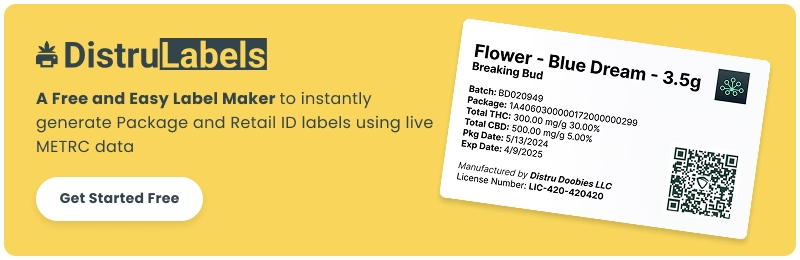
To further simplify labeling, we offer Distru Labels, a free labeling tool for New York cannabis operators. It allows you to create and print compliant retail labels using live data pulled directly from Metrc, no manual exports, re-entry, or extra software required.
Compliance Requirements for NY Retail Labels
The Retail ID is just one part of the New York cannabis labeling requirements in 2025. Every label must be a complete source of information for the consumer and include the following elements:
- THC hexagon symbol
- Processor name and license number
- Brand name
- Product name
- Batch/lot number
- Serving size
- Total THC + total CBD
- THC/CBD per serving
- Ingredients
- Allergen statements
- Warning statements
- Child-resistant packaging information
- A QR code linking to the test results and product data
The text in all cannabis retail labels in New York must be at least 6-point font size, and it must be written in the English language. You can include accurate foreign language translation if allowed, and New York City may require more languages for certain purposes.
We know this feels like a lot, but Distru is here to facilitate it all. Our new label maker changes the process, allowing you to generate all the Metrc Retail IDs you need in minutes.
Say goodbye to time-consuming data re-entry across multiple systems and the stress of meeting complex requirements. The labels produced by Distru feature every element necessary for compliance, including this QR code that is now mandatory in New York, making your operation smooth and worry-free.
Metrc Package Tags vs. Retail ID in New York: Main Differences
Metrc Package tags and Retail IDs have completely different jobs. Here's how you can differentiate them both:
| Feature | Metrc Package Tag | Metrc Retail ID |
|---|---|---|
| Purpose | Wholesale-level compliance and logistics, as well as supply chain tracking. | Consumer-facing label identity, SKU management, POS integration, COA lookup, and final-stage traceability. |
| Physical Form | RFID Chip sticker (Yellow/Blue). Blue is for adult use. Yellow is for Medical / Registered Organizations. | QR Code printed directly on the final unit label. |
| Applied To | The wholesale container (the tub of flowers or the case of vapes). | Every single retail unit (the 1g concentrate jar or the single gummy pack). |
| Who Generates | Metrc (ordered by any licensee). | Processor/distributor (Generated from Metrc). |
| Customer View | Never seen by the customer. | Must be visible to the customer for COA lookup. |
| Use in Transfers | Necessary at all major transfer points | Necessary for transfers from the processor/distributor to the retailer. |
Best Practices for Metrc Compliance in New York
There are many things to learn when it comes to Metrc compliance in New York State, but success isn't about knowing all the rules. You need to build them into your habits. Want to know how? Below are the best practices you should implement.
.avif)
Daily Operating Procedures
To simplify compliance, you should make it part of your day-to-day life. This is what we recommend:
- Morning Reconciliation: Before opening, check all active packages in Metrc against your physical inventory. Catching discrepancies before an OCM inspector does can help you prevent compliance issues that can quickly escalate.
- Transfer Acceptance: Although it varies by state, and New York has yet to clarify this point, Metrc usually enforces a strict 24-hour rule. It says you have one business day to receive manifested packages in Metrc after they physically arrive. Not following this requirement can trigger an automatic compliance flag. You should proactively monitor your incoming transfers to avoid it.
- End-of-Day Processes: At the end of the day, close out all sold retail packages, double-check if all sales were properly recorded in both Metrc and your internal system, and verify that your remaining inventory matches the state records. This is key to avoiding reporting delays and discrepancies.
- Weekly Internal Audits: Perform weekly self-audits. If you don't want to miss any important aspect, use an OCM/Metrc compliance checklist that covers package tag integrity, retail ID accuracy, label compliance, and inventory reconciliation. By catching and correcting issues, you save yourself a lot of headaches during inspections and create a strong defense against those potential violations that can jeopardize your license.
Preparing for OCM Inspections
What would you do if an inspector from the OCM started knocking at your door? A regulatory audit should never be a surprise. The goal is to always be inspection-ready, so when they walk in, it's just another day at the office.
Some of the most common red flags for regulators include:
- Inventory discrepancies
- Missing or incomplete records
- Frequent or undocumented adjustments
- Testing failures
- Non-compliant packaging
- Late transfer acceptances
- Missing Retail IDs
- Packages labeled with QR codes that don't have an associated test result.
To avoid these situations, prepare yourself and your team. You should be able to instantly locate and scan any product the inspector requests. So, keep all records, standard operating procedures (SOPs), training logs, and any other type of documentation readily available.
Also, create clear, organized paper and digital trails to show inspectors that your physical inventory rightly matches your Metrc records and that all your labels are fully compliant.
And if an inspector finds a violation, be cooperative. Respond promptly, factually, and thoroughly. Detail the specific corrective actions you have or will take to ensure the issue won't happen again.
The Future of Track-and-Trace in New York
Right now, and for a while, New York is all about slowly rolling out Metrc. The transition extends well into 2026, so you'll be seeing headlines about it for quite some time.
The phased implementation of Metrc is happening at a time when it feels most needed. Over 500 adult-use dispensaries are open statewide in 2025. Plus, the OCM acting director, Felicia A. B. Reid, recently hinted that New York could potentially support 1,500 more. The sheer size and projected growth of this market call for a reliable tracking system.
Metrc's standard features have long been used in many states to help with regulatory enforcement and collect market data. But now, with the rising number of dispensaries driving customer demand and Retail ID becoming mandatory in New York, the emphasis seems to be on product-label traceability. Retail ID puts a cannabis good's COA a simple scan away for consumers while allowing operators to speed up processes at the point of sale.
New York's regulations are still evolving, but tracking isn't going anywhere. It's the present and the future of this industry. Stay ahead of the game and start building a solid tech stack, one that integrates with Metrc but also simplifies your daily operations. This is the most important investment you can make today.
Mastering Metrc for Success in NY
Metrc package tags track bulk products through the supply chain, like the VIN number on a car, telling the state where each batch came from and where it's been. Retail IDs identify individual units at the storefront, like the license plate on a car, getting scanned at the cash register to track the final sale. Both are required. Neither replaces the other.
Right now, it may seem difficult to differentiate between them. But once you understand this distinction, you can start using it as a competitive advantage in a market that's growing non-stop and desperately calling for a reliable, standardized, and integrated tracking system.
Also, we're here to help. At Distru, we built our label maker specifically to simplify the most tedious part of this process, creating compliant cannabis retail labels in New York. And it's free for all cannabis licensees!
You can design a template with all the elements required by the OCM and auto-fill the data from your inventory. Additionally, Distru's label maker connects directly to Metrc, so you can generate and print those crucial IDs without the manual export/import work, no matter how many of them you need.
Ready to simplify cannabis labeling in New York? Try Distru's free label maker today and get yours done in seconds!


