In This Article:

Ask AI about this article
OpenAI
Claude
Perplexity
Google Gemini

Build vs. Buy Software in 2027: The Maintenance Math

Distru Team  |
Updated
November 25, 2026
TL;DR

• AI coding tools cut the cost of building internal software, but upkeep from Metrc changes, integrations, security and bugs often outweighs the original build over two years.

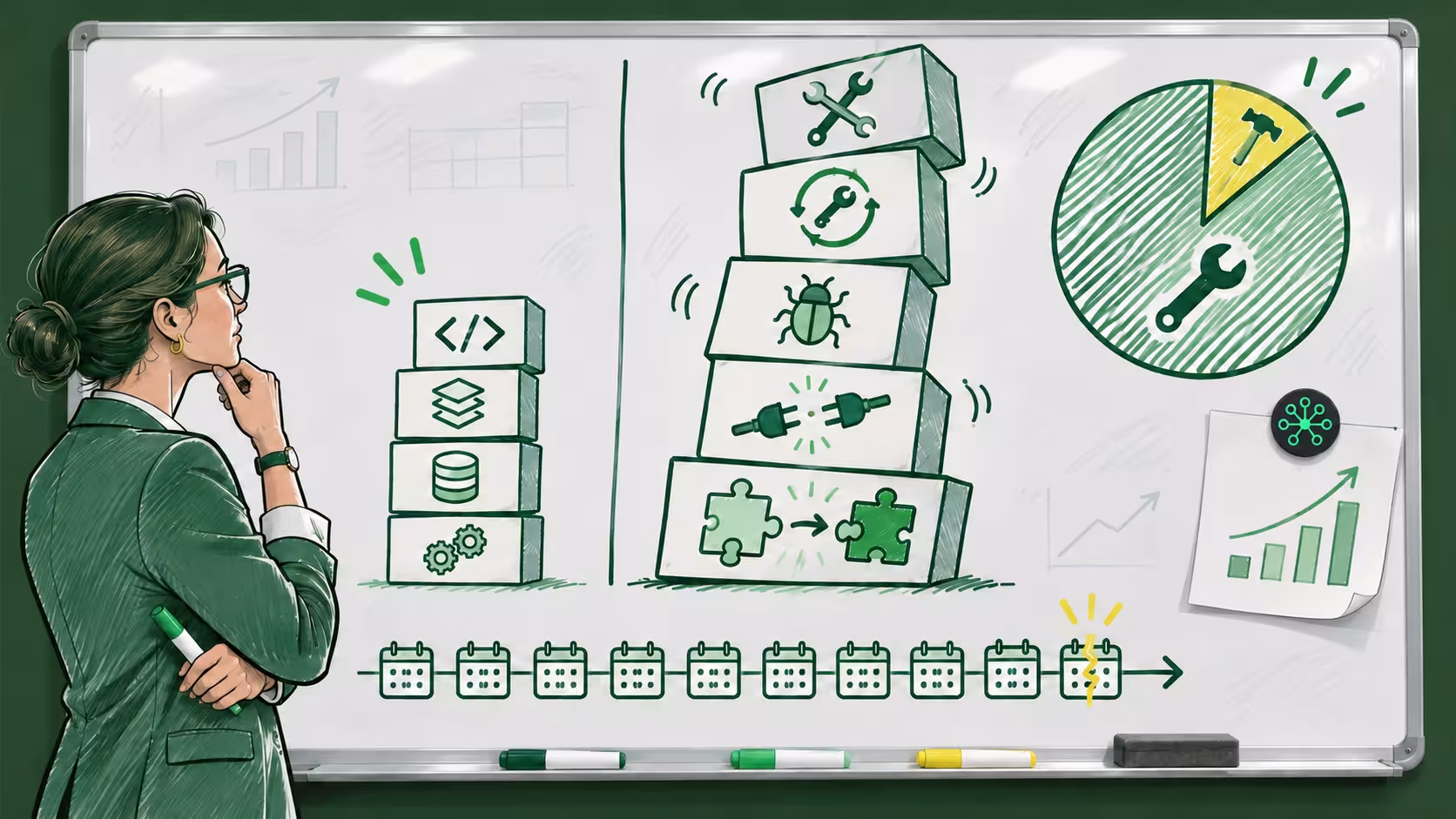
• In an illustrative model, a four-week build took 160 of 520 hours in year one, and upkeep made up 81.8% of the two-year cost.

• Most teams do best buying the system of record that keeps up with Metrc and accounting, then building their own dashboards on top through an API.

The internal tool works on launch day. Your tech lead built it in four weeks with Claude's help, it pulls orders, prints labels and pushes packages to Metrc, and everyone's impressed. Six weeks later the state changes a required field, the tool starts failing on every new package, and the one person who understands it is on vacation.

That gap between the launch-day demo and week ten is what this post is about. Building software got dramatically cheaper in 2026. Keeping it running didn't.

Why building got cheap

AI coding tools changed the first half of the math. A capable developer with Claude or a similar assistant can stand up an internal app in days that used to take a quarter. Plenty of cannabis operators are doing exactly that: custom dashboards, label tools, reorder calculators, even full internal platforms. Some are good enough that other operators want to license them.

So the question your team is asking is fair. If we can build it, why pay for it?

What does the build estimate leave out?

The build estimate covers the code. It usually skips everything that happens after launch:

  • Rule and system changes you don't control. Metrc changes how it works by state. In Michigan, Metrc retired its API v1 for third-party integrators and told them to move to Metrc Connect. In New York, Metrc made expiration dates required on final-form, count-based items starting May 15, 2026. Minnesota assigned expiration or use-by dates to every item from June 15, 2026. Each one is a code change for anyone who built their own integration.
  • Accounting and partner integrations. QuickBooks, payment processors and marketplaces change their own APIs on their own schedules.
  • Security. Who rotates the keys, patches the libraries and reviews who has access when someone leaves?
  • Bugs and edge cases. Partial transfers, rejected packages, a product with two units of measure. The first month finds most of them. The rest show up at month-end.
  • The bus factor. If one person built it, one person can fix it. That's a risk, not a feature.

The maintenance math, worked through

Here's an illustrative model. Swap in your own hours and rate; the shape is what matters.

  • Initial build: 160 hours (four weeks) at $85 an hour is $13,600.
  • Ongoing upkeep: 6 hours a week for rule changes, bug fixes and user requests. Over 52 weeks that's 312 hours, or $26,520.
  • Incidents: three outages a year at 16 hours each is 48 hours, or $4,080.

Year one comes to $44,200. Year two, with no new build, is $30,600. Over two years that's $74,800, and 81.8% of it is upkeep, not the build everyone priced. Put differently: the four weeks your tech lead quoted is 160 of the 520 hours year one actually takes.

The math changes if your tool is small and stable. A dashboard that reads data and never writes it might need an hour a month. A tool that writes to Metrc, touches money or runs every order is the other end of the scale.

When is building the right call?

Build when the tool is yours alone and failure is cheap:

  • Read-only dashboards and reports that sit on top of data you already trust.
  • One-off analyses, like a pricing study or a territory map.
  • Your real edge, the workflow that makes your business different and no vendor would build for you.

When is buying the right call?

Buy when the system has to be right every day and the rules belong to someone else:

  • Your system of record for inventory, orders and invoices.
  • Compliance reporting, where a state change on a Tuesday has to work by Wednesday.
  • Accounting sync, where errors land in your books.

The honest test: if this breaks at 4 p.m. on the last day of the month, who fixes it, and what does it cost you while it's down?
One system for the whole operation. Distru ERP. Distru.

What most operators land on: buy the record, build on top

The split that works for most AI-savvy teams is simple. Buy the system that holds the records and keeps up with Metrc and accounting. Build your own dashboards, scores and automations on top of it, through an API and an MCP server, where a bug costs you a wrong chart, not a compliance problem.

That's the model Distru, a cannabis ERP with a built-in B2B wholesale marketplace, is built for. Distru keeps inventory, orders, invoices and Metrc on one set of records, and 450+ cannabis operators run on it. Your team builds on top with the Distru API for scheduled jobs and Distru MCP for questions in Claude or ChatGPT. When Metrc changes a field, keeping the integration current is our job, not your tech lead's weekend. Our post on MCP vs. API vs. CLI covers which door fits which job.

Where this stops working

Buying doesn't remove the work of keeping data clean. If product names are inconsistent or counts are off, a purchased system shows you the mess just as fast as a homegrown one. And some operators really do need to build the core, usually because their model is unusual enough that no vendor fits. If that's you, budget for the upkeep from day one and make sure more than one person can maintain it.
Stop retyping data into Metrc. Metrc integration. Distru.

Weighing a build right now? Bring the plan and we'll walk through which parts we'd buy and which we'd build, on your actual workflow.


FAQs

Should a cannabis company build its own ERP?

Usually not. Building the first version is easier than ever with AI, but an ERP has to keep up with Metrc changes by state, accounting integrations, security and bugs every day. Most teams do better buying the system of record and building their own tools on top of it.

What costs do build estimates usually leave out?

Upkeep. Estimates cover the build but often skip rule changes you don't control, partner API updates, security patches, bug fixes and the risk of one person being the only one who can maintain it. In many cases those ongoing costs exceed the original build within the first two years.

When does building your own software make sense?

When the tool is yours alone and failure is cheap. Read-only dashboards, one-off analyses and the workflow that makes your business different are good candidates. Systems that must be right every day, like compliance reporting and accounting sync, are usually better bought than built.

Can I build my own tools on top of Distru?

Yes. Distru keeps inventory, orders, invoices and Metrc on one set of records, and your team builds on top with the Distru API for scheduled jobs and Distru MCP for questions in Claude or ChatGPT. A bug in your dashboard then costs a wrong chart, not a compliance problem.

Who keeps the Distru Metrc integration current?

Distru does. When Metrc changes how something works in a state, updating the integration is part of what Distru maintains, so your developer doesn't have to rewrite code for every bulletin. Your team stays responsible for entering accurate data and reviewing what syncs.

How many cannabis operators use Distru?

More than 450. Cannabis operators across 30+ states run inventory, production, wholesale orders and Metrc on Distru, and many build their own reports and tools on top through the Distru API and Distru MCP rather than maintaining a homegrown system of record.

The AI cannabis library

Free skills to put AI to work on your inventory, compliance and costing, and guides on where it actually saves time.

SKILL
Inventory Management

Distru Expiring Inventory

See stock about to expire, who already buys it, and a promo email draft to review.

SKILL
Compliance

Cannabis Inspection Readiness

Turn an upcoming state inspection into a checklist, binder index and gap list.

SKILL
Compliance

Cannabis Transfer Manifest Precheck

Check a B2B transfer before the driver leaves and get GO or HOLD per line.

SKILL
Purchasing

Cannabis Replenishment Planner

Turn sales and on-hand exports into a reorder plan and a draft PO by vendor.

SKILL
Compliance

Cannabis State Rules Lookup

Get a cited, dated answer to a state cannabis rule question.

SKILL
Operations

Cannabis Staff Scheduling Planner

Build a shift schedule that matches demand and stays inside your labor budget.

SKILL
Cultivation

Cannabis Harvest Yield Analysis

See which rooms and strains actually make money, from your own harvest data.

SKILL
Compliance

Cannabis Traceability Reconciliation

Find out why your physical count doesn't match Metrc or BioTrack.

SKILL
Compliance

Cannabis SOP Generator and Trainer

Turn process notes into an inspection-ready SOP and a staff training packet.

SKILL
Finance and COGS

Cannabis Batch COGS Calculator

Find out what a batch really costs per finished unit, line by line.

AI GUIDE
Blog

Why Your MCP Is Eating Your Tokens (and How to Fix It)

MCP token usage climbs fast when tool definitions and big results flow through the model. Five fixes cannabis teams can use today, from scoping to scripts.

AI GUIDE
Blog

MCP vs. API vs. CLI, Explained for Cannabis Operators

MCP vs API vs CLI for cannabis operators: which one fits each job, what each costs to run, and who approves what an AI assistant changes in your ERP.

AI GUIDE
Blog

Why the Harness Matters More Than the AI Model

Two products can use the exact same AI model and perform completely differently. Here's why the harness, not the model, usually explains why.

AI GUIDE
Blog

What Is an Agent Harness? A Plain-English Primer

An AI model alone can't do much. The 'harness' around it is what makes it useful. Here's what that actually means, no jargon required.

AI GUIDE
Blog

Why MSOs Need an AI Strategy Before More Software

Adding another point solution won't fix an MSO's AI readiness problem. Here's why the data foundation has to come first.

AI GUIDE
Blog

The Supply Chain Buyer's Guide to AI Agents and MCP

Evaluating AI agent features in supply chain software? Here's a practical buyer's checklist, including what MCP means for your evaluation.

AI GUIDE
Blog

AI in Supply Chain: What's Hype, What's Working

AI in supply chain gets a lot of hype. Here's an honest look at what's actually delivering results in 2026, and what still needs a person.

AI GUIDE
Blog

Where AI Agents Fit in Cannabis Compliance

Not every step of your compliance workflow is a fit for AI. Here's a clear map of where it helps, and where it should stay hands-off.

AI GUIDE
Blog

The Skills Ops Teams Will Need When AI Agents Arrive

AI agents are coming for repetitive ops tasks in cannabis. Here's what your team needs to get good at instead, starting now.

AI GUIDE
Blog

What Happens When AI Gets Access to Your ERP

Giving an AI tool access to your cannabis ERP isn't all-or-nothing. Here's what real, scoped access looks like, and what to watch for.

AI GUIDE
Blog

AI and 280E: Where Automation Actually Saves Money

280E just got more complicated for mixed medical and adult-use operators. Here's where automated cost tracking actually helps, and its limits.

AI GUIDE
Blog

Can AI Forecast Wholesale Demand Better Than Excel?

Your wholesale forecast spreadsheet has limits. Here's what AI-assisted forecasting can actually add, and where a spreadsheet still wins.